


A Visit To The House And Garden Of The Late A. J. Downing. Part 2
Description
This section is from "The Horticulturist, And Journal Of Rural Art And Rural Taste", by P. Barry, A. J. Downing, J. Jay Smith, Peter B. Mead, F. W. Woodward, Henry T. Williams. Also available from Amazon: Horticulturist and Journal of Rural Art and Rural Taste.
A Visit To The House And Garden Of The Late A. J. Downing. Part 2
To have done so would have added greatly to the beauty of the place, and there is no doubt that with his love for lawns he would hardly have been contented long with the small though beautiful one which he possessed. By careful planting originally, and by regular mowings every fortnight, this garden is able to boast a lawn whose velvet it will not be easy to rival on our river; and whose exquisitely tinted surface, shaded with clumps of trees and enriched with flower and vase, was a real triumph in our adverse climate and beneath our scorching suns.
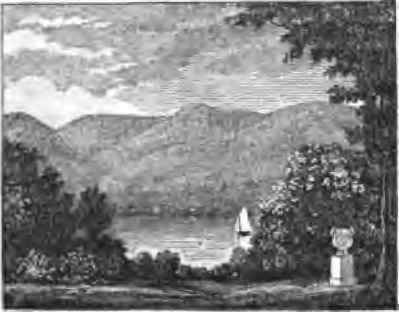
VIEW FROM TBI LAWK.
* The hedge of arbor vitae which concoals the green-house yard, was the first of the sort planted in this part of the country. It forms a handsome, lofty, and impervious screen.
In passing along the path which we have entered, you catch a glimpse through the trees of the little Sundial with its motto, "Horas non nomero nisi serenas" - "I number none but sunny hours," and few others ever passed over this happy place. When I first saw this dial the ice was on the ground, and a little hillock of snow upon the top of the pillar prevented the sun from recording the hours. I brushed away the snow to find the time. Mr. Downing was with me, and, I remember, told me about some ancient dial he had seen when abroad. This morning the first snow of the year is on the dial and on his grave. Still further on, we come to that portion of the walk from which we obtain the view of his house given in the frontispiece of this number. In the foreground is the graceful and effective cast of the Warwick Vase, which forms the subject of the vignette at the end of the present article, and which will give to many of our readers who have heard of this celebrated production of antiquity an idea of its exquisite decoration and fine proportion.
Looking at the house where we stand, and marking its bold yet unassuming architecture, and then referring to its plan as given in the drawing of the grounds, we venture to ask whether such a building, erected as it was at the age of twenty-four, before Mr. Downing had ever seen a private dwelling having the slightest pretension to elegance, and when all his ideas of such matters were procured from one or two English books, does not exhibit a native taste and refinement in the man. Many of our professed architects who have had the advantage of years of study and travel, together with the use of the best books, build houses which do not exhibit half the tasteful design nor the convenient and elegant arrangement of this young man's work.
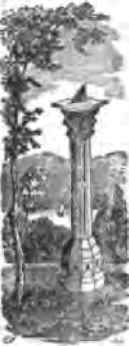
SUNDIAL.
Continuing our walk, we find that the shrubbery on our right, forms the boundary of the garden; and that the path which we have entered, and which has this shrubbery for wall on one side, is the outline of the garden, and commands all that is worthiest seeing in that small but beautiful domain. You notice, as we pass, that there is no separate flower garden. Mr. Downing never thought well of drawing a line between the lawn and shrubbery, and the parterre. His manner was to set his flower beds in grass, or to lay them along the edges of paths. Thus the walk which runs east and west between the Hermitage and the Arbor, is lined on one side by a border containing carnations and a few fine roses; but for the most part you will find circular beds of flowers set like gems here and there in the lawn, or grouped in irregular masses before the shrubbery, which served for back-ground. Two of these circular beds were particularly noticeable, and formed brilliant objects in the portion of the ground where they were placed.
A bed of scarlet geraniums near the Warwick Vase was a magnificent object all the summer; and another of the portulacca presented a disc of purplish crimson which seemed to palpitate at radiant morn and glowing noon with what appeared at times like actual emissions of light There was a fine bed of crimson roses, too, which were staked down, and thus kept from branching; and another of white yucca, near the bed of portulacca, cooling the eye after its bath in that bed of fire with its snowy and abundant blossoms.
Near the north end of the house, if you examine the plan, you will find a thick, impervious shrubbery, bounded on one side by the carriage road and on the other by the path bordered with flowers to which we have referred above. This shrubbery in summer entirely conceals that portion of the garden which lies north of it, and is traversed by a winding path having near one end the Rustic Hermitage, and near the middle the small Rock-work devoted to those plants which love that soil.
The Hermitage is a pretty, rural structure, neatly constructed of rough bark and logs, presenting an attractive object in the walk, and furnishing a cool retreat from the burning heat of our midsummer noons. At one end you may see the bee-hives - homes of the little " singing masons building roofs of gold," who find their favorite food of lemon thyme covering the rocks near by. The Rock-work is a pretty sight in summer, with its fine beds of moss and thyme, and its stately ferns, under whose shadow the hare bells and columbines grew fair as in their native woods. It is surprising to see how delicate the plants are that thrive best on rocky soils, and flourish from the crevices of stony places. This little rockery is one of the pleasantest features in the garden; it is quite secluded, and has scarcely any outlook. Beyond the thickly planted plat of which we have been speaking, you may see, by following the plan, that the path we took at first, carries us round a large and open lawn. Near the center stands the large bronze cast of the Borghese Vase, sent to Mr. Downing from France early in last spring, and which forms a very marked feature in the northern part of the garden.
Continue to:


My Books

