


A Visit To The House And Garden Of The Late A. J. Downing
Description
This section is from "The Horticulturist, And Journal Of Rural Art And Rural Taste", by P. Barry, A. J. Downing, J. Jay Smith, Peter B. Mead, F. W. Woodward, Henry T. Williams. Also available from Amazon: Horticulturist and Journal of Rural Art and Rural Taste.
A Visit To The House And Garden Of The Late A. J. Downing
To describe a dwelling and a garden like Mr. Downing's, is like analyzing a poem whose beauty has long ministered to our daily happiness, and whose melody has for many years sung unquestioned to our hearts. Hence, in many ways, the task is not one that we should seek, nor can we hope that we shall perform it to the satisfaction of all those who knew and loved the place; hut where love guides the pen, we can not wholly fail, and the artist's pencil will aid us where words are weak and insufficient. The library is a cheerful and delightful room opening from the hall, and having doors leading on one side to the parlor, and on the other to the dining room. On the west side is a large bay window, and in front of it stands the spacious table at which Mr. Downing wrote. In the winter the family forsook the fine south room, which on account of its size was not easily warmed, and lived in the library, which, with its cheerful fire and books and busts, became the gathering point of the household, and the chosen seat of the winter's evening mirth and daily study.
For some time Mr. Downino's office was the upper south chamber in his house, but increasing business and the frequency of calls made it necessary to construct a room' which could be entered from without. For this purpose the office was built - an addition to the house entered from the garden by a porch, and from the library by one of the book-cases, which, set into the wall, was made into a door, and when shut could not be distinguished from the others in the room. The office is divided by a partition into two rooms; one was Mr. Downing's private study, the other the place where the architectural business was carried on. No place could be more delightful than this room to work in. On one side the southern windows let in the warm and cheerful sunlight, on another the rows of books give a grace and charm to the apartment, and opposite them the bright wood fire warms body and soul with its crackling flames. The room is no merely whitewashed parallelogram, but, though inexpensive in its construction, is agreeable in color and proportion.
The walls are divided into panels, and the wood-work is stained; some fine architectural prints adorn the western end; and the whole air of the place is that of taste and refinement Let us first, in order to see clearly what Mr. Downing has done for this place, find out what was its condition when he first became its master. The ground is in shape nearly a parallelogram, and together with two other lots east and southeast of the present garden, constituted the original property as it was left at the death of his father. All the land that Mr. Downing owned at the time he died, was the lot represented in the plan, containing a little over four acres, all which was under cultivation. The whole place is surrounded by a hedge; on three sides this is of English thorn, and on the south it is of arbor vita.* The house in which Mr. Downing was born, now thirty-seven years ago, stood where the green-house is at present; and the wistaria vine which is trained on a trellis over the path, formerly climbed up the front of the little dwelling. East of the cottage, and, I think, connected with it, stood the old green-house, having in one end an office where the business of the place was conducted; and that portion of the ground immediately about the house was cultivated as an ornamental garden.
The tall balsam fir near the gate is one of the few trees planted at the time we speak of, and still remaining in its original place. This tree is a specimen of remarkable beauty; rising full seventy feet without a curve and without a single dead branch, it was always a pleasant memorial with Mr. Downing of his early days. That portion of the original garden which was not laid out in ornamental beds was planted as a nursery, and constituted three-fourths of the whole lot It continued in this way till within fifteen years, when Mr. Downing and his elder brother Charles, who since their father's death had carried on the business together, separated, and the place came into the hands of its late owner. He now commenced his alterations; and shortly after his marriage, which took place about this time, began to build his house. He lived for the first year after his marriage at his father-in-law's, Mr. J. P. De Windt, in Fishkill Landing, and crossed the river every day to superintend the erection of his new dwelling.
He continued a nurseryman till about six years ago, when he abandoned the business altogether, altered his grounds to nearly their present shape, and commenced the practice of landscape gardening and rural architecture.
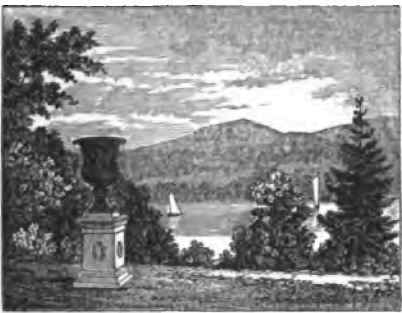
TBI Of TBs GROUNDS.
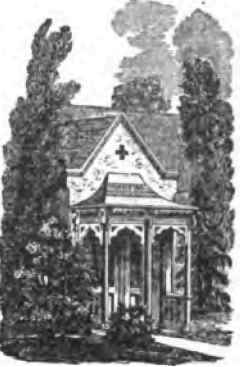
OFFICE PORCH.
The arrangement of the grounds is simple. Entering at the gate, the visitor follows the carriage-road, and when opposite the green-house, takes the path which turns eastward and skirts the vineyard. This path in fact divides the lawn; as it approaches the house it runs down toward the vineyard, leaving the greatest extent of lawn before the building, and having accomplished this, turns again toward the west. A thick shrubbery runs along the edge of the vineyard, between it and the path, arranged in such a way as to give views of the river and the opposite shore without allowing the vine poles to appear. The vineyard, seen in the plan, is a new one just in bearing, having been planted three years this summer. It contains nearly a thousand vines, Isabellas and Catawbas. Mr. Downing had a few other varieties scattered through the grounds; there is a fine specimen of the Elsinborough near the office; but he had none of the more delicate varieties which require artificial heat. Mr. Downing spoke at times of removing his vineyard to another spot, and turning the whole into lawn and ornamental ground.
Continue to:


My Books

