


Everbearing Raspberries - The Everlasting Rabbit
Description
This section is from "The Horticulturist, And Journal Of Rural Art And Rural Taste", by P. Barry, A. J. Downing, J. Jay Smith, Peter B. Mead, F. W. Woodward, Henry T. Williams. Also available from Amazon: Horticulturist and Journal of Rural Art and Rural Taste.
Everbearing Raspberries - The Everlasting Rabbit
Everbearing Raspberries
Mr. Flagg of the Prairie Farmer, says that the only everbearing raspberry he ever saw that proved profitable, is the Ohio Everbearing, heavily manured.
Evergreen Hedges
A Friend to Imprort-mtnt, (Northampton, Mass.) We prefer the Norway Spruce to the Hemlock, for a hedge, because it grows taster, and makes a stronger barrier. As the shoots of the latter tree are slender and pliant, they require to be sheared many years before they form an Impenetrable hedge. In point of beauty, there are few hedges that surpass a hemlock - as some One hedges near Philadelphia bear witness. Plants six to eighteen inches high, are the most suitable. Tour soil would be improved by trenching, or sub-soil ploughing.
Evergreen Screens
0. V.. (Syracuse, N. Y.) Nothing would be more suitable for a screen for the purpose you mention than evergreens - especially a mingling of the following sorts: Norway Spruce, Hemlock, American Arbor Vitas, with an occasional White Pine, Scotch Pine, and Balsam Fir. Do not plant them too thick - or if so planted, thin them out before the branches touch - otherwise you will lose much of the beauty of the trees.
Evergreen Seeds
F. Jones, (Clarke Co., Ky.) Seeds of the Deodar and Araucaria cannot we think, be procured in this country. It is possible that by addressing Messrs. Whitley and Osborne, Fulham, near London, they may be obtained.
Evergreen Thorn - Pyracantha
The fiery or evergreen thorn - crataegus pyra-cantha - is an evergreen shrub, at present only to be found occasionally in some amateur's grounds, but highly deserving a place everywhere that ornament or beauty is sought to be created.
As a single plant, it has rare attractive features in its clusters of white flowers, blooming in the month of May, followed by round brilliant scarlet berries, that often remain on a great part of winter, and from whence its name of fiery thorn. In forming low-growing hedges, it is one of the very best plants, as it is perfectly hardy, and bears the shears as well as other thorns. Our engraving shows a plant with a few clusters of flowers. Any good rich garden soil will answer to grow it.
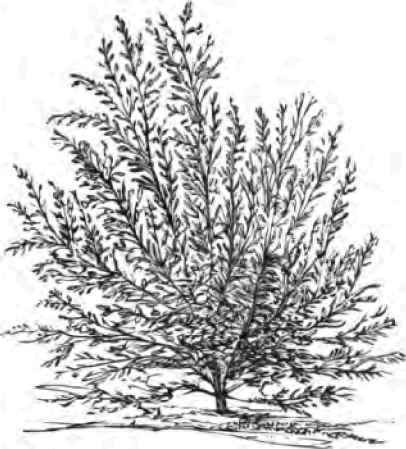
Fig. 62. - Evergreen Thorn.
Evergreens Off The Sea-Shore
(W.) Where the soil is of fair average quality, Arau-oaria imbricata, Pinus insignis, P. laricio, P. Austriaca, P. pinaster, Cryptomeria Japonica, Cupressus macrocarpa, and Abies Cephalonioa, do well if not too cold. Cedrus deodara thrives just so long as shelter is provided; but no sooner does it outgrow its nurses or other protection than the leading shoot becomes blighted, and the habit of a shrub supersedes that of a tree. Where shelter has been provided and continued, mere proximity to the sea has not been prejudicial.
The Everlasting Rabbit
The season now is, when the rabbit comes in for a share of the tree growers' attention. Dr. Howsley, of Leavenworth, Kan., says, for several years he has used with the most satisfactory results, a white-wash, composed of fresh slacked lime and soft soap, brought to the consistency of ordinary paint, with common flour paste added to make it adhesive. This composition, applied with a common paint brush has, with me, always been effectual.
Continue to:


My Books

