


The Eureka Grape - Everbearing Mulberries
Description
This section is from "The Horticulturist, And Journal Of Rural Art And Rural Taste", by P. Barry, A. J. Downing, J. Jay Smith, Peter B. Mead, F. W. Woodward, Henry T. Williams. Also available from Amazon: Horticulturist and Journal of Rural Art and Rural Taste.
The Eureka Grape - Everbearing Mulberries
The Eureka Grape
A committee have in hand Mr. Prince's Eureka grape, and will report upon it in due time. We have teen it, but do not with to anticipate the report of the Committee.
The European Weeping Ash. Frax Inus Excelsior Pendula
This is one of the oldest varieties of weeping trees known, and more extensively planted than any. It was discovered about the middle of the last century, growing in a field in England. The branches are stiff, and can not be called graceful in their downward curves; but its clean, glossy foliage and its very rapid growth render it one of the most valuable, especially for forming arbors.
The European Weeping Birch. Be-Tula Pendula
A tree of rapid, upright, spreading growth, that while young exhibits very little of a drooping habit, and even when old is not marked as a weeper, like many others. It is, however, very graceful, and as it increases in years presents more and more of the pensile features that, combined with its delicate foliage, make it a charming tree for grouping with others of a like slender spray and airy foliage.
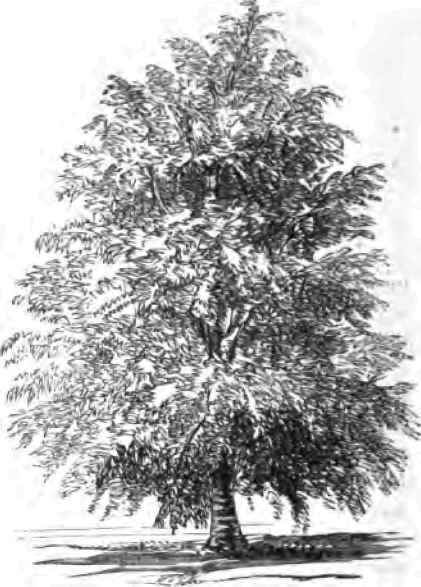
Fig. 37. - Cut-Leaved Weeping Birch.
Eurya Sp
This, was distinguished as a "broad-leaved Eurya;" it has moderate-sized, elegantly-acuminated, Camellia-like foliage, broadly margined, and more or less blotched inwards with white, and the young foliage comes out stained with a fiery orange-color, which gives the plant a bright, extremely interesting, and showy character. It received a First-class Certificate.
Evans's Rural Economist
This is a new monthly, devoted to Agriculture, Horticulture, and Rural affairs. The first number is well printed, the matter good, and the whole has a promising appearance. It has made its appearance at an unpropitious moment, but we wish it an abundant success. It is edited by Dr. Edmund C. Evans, and is published at West Chester, Chester Co., Penn.
Evening Party Apple
Size, small, 1 7/8 of an inch long, by 2( broad; Farm, roundish oblate ; Skin, nearly covered with red, in stripes on a whitish-yellow ground, rich whitish-yellow at the eye, numerous light russet dots; Stem, | of an inch long, by 1/12 thick, inserted in a wide, deep cavity, occasionally russet-ed; Calyx, small, closed, set in a moderately deep, slightly plaited basin; Core, medium ; Seed, grayish brown, short, plump, obtuse, 2/7 of an inch long, 1/5 wide, 1/8 thick ; Flesh, yellowish white, tender, juicy; Flavor, pleasantly saccharine and spicy; Quality, "very good" if not "best;"
Maturity, January to March; Wood, young shoots reddish, old wood grey.
[This apple, from its appearance no less than its qualities, is destined to become a favorite].
The Ever-Flowering Weeping Cherry. Cerasus Semper Florem
This is of comparatively recent introduction, and forms a charming tree of a decided drooping habit, and producing a succession of flowers and fruit all the season.
Everbearing Mulberries
A. F. can safely plant Downing's Everbearing. It is a very fine fruit, and hardy around New York and along the Hudson. We have never seen the fruit of the others alluded to, and therefore cannot speak of them from personal knowledge.
Continue to:


My Books

