


April - First And Second Weeks. April 1-15. Flowers. Part 2
Description
This section is from the book "The Garden Week By Week Throughout The Year", by Walter P. Wright. Also available from Amazon: The Garden Week by Week Throughout the Year.
April - First And Second Weeks. April 1-15. Flowers. Part 2
Hardy Annuals
Early April is generally the best time of the year for sowing hardy annuals out of doors, because the soil has become well warmed by the spring sun, and is in a condition to crumble freely under the rake. I gave a list of plants in my first chapter, and I need do no more now than advise the reader to give special attention to such particularly valuable kinds as Sweet Peas, Mignonette, Godetias, Clarkias, Poppies, Rose Mallow (Lavatera), Miss Jekyll's Love-in-a-Mist, double annual Chrysanthemums, and Nasturtiums. In mentioning the names of these and other kinds, I stated the distance that they should go apart. Let the amateur beware of crowding. Clumps look better than rows, both in beds and borders. It is not a bad plan to drop three or four seeds in groups about a foot apart, and thin the resulting plants down to one. The advantages of this plan over sowing a broad patch is that less seed is used and less trouble involved in thinning. Remember that while annuals make beautiful and cheap beds when they are well grown, they are also well worthy of being put into herbaceous borders, where the later-blooming kinds can be utilised to succeed the early-flowering perennials. (See remarks in Chapter III (March. The Dawn Of Spring)).
Sweet Peas
The Sweet Pea is the queen of hardy annuals, and is well worthy of special culture. A row of mixed varieties looks charming, but those who like to grow special varieties under name may make up continuous rows by sowing or planting short lengths (perhaps only three or four feet) of each sort; if the latter plan is adopted, it is well to blend colours. Red, white, and blue are harmonious neighbours. Blue looks well beside cream. But separate clumps may be made instead of straight rows if desired. Clumps look well in mixed borders, and in special positions on lawns. If the soil is rich and moist, neither rows nor clumps ought to be nearer than six feet to each other. A circle made for a clump (and the circle system is the best, as it keeps the plants from crowding at the centre) ought not to be less than a yard across. The drills for both rows and clumps should be made about three inches deep in fine, friable soil. Some Sweet Peas have white and some black seeds; it is a good plan to chip the latter with a sharp knife, as this facilitates germination. Those who have raised plants under glass may plant them out not less than six inches apart in April; they will probably give flowers earlier than those sown out of doors, and the plants are likely to be stronger. Lime should be dusted along the rows to keep off slugs. It is a good plan to get the sticks which are to support the plants at once, and to cut out some of the twiggy shoots on the upper part to place among the plants as protection. The principal sticks can be put in later if they are regarded as an eyesore while bare, but aesthetic considerations must not be carried far. The sticks ought to be put in when the plants throw out tendrils, and it is inevitable that the sticks are bare for a few weeks.
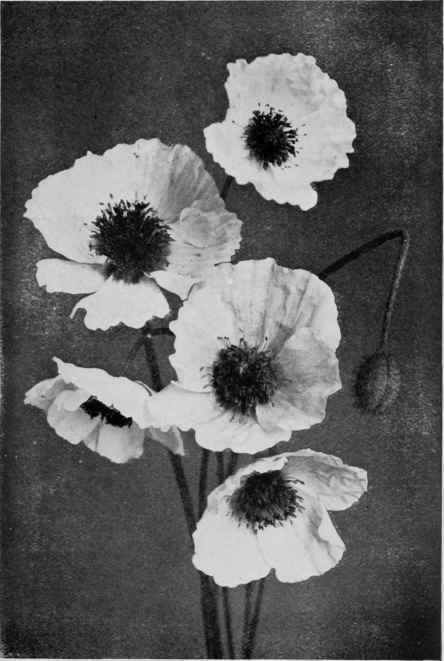
White Iceland Poppies.
Some good varieties of Sweet Peas were named in Chapter I (Jan. The Opening Year).
Continue to:


My Books

