


February - First And Second Weeks. Fruit. Part 2
Description
This section is from the book "The Garden Week By Week Throughout The Year", by Walter P. Wright. Also available from Amazon: The Garden Week by Week Throughout the Year.
February - First And Second Weeks. Fruit. Part 2
Staking Fruit Trees
Amateurs, who are not in the way of providing every kind of accessory required in gardening, are often bothered by what, with the large grower, is a commonplace thing. Thus, when they are told that if they plant standard trees they must provide stakes for them, they are apt to feel troubled, because they do not know what kind of stakes to use, nor where to get them, nor how to deal with them. The amateur sees brooms in the oilman's shop, and rakes in the ironmonger's, but neither the oilman nor the ironmonger exhibits fruit-tree stakes. In the country the village haulier (who may also be your coal merchant) can generally advise; and in the suburbs a builder might help, but it is just as well to try the nurseryman from whom the trees are brought. Ash stakes eight feet long, sharpened and soaked in creosote at the base, will answer the purpose. They should be driven well down at the same time as the trees are put in, and rammed in with the trees, then they will be quite tight. The amateur should not forget to put a pad at the top, so that neither the edge of the stake top, nor the tying material, can injure the bark. It is only standard trees - that is, trees with long stems - which need staking.
Wall And Wire-Frame Trees
I have already mentioned that flat, trained trees are very suitable for walls and wire frameworks beside paths. I certainly think that every amateur gardener who has a quarter of an acre of ground should make a point of growing a selection of Apples and Pears, if nothing else. My two points about the upright cordon tree (see Chapter I (Jan. The Opening Year).): that it takes up very little room, and that a number of varieties might be planted in a very small area, may be supplemented by a third: that it is cheap. These trees do quite well two feet apart. The following varieties should be grown, whatever others are liked, because they have general qualities:

Fig. 28. - Staking Fruit Trees.
a. Stake driven in without damaging the roots.
b. How to secure the stem to the stake.
c. How to make the head of the tree fast to the stake.
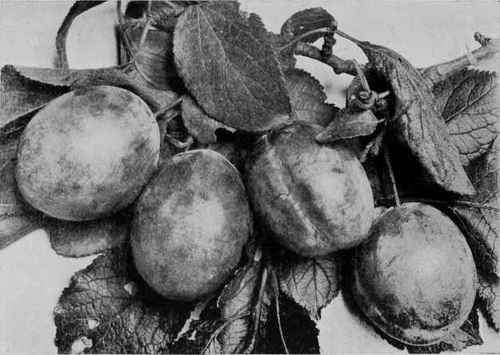
Cue's Golden Drop, one of the best of late dessert Plums; it will thrive on a wall facing east.
Dessert Apples Gladstone Beauty of Bath Worcester Pearmain James Grieve Cox's Orange Pippin Baumann's Winter Reinette.
Cooking Apples Lord Grosvenor Lord Derby Peasgood's Nonsuch Lane's Prince Albert Newton Wonder Bramley's Seedling.
Pears Jargonelle Clapp's Favourite Williams' Bon Chretien Beurre Hardy Emile d'Heyst Louise Bonne of Jersey Doyenne du Cornice Beurre Diel Winter Nelis Josephine de Malines Cooking Fear Catillac.
The above varieties are approximately in the order of their ripening.
I give prominence to Apples and Pears because they are the most in demand, but a few Plums and Cherries may be added with advantage where space permits. These, however, do better as fan trees than single stem cordons, and where fans are used there should be more wires on the trellis; in fact, beginning at two feet from the ground, they should be placed a foot apart right to the top. The varieties might be:
Dessert Plums Early Transparent Gage Denniston's Superb Late Transparent Gage Kirke's Jefferson's Coe's Golden Drop.
Cooking Plums Rivers' Early Prolific The Czar Victoria.
Gisborne's Prolific Monarch President.
Dessert Cherries May Duke Napoleon Bigarreau Governor Wood.
Cooking Cherries Flemish Red Morello.
One sees Gooseberries more and more used as trained trees, and they yield their finest fruit when restricted to two or three branches, which are allowed to extend several feet, and are pruned by stopping the side shoots in summer and cutting them close back in late winter. Such trees can be trained on a wall or a wire framework the same as cordon Apples and Pears. If selected varieties are grown, the fruit will grow as large as Walnuts, and often bring a special price when offered for sale at the best town shops. These very large fruits are not generally the best in flavour, however. Several of the small Gooseberries are quite delicious as dessert fruits. Here are selections to embrace various types:
Large Gooseberries.
Antagonist Dan's Mistake London Trumpeter.
Fine-Flavoured Gooseberries Bright Venus Langley Beauty Langley Gage Red Champagne.
Gooseberries for Tarts Crown Bob Whinham's Industry.
All may be grown as bushes or trained trees.
Red and White Currants are also grown on the flat system against walls and wires, being pruned the same as Gooseberries. They do not object, nor does the Gooseberry, to a north or east wall. The Blackcurrants are not so suitable, and if they were grown as trained trees at all they would have to be grown as fans, so that young wood could be tied in, like Peaches. The following are good varieties and they are also suitable for culture as bushes:
Red Currant Raby Castle.
White Currant White Versailles.
Black Currant Boskoop Giant.
Raspberries are often trained to wires, but a lofty framework, such as is used for the larger fruits, would be partially wasted on them. They do not need more than two wires at the most, one a yard from the ground, the other eighteen inches higher; and they are more often restricted to one only, four feet above the ground.
Canes may be planted in February, and cut back near the ground.
Continue to:


My Books

