


Part 102. The Vegetative Organs Compared - The Crowfoot Family. Part 2
Description
This section is from the book "Plants And Their Uses - An Introduction To Botany", by Frederick Leroy Sargent. Also available from Amazon: Plants And Their Uses; An Introduction To Botany
Part 102. The Vegetative Organs Compared - The Crowfoot Family. Part 2
Most of the crowfoot family are like marsh-marigolds in having their leaves petiolate. In some cases there is no petiole. The leaf is then described as sessile,8 a term applied to any stalkless organ of a kind which is commonly stalked.
As regards their arrangement the leaves of marsh-marigolds are like almost all the others of the family in being alternate, i. e., one at each node. In clematises there appear two leaves at a node-such are called opposite-while in anemonies there are often more than two forming a ring, encircling the stem. Such a ring is termed a whorl or verticil,9and the leaves are said to be whorled or verticillate. When leaves are opposite they are of course virtually in whorls of two. Leaves forming a rosette may approach closely the verticillate arrangement, and it becomes a fair question whether verticils may not be after all merely rosette-like clusters in which the internodes have developed scarcely at all. This view is favored by the fact that internodes of perceptible length do sometimes separate the leaves of such verticils as those of anemony. Furthermore, in clematises the leaves before they expand often show one of a pair distinctly shorter (and therefore presumably younger) than the other, just as if they were really alternate but with only one of every two successive internodes developed. Although we may admit that the alternate arrangement passes readily into the verticillate even on the same plant, it is of course necessary in practical description to distinguish the types.
Students are sometimes puzzled as to how they may distinguish between a leafy shoot and a compound leaf, or between simple leaves and leaflets. They will be helped by remembering that a stem branch arises normally from the axil of a leaf-member, and is an axis bearing leaves in the axils of which buds may develop. Conversely leaf-members normally subtend,10 i. e., stand just below, a bud or shoot, and are lateral members radially disposed about an axis and flattened, at least, when young, transversely with reference to it. Traces of this flattening may be observed commonly even in the petiole on the upper or inner surface, especially near the base. These tests applied to the foliage of columbines, for example, will show why it must be considered as made up of branched leaves-decompound leaves with many leaflets-rather than a branched stem bearing many simple leaves.
8 Ses'-sile - L. sessilis, sitting.
9 Ver'-ti-cil - L. verticillus, the whirl or whorl of a spindle, which is a disk-like piece of wood or metal encircling it; hence, in botany a ring of parts similar to one another encircling an axis.
10 Sub-tend' - L. sub, under; tendere, stretch.
The stem and leaves of the marsh-marigold, as of marsh-loving plants in general, are quite smooth and unprovided with any hairy or other protective covering. Plants or parts in this condition are described as glabrous.11 When covered with soft, downy hair they are said to be pubescent.12 Many ranunculaceous plants, especially those growing in dry, sunny places (as for example the pasque-flower, the tall crowfoot, and the bulbous crowfoot) are pubescent, particularly when young.
11 Gla'-brous - L. glaber, without hair.
12 Pu-bes'-cent - L. puber, downy.
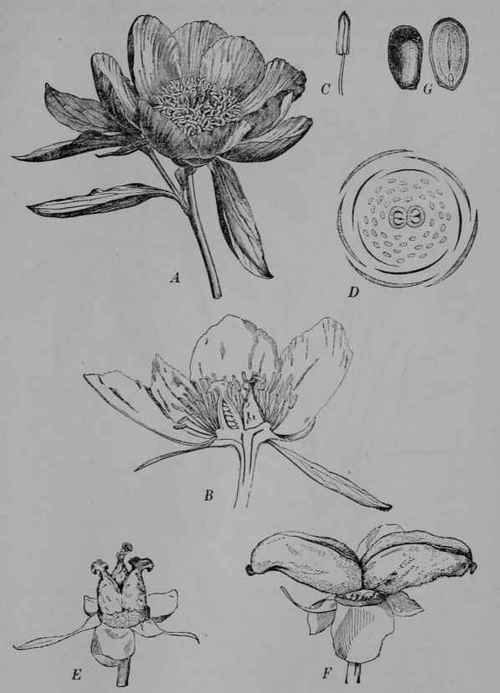
Fig. 282.-Peony (Poeonia officinalis, Crowfoot Family, Ranunculacece). A, flowering branch. B, flower, cut vertically. C, stamen. D, floral diagram. E, flower, with stamens and petals removed. F, fruit. G, seed, entire, and cut vertically. (LeMaout and Decaisne.)-Perennial herb growing 1 m. tall; leaves dark green above; flowers crimson; fruit hairy. Native home, Europe.
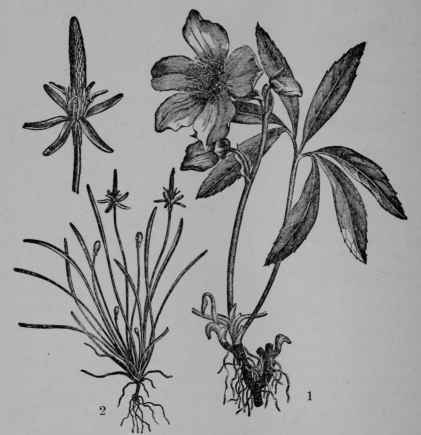
Fig. 283.-Christmas Rose and Mouse-tail (Helleborus niger and Myosurus minimus. Crowfoot Family, Ranunculaceoe). 1, Flowering plant of Christmas rose, 1/3. 2, flowering plant of mouse-tail, 2/3, with flower, enlarged, above. (Kerner.)-The Christmas rose is a perennial herb, about 30 cm. tall; leaves evergreen, glossy; flowers white or pinkish; fruit dry. Native home, Europe. The mouse-tail is an annual with greenish flowers and dry fruit. Native to Eurasia, Northern Africa, Australia, and North America.
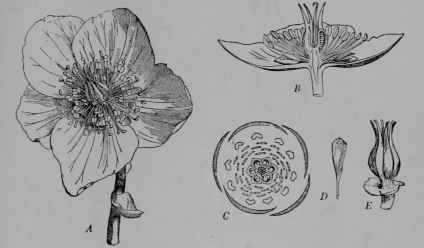
Fig. 284.-Christmas Rose. A, flower, entire. B, same, cut vertically. C, floral diagram. D, staminode. E, pistil. (LeMaout and Decaisne.)
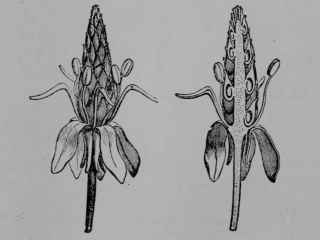
Fig. 285, I.-Mouse-tail. Flower, entire. Same, cut vertically. (Baillon.)
Continue to:


My Books

