


Part 102. The Vegetative Organs Compared - The Crowfoot Family. Part 3
Description
This section is from the book "Plants And Their Uses - An Introduction To Botany", by Frederick Leroy Sargent. Also available from Amazon: Plants And Their Uses; An Introduction To Botany
Part 102. The Vegetative Organs Compared - The Crowfoot Family. Part 3
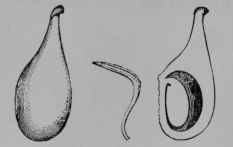
Fig. 285, II.-Mouse-tail. Pistil, entire. Same, cut vertically. Staminode. (Baillon.)
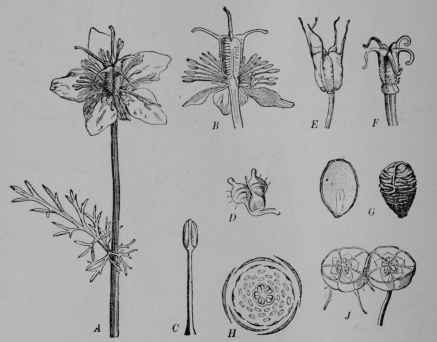
Fig. 286.-Fennel-flowers (Nigella sativa and N. damascena, Crowfoot Family, Ranunculaceoe). A, flowering top of N. sativa. B, flower, cut vertically. C, stamen. D, staminode. E, fruit. E, pistil. G, seed, entire, and cut vertically. H, floral diagram. J, fruit of N. damascena, cut across. (LeMaout and Decaisne.)-Annuals with bluish or white flowers and dry fruit. Natives of the Old World.
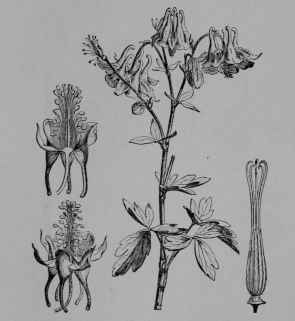
Fig. 287, I.-Columbine (Aquilegia vulgaris, Crowfoot Family, Ranunculaceoe). Flowering top. Flower, entire and cut vertically. Pistil surrounded by rudimentary stamens. (Baillon.)-Perennial herb 45-60 cm. tall; leaves finely hairy; flowers purple, violet, white, etc.; fruit dry. Eurasia. Common in gardens.
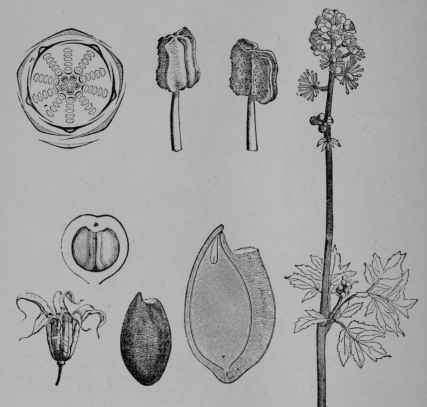
Fig. 287, II.-Columbine. Floral diagram. Stamens. Ovary, cut across. Fruit. Seed, entire, enlarged. Same, cut vertically. (Baillon.) Fig. 288, I.-Baneberry (Actoea spicata, Crowfoot Family, Ranunculacece). Flowering top. (LeMaout and Decaisne.)-Perennial herb 30-60 cm. tall; flowers white or bluish; fruit fleshy, purplish or red. Native home, Eurasia, Northern States.
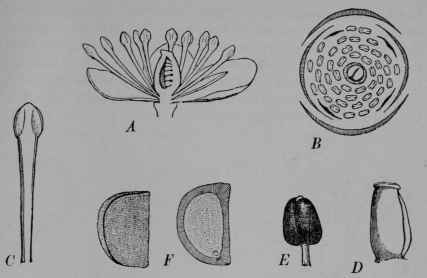
Fig. 288, II.-Baneberry. A, flower, cut vertically. B, floral diagram. C, stamen. D, pistil, enlarged. E, fruit. F, seed, entire and cut vertically. (LeMaout and Decaisne.)
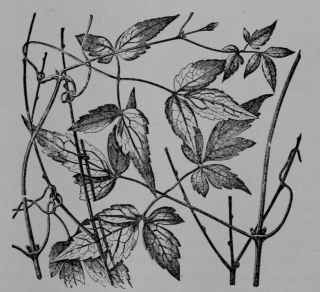
Fig. 289.-Mountain Clematis (Clematis alpina, Crowfoot Family, Ranunculacece). Part of plant climbing by means of its leaf-stalks used as tendrils. (Kerner.)-A somewhat woody climber with stems nearly 2 m. long, bright blue flowers and hairy-tailed fruits. Native home Eurasia and Northwestern North America; cultivated.
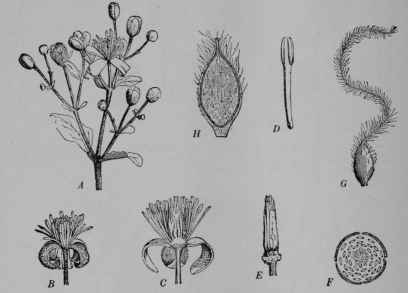
Fig. 290.-Vine-bower Clematis (Clematis Vitalba, Crowfoot Family, Ranunculacece). A, flower-cluster. B, flower. C, same, cut vertically. D, stamen. E, pistils. E, floral diagram. G, fruit. H, base of fruit, cut vertically. (LeMaout and Decaisne.)-A somewhat woody climber growing 10 m. long; flowers dull white; fruit hoary. Native home, Mediterranean Region; cultivated in gardens.
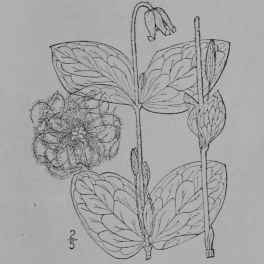
Fig. 291.-Erect Silky Clematis (Clematis ochroleuca, Crowfoot Family, Ranunculaceoe). Flowering branches. Fruit. (Britton and Brown.)- Perennial herb, somewhat woody, 30-60 cm. tall; leaves silky-hairy beneath; flowers yellowish; fruit yellowish brown. Native home, Eastern United States.
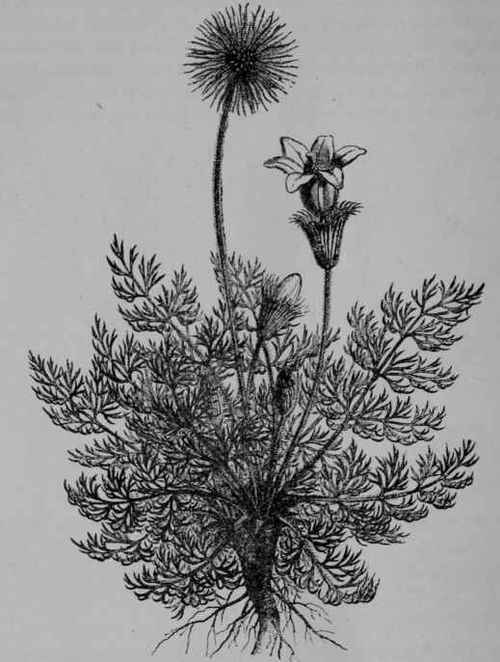
Fig. 292.-Pasque-flower (Anemone Pulsatilla, Crowfoot Family, Ranunculaceoe). Plant in flower and fruit. (Baillon.)-Perennial herb about 20-30 cm. tall; leaves hairy; flowers blue or purplish; fruit hoary. Native home, Europe; cultivated in gardens.
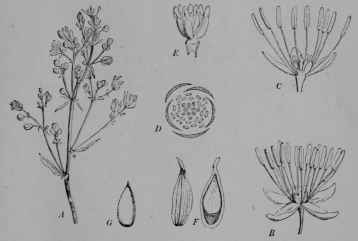
Fig. 293.-Meadow Rue (Thalictrum flavum, Crowfoot Family, Ranunculacece). A, flower-cluster. B, flower, enlarged. C, same, cut vertically. D, floral diagram. E, pistils. E, fruit, entire, and cut vertically. G, seed. (LeMaout and Decaisne.)-Perennial herb about 1 m. tall; flowers yellow; fruit dry. Native home, Eurasia.
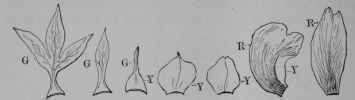
Fig. 294.-Bracts and petals of peony connected by intermediate forms. Parts marked G are green; Y, yellow; and R, red. (Original.)
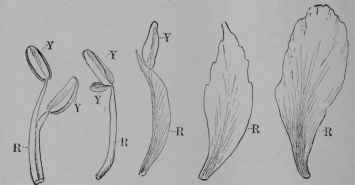
Fig. 295.-Stamens and staminodes of peony showing intermediate forms. Parts marked R are red; and those marked Y are yellow. (Original.)
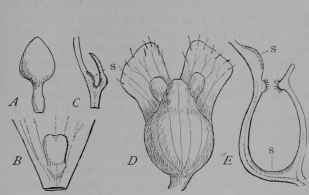
Fig. 296.-Staminodes. A, Anemone Pulsatilla. B, Ranunculus acris, view from above. C, same, cut vertically; the shaded area (S) indicating the surface secreting nectar. D, Nigella damescena, view from above. E, same, cut vertically; secreting surfaces (S) shown as before. All variously enlarged. (Redrawn from Prantl.)
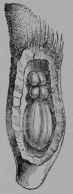
Fig. 297.-Ovary of an anemony, opened to show the two pairs of rudimentary ovules above the single normal one, enlarged. (Baillon.)
Continue to:


My Books

