


Part 173. The Blue Algae - Plant Life-Histories
Description
This section is from the book "Plants And Their Uses - An Introduction To Botany", by Frederick Leroy Sargent. Also available from Amazon: Plants And Their Uses; An Introduction To Botany
Part 173. The Blue Algae - Plant Life-Histories
Part 173. The blue algae (Class Cyanophyceae). Among the useful plants we have studied the only alga is the so-called carrageen or "Irish Moss", and this, as we shall see, belongs to one of the most highly developed classes of seaweeds. It agrees with the great majority of algae, however, in being aquatic and containing chlorophyll, and in being without true stem-, leaf-, or root-members. Before passing to a more detailed examination of the higher algae it will be most instructive for us to study some of the simpler forms. About as simple as any are the exceedingly minute plants which for want of a better name we may call tint-ball algae (Chroöcoccus), and which when highly magnified present the appearance shown in Fig. 305. An individual (A) consists merely of a spheroidal mass of rather firm consistency and blue-green color, surrounded by a transparent gelatinous envelope. Near the center of the mass may be seen under favorable circumstances a comparatively small, somewhat denser spot. After the plant is dead, the application of pure water dissolves out a blue substance-called phycocyanin 1- leaving the yellow-green chlorophyll. This in turn if dissolved out by alcohol leaves a colorless, minutely granular material which examined chemically would be found to consist of a highly complicated mixture of proteids. To such a mixture of organized proteids the name protoplasm 2 has been given. This when active forms the living part of the plant. Whatever is alive in any plant or animal is protoplasm. Hence protoplasm has been called "the physical basis of life." Its exact chemical constitution is not known, nor does it seem likely that it ever can be known; for to analyze a sample of protoplasm chemically is to kill it, and dead protoplasm surely differs in important ways from protoplasm alive. Moreover, through the many complicated reactions going on within, any active mass of protoplasm is doubtless continually changing its composition. One of the products of the activity of the protoplasm of a tint-ball is the blue substance above mentioned; another product is the chlorophyll by means of which it is able to make food in the sunlight like any other plant containing leaf-green. Still another product is the gelatinous material forming the envelope by which the little mass of protoplasm is surrounded. Chemical tests would show that this envelope consists of a kind of cellulose. The food which the protoplasm is able to make from the substances it absorbs through its cellulose shell from the surrounding water, is used by the plant as material for growth. That is to say, it uses the food to make new protoplasm out of which come new coloring matters, new cellulose, and other organic products. As the growth of the sphere is mainly in one direction it becomes elongated into an ellipsoid as shown at B. Meanwhile, the denser central part of the protoplasm has similarly elongated and finally divided into distinct halves. These halves move toward the ends of the ellipsoid, thus becoming surrounded on all sides by the thinner protoplasm. Soon there appears in the ellipsoid a plane of separation extending through the center at right angles to the long axis; then each of the portions of protoplasm on either side of this plane becomes larger and rounder, and each along the plane of separation builds a layer of cellulose which presently appears as a cross partition (C). At last, as a result of further growth and rounding we have two distinct spherules of protoplasm, each with its central, denser part and each surrounded by its own cellulose envelope essentially like the original tint-ball. Thus through growth and division one plant has become two. These plants may remain attached to one another and each of them may divide again and repeat the process a number of times without separating. The result then is a colony in which all the stages in the life-history of the individual may often be observed.
1 Phyco-cy'an-in - Gr. phykos, seaweed; kyanos, blue.
2 Pro'to-plasm - ML. protoplasma, the first creature made - Gr. protos, first; plasma, anything formed.
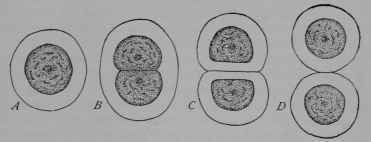
Fig. 305.-Tint-ball Alga (Chroöcoccus turgidus, Tint-ball Family, Chroöcoccaceoe). A, plant as ordinarily seen; magnified about 400 diameters. The inner shaded mass of protoplasm is bluish green, surrounded by a transparent gelatinous envelope. B, same, beginning to divide into two plants. C, the division advanced by the formation of a double wall between. D, the division complete. (Redrawn from Kirchner.)- Found in swamps and on wet rocks throughout the world.
We need a few technical terms to designate such parts as have just been described. A mass of protoplasm capable of more or less individual activity is called a cell.3 All plants, and all animals as well, consist of one or more cells. Usually in plants the protoplasm is inclosed by a cellulose envelope known as the cell-wall, all within which is then distinguished as the cell-contents. Since a cell-wall implies at least the previous existence of living cell-contents, the term cell may be applied even to the empty chamber from which all life has gone. In the living protoplasm a comparatively large, dense kernel, more or less clearly marked off, is termed the nucleus,4 the rest of the protoplasm being distinguished as the cytoplasm; 5 while any liquid part of the cell-contents is called cell-sap; and the entire protoplasmic part, a protoplast. The process through which one cell becomes two by enlarging and splitting in halves is known as fission.6
3 Cell - L. cella, a small room or hut.
4 Nu'cle-us - L. a little nut or kernel - nux, nut.
5 Cy'to-plasm - Gr. kytos, a hollow or cell. Originally a synonym of protoplasm, the word cytoplasm has now taken on the restricted sense above defined.
6 Fis'sion - L. fissio, a dividing.
Continue to:


My Books

