


Part 173. The Blue Algae - Plant Life-Histories. Continued
Description
This section is from the book "Plants And Their Uses - An Introduction To Botany", by Frederick Leroy Sargent. Also available from Amazon: Plants And Their Uses; An Introduction To Botany
Part 173. The Blue Algae - Plant Life-Histories. Continued
Successive fissions often take place in such a way that the partitions are in planes at right angles to one another, with the result, shown in the tint-balls, that more or less cubical groups of cells are formed-an arrangement which sometimes passes into a globular or irregular one through changes in the direction of growth or division. If instead of forming partitions at various angles, the cleaving planes are always parallel, so that successive fissions are in the same direction, then we have a chain or row of cells. This is what happens in the colonies of algae known as "fallen stars" (Nostoc, Fig. 306), because of the sudden appearance of their glistening balls when swollen by rain. Here numerous blue-green cells, like beads on a string, are embedded in a copious mass of jelly secreted by the protoplasm; for instead of forming distinct cell-walls this mucilaginous cellulose, for the most part, becomes homogeneously fused. At intervals in the chain somewhat larger cells are formed, each with a distinct wall. Certain of these cells, called heterocysts 7 have most of their protoplasm replaced by a pale or colorless cell-sap and become incapable of further development. At points where the heterocysts thus limit growth the chain eventually breaks into short lengths each made up of a comparatively small number of cells. These groups are termed hormogonia.8 While the cell-row is dividing into hormogonia the gelatinous envelope is becoming fluid, and as the hormogonia separate they are observed to take on a swaying, worm-like movement which enables them soon to pass into the surrounding water and travel in various directions. In a little while they come to rest, secrete a new gelatinous envelope, and by repeated fission of the cells develop a new colony. On the approach of adverse conditions, such as those of winter, certain of the cells protect themselves by a dense wall, store up food in the cytoplasm, and become brownish. In this condition they are very resistant of cold and tolerant of drying, and are thus able to survive unharmed under conditions which destroy the. other cells. These resistant cells are called resting spores. When the other members of the colony perish and the mucilaginous envelope dissolves, these spores are set free; and on the return of favorable conditions they germinate by a swelling of the protoplasm which ruptures an outer dense layer of the wall. Covered then by a thin, inner layer the protoplasm elongates, as shown in Fig. 306, B, C, D, and by repeated fission together with a copious secretion of jelly a new "fallen star" colony is started.
7 Het'er-o-cyst - Gr. heteros, different; kystis, a bag.
8 Hor"mo-gon'i-um - Gr. hormos, a chain; gonos, offspring.
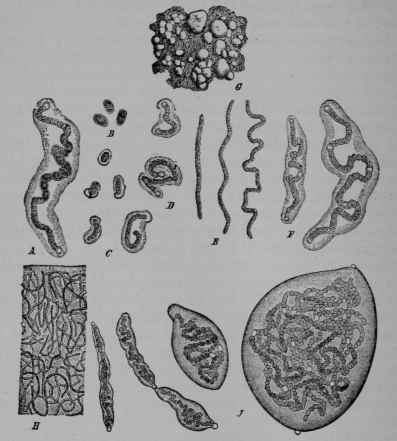
Fig. 306.-Fallen Stars (Nostoc spp., Fallen Star Family, Nostocaceoe). A-F, Nostoc paludosum. A, chain-colony with resting spores near the middle and heterocysts at the ends, 325/1. B, resting spores. C-F, germination of resting spore, and stages in the formation of a new chain-colony. G-J, Nostoc sphoericum. G, gelatinous balls as they appear in moist earth, 2/3 natural size. H, part of a slice cut through the ball, 100/1. J, early stages in a growing colony, 200/1. (Janczewski, Thuret.)-Protoplasts bluish green, enveloped in a gelatinous mass which they produce. Found mostly in water or on moist earth in various parts of the world.
Nostoc and Chroococcus may be taken as typical of the Class Cyanophvceae the members of which occur abundantly in salt or in fresh water or on surfaces frequently wet, and are characterized by having their chlorophyll more or less masked by phycocyanin, and by consisting of single cells or cell-colonies of various form, reproducing only by fission, although the colonies sometimes multiply through hormogonia or resting spores.
The lower members of the class have about the simplest organization known. They are doubtless as much like the earliest organisms which appeared upon the earth as any creatures now living. It is interesting and perhaps significant, that the algae previously referred to as thriving in the scalding water of hot springs, belong to this class. From an economic point of view the blue-green algae have an especial importance as being the chief cause of offensive odors which develop at certain seasons in the stored water-supply of many cities, often rendering it unfit for use. Through experiments recently performed on a large scale by the United States Department of Agriculture, it has been found that an exceedingly minute percentage of copper sulphate added to the water will kill them and other harmful plants without leaving any traces of itself which are either perceptible or harmful to man or beast in the slightest degree.
Continue to:


My Books

