


Part 174. The Green Algae - Plant Life-Histories. Part 2
Description
This section is from the book "Plants And Their Uses - An Introduction To Botany", by Frederick Leroy Sargent. Also available from Amazon: Plants And Their Uses; An Introduction To Botany
Part 174. The Green Algae - Plant Life-Histories. Part 2
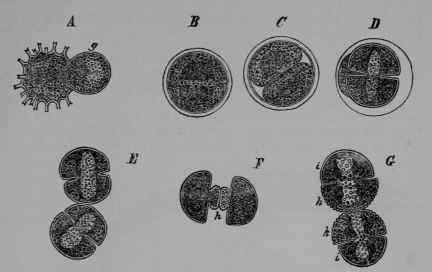
Fig. 310.-Grape Desmid. Germination of zygospore: A, protoplast emerging; B, protoplast beginning to divide in half; C, division nearly complete; D, division complete within the thin temporary cell-wall; E, the two desmids escaped from the wall; F, one of them dividing by fission; G, the fission nearly complete, 190/1. (DeBary.)
A spore formed as above described by the union of two similar protoplasts is termed a zygospore,5 the uniting protoplasts are known as gametes,6 and the process of their union is called conjugation.7
5 Zy'go-spore - Gr. zygon, yoke.
6 Gam'ete - Gr. gametes, a spouse.
7 Con"ju-ga'tion - L. con, together; jugare, join or yoke.
Closely related to the desmids are the "pond-scums," algae which form tangled masses of delicate threads floating near the surface of quiet fresh water. A very common genus is Spirogyra (Fig. 311) in which the plants are unbranched filaments consisting of a single row of comparatively large cylindrical cells containing spiral, ribbon-like chromatophores, rather prominent pyrenoids, and copious cell-sap. Elongation of the thread results from fission of the cells much as in Nostoc; but with Spirogyra the more intimate union of adjacent cells gives rise to a multicellular individual rather than to a colony of unicellular plants. Conjugation takes place between cells of separate plants growing near together. Outgrowths from two opposite cells meet, and by absorption of the walls at the point of contact form a tube connecting the cavities. Through this tube the gamete from one cell passes into the other cell to form a zygospore. Germination takes place in the manner indicated by Fig. 312.
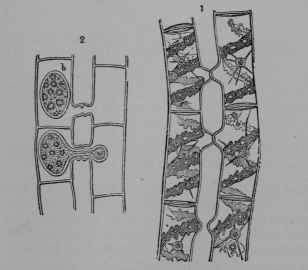
Fig. 311.-Pond-scum (Spirogyra sp., Pond-scum Family, Zygnemaceoe). 1, segments of two thread-like plants beginning to conjugate by the protrusion of adjacent cell-walls toward each other. 2, later stages resulting in the formation of a zygospore (b). Much magnified. (Ker-ner.)-Pond-scums abound on the surface of ponds, forming masses of bright green color through the summer which turn brownish toward spring when conjugation takes place.
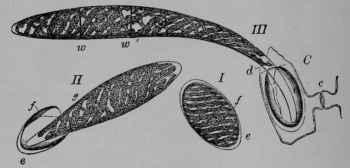
Fig. 312.-Pond-scum. Germination of zygospore. I, resting zygospore; f, yellowish-brown layer of the cell-wall; e, outer layer of wall. II, the protoplast emerging from the old wall, covered by a thin wall (g) of its own. III, young plant beginning to form a thread-like row of cells by elongating and forming cross-partitions (w, w'); its small end (d) still within the old spore-wall, enclosed by the old cell-wall of the original plant whose conjugating-tube (c) is still visible. Much magnified. (Pringsheim.)
What is here especially noteworthy is that in the conjugation of Spirogyra we have a simplest form of sexual reproduction. Whereas in Cosmarium the gametes are just alike, in Spirogyra the one which passes over might be called male, and the other, female, although before conjugation no difference between them is perceptible.
Somewhat more highly developed in both the vegetative and the reproductive system are the green algae of the genus Ulothrix (Fig. 313) which consist of cylindrical cells forming an unbranched filament fastened by one end to a rock or other firm support. These filaments grow so crowded as to form a woolly mat which suggests the name wool-weeds as appropriate for the group. A differentiation of the plant-body appears in a specialization of the lowest cell as an organ of attachment. This, therefore, is analogous to a root while the remaining green part has the function of a shoot. But the resemblance not being one of homology, it will be most accurate for us to name organs of this kind pseudo-roots and pseudo-shoots respectively. Thallus 8 is a general term for any plant-body in which true roots, true stems, and true leaves do not appear. The pseudo-shoot of a wool-weed elongates by fission of its cells, each of which contains a single nucleus and a chromatophore in the form of a nearly complete hollow cylinder.
8 Thal'lus - Gr. thallos, a young shoot.
Continue to:


My Books

