


Part 174. The Green Algae - Plant Life-Histories
Description
This section is from the book "Plants And Their Uses - An Introduction To Botany", by Frederick Leroy Sargent. Also available from Amazon: Plants And Their Uses; An Introduction To Botany
Part 174. The Green Algae - Plant Life-Histories
174. The green algae (Class Chlorophyceae) include many familiar water plants.
They are characterized by having the chlorophyll ordinarily unmasked by any other pigment, their structure and their methods of reproduction including widely varied types.
A very simple form, common throughout the world on rocks or tree-trunks which are often wet by rain, is the wall-stain alga (Pleurococcus) shown in Fig. 307. Except for the absence of blue pigment it is much like a tint-ball alga. The cell-wall of this alga is ordinary firm cellulose, the nucleus is more distinct than in the tint-balls, and the protoplasm shows further differentiation in the presence of specialized bodies of varied form called chromatophores,1 to which the chlorophyll is confined. Reproduction, as ordinarily observed, is by fission in three directions; and, since the cells often remain attached, more or less globular colonies result. Further development under certain conditions has been reported; but however that may be, the life-history of the plant as commonly seen consists simply of fissions repeated indefinitely.
1 Chro'mat-o-phore - Gr. chroma, color; phoros, bearing.
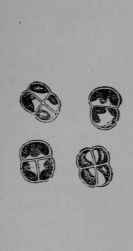
Fig. 307.-Wall-stain Alga (Pleurococcus vulgaris, Wall-stain Family, Pleurococcaceoe). Plants showing fission in various directions, 540/1. (Wille.)-Growing commonly upon moist rocks, bricks, and tree-trunks, forming extensive green-stains, throughout the world.
Somewhat higher in organization are the yellowish green, unicellular, fresh water algae known as desmids, of which Cosmarium (Figs. 308-310) is a typical genus. Desmids are of varied and often strikingly beautiful forms, the firm, cellulose wall being sometimes curiously sculptured and frequently developing sharp projections, while the chromatophores take the form of disks, plates or bands symmetrically arranged. Within the chromatophores may be seen transparent spots called pyrenoids 2 in which starch is formed. Many of the genera have the plant-body constricted in the middle, as in Cosmarium, forming thus two semicells; and in all cases the halves are symmetrical. This peculiarity modifies in an odd way the process of fission, by which they multiply under ordinary conditions. As shown in Fig. 308, the outer firm layer of the wall, ruptures at the place of constriction, allowing the semicells to separate, while the protoplasm of the isthmus or neck which joins them elongates, being still covered by a thin, elastic, inner layer of cellulose. The nucleus and chromatophores divide, half going to either end. A partition is then formed across the middle of the isthmus, and the new part on either side grows larger and rounder until finally two separate and complete cells are formed each with a new and an old half. Meanwhile chromatophores pass over into this new semicell, and its outer wall becomes thickened and sculptured like the other. In some desmids after fission the cells remain attached forming a row comparable to the chain in Nostoc. A striking peculiarity of the free forms like Cosmarium is their power of locomotion. While not rapid, the movement is quite perceptible under the microscope. It has been found to be accomplished by protrusions of mucilaginous material, and its direction to be influenced by light. Resting spores are produced in the peculiar manner shown in Fig. 309. Two cells lying side by side, each rupture the outer wall across the middle and the halves separate as for fission, but instead of forming a cross partition the protoplasm of each plant flows out of the old cell-wall and toward the other protoplast. When the two protoplasts come in contact they fuse into a single spherical mass, the two nuclei merge into one, the chromatophores disppear, and the whole contents becomes brownish, while the outer cell-wall or exospore 3 thickens and puts forth a number of projections. In this condition the spore is comparatively resistant of cold or dryness. On the return of favorable conditions germinations take place as shown in Fig. 310. The contents swell, rupture the exospore, and emerge, surrounded by the delicate inner wall or endospore.4 Soon a division of the nucleus takes place followed by division of the protoplast into halves, which become constricted, turn green and form cell-walls much like the uniting pair from which they were derived. Freed from the endospore the newly formed desmids swim about and multiply by fission, during which process the chromatophores soon become distinct and the cell-wall takes on its characteristic sculpturing.
2 Py-re'noid - Gr. pyren, the stone of a fruit; eidos, resemblance.
3 Ex'o-spore - Gr. exo, outside; sporos, spore.
4 En'do-spore - Gr. endon, within.
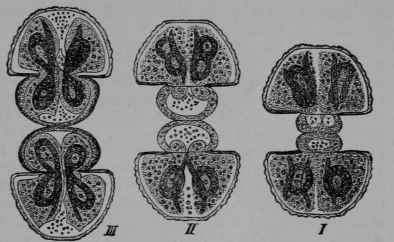
Fig. 308.-Grape Desmid (Cosmarium Botrys, Desmid Family, Desmidiaceoe.) I-III, stages of fission, 390/1. (DeBary.)-Bright green. Common in fresh water.
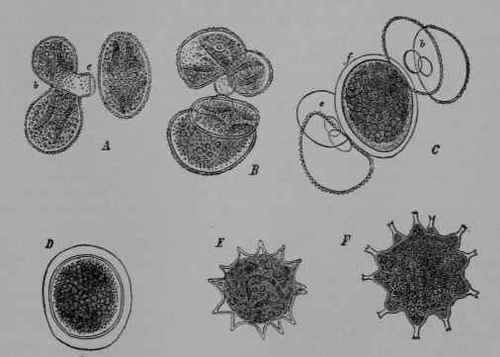
Fig. 309.-Grape Desmid. A, first stage in conjugation; the two halves of the cell-wall (b) have been broken apart by the protruding protoplast (c). B, later stage; the protoplasts of two plants are coming together. C, final stage; the two protoplasts have fused into one mass to form a zygospore (f) leaving the old cell-walls (e, b) empty. D, E, F, stages in the ripening of the zygospore which surrounds itself 'with a protective wall from which numerous projections finally arise, 300/1. (DeBary.)
Continue to:


My Books

