


Part 178. The Fission Fungi - Plant Life-Histories
Description
This section is from the book "Plants And Their Uses - An Introduction To Botany", by Frederick Leroy Sargent. Also available from Amazon: Plants And Their Uses; An Introduction To Botany
Part 178. The Fission Fungi - Plant Life-Histories
Part 178. The fission fungi (Class Schizomycetes). Fungi, broadly defined, are thallus-plants without chlorophyll. In their structure and life-histories they present often noteworthy parallels to what we have already seen in typical algae. Thus, closely similar to the Cyanophyceae are the Fission Fungi, otherwise known as Bacteria. A typical example is the "hay bacillus" (Fig. 322) so-called because it thrives in an infusion of hay. About twenty-four hours after such an infusion is made, the liquid gives off an offensive odor and becomes turbid through the presence of myriads of organisms which under a very high power of the microscope appear as short, colorless rods (B). These are seen to be in rapid motion, but it is only by special staining and very great magnification that the exceedingly delicate lash-like projections which cause the movement can be discerned. The ability of these plants to feed upon the organic substances dissolved in the water about them, renders it unnecessary for them to manufacture food for themselves by the aid of sunlight out of inorganic materials; hence like all fungi they can dispense with chlorophyll, and grow as well, often better, in the dark than in the light. A plant which feeds upon dead organic material is termed a saprophyte,l and when the chemical changes induced by its activity are offensive the process is putrefaction.2
1 Sap'ro-phyte - Gr. sapros, rotten.
2 Pu"tre-fac'tion - L. putris, rotten)facere, make.
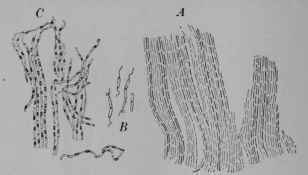
Fig. 322.-Hay bacillus (Bacillus subtilis, Rod-germ Family, Bacteriaceoe). A, rod-like plants embedded in the film-like gelatinous mass which they produce, 500/1. B, plants swimming freely by means of slender lash-like projections, 1000/1. C, plants in the thread condition forming resting spores, 800/1. (Strasburger.)-These plants cause putrefaction in various liquids such as water in which hay has been soaked.
The motile rods multiply rapidly so long as there is any food available or until the putrid products become so concentrated as to be harmful to the plant. Then the plants rise to the surface of the liquid, lose their swimming organs, form long threads by remaining attached end to end after fission, and at the same time they secrete a gelatinous covering which binds them all together into a rather firm layer or scum (A). While in this stage resistent resting spores are formed in many of the cells, by the protoplast becoming round and secreting a new cell-wall (C). If the liquid is allowed toevaporate and the scum to dry it will become more or less powdery, and slight currents of air may then carry away minute bits containing many of these excessively small spores which no mere drying can harm. Myriads of such spores are floating about in the air around us. When a Bacillus spore falls into any putrescible liquid it germinates by elongation of the protoplast and the development of swimming lashes, thus forming a motile rod like that already described.
Very similar to Bacilli, both in structure and life-history, are the many forms of the genus Bacterium which differs from Bacillus mainly in lacking swimming organs. Bacterium acidi lactici (Fig. 323) causes milk to sour by converting its sugar into lactic acid. Such decomposition, in which the products are not offensive, is distinguished as fermentation.3 Both fermentation and putrefaction are regarded as due to the action of enzyms (comparable to diastase) which are secreted by the active organisms concerned. The tuberculosis bacterium is another species especially noteworthy as it is the germ of "consumption" in man and other animals, producing various forms of the disease according to the part of the body in which it develops. An organism which thus feeds upon the substance of another living thing is called a parasite;4 the organism which supports it being termed the host. Bacteria capable of producing the disease often occur abundantly in the sputum of tuberculous patients, and if this dries small bits are readily detached and blown about. A sufficient number drawn into the lungs or getting into the blood of a susceptible host give rise to the disease. Hence the wisdom of isolating tuberculous patients to avoid contagion, and the importance of enforcing the regulations of Boards of Health against all spitting in public places. Direct sunlight being soon fatal to the plant in all its stages, affords a most valuable means of preventing infection, and often of effecting a cure by killing the parasite.
3 Fer'-men-ta'tion - L. fervere, boil, be agitated.
4 Par'a-site - Gr. parasitos, one who eats at another's table, a hanger on; - para, beside; sitos, food.
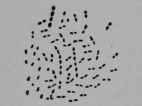
Fig. 323.-Milk-souring bacterium (Bacterium acidi lactici, Rod-germ Family, Bacteriaceoe). Plants stained, 1000/1. (Migula.)-Causes the souring of milk by converting the milk-sugar into lactic acid.
Nearly all contagious diseases are caused by fission fungi, and to the micro-organisms or "microbes" of this same class are due almost every sort of putrefaction, fermentation, and decay. The discovery of this important truth has given a new significance to cleanliness, and a knowledge of their life-histories and peculiar properties affords a scientific basis for methods of preventing or regulating the activities of these excessively minute, yet exceedingly powerful agents of change. While some forms of bacteria are a menace to health others are useful in important ways as in the manufacture of butter and cheese, in the retting of flax and other fibers, and as improving the soil for many farm-plants.
The various forms assumed by the cells and colonies of fission fungi may all be closely matched by forms of blue algae. The fission fungi, therefore, are regarded as descendants of the fission-algae (as the blue algae are sometimes called) which have adopted a saprophytic or parasitic mode of life. All plants which contain chlorophyll and, like the algae, make all their own food by means of sunlight, are termed holophytes;5 while those which feed upon organic materials either as saprophytes or parasites are distinguished as hystero-phytes.6 Doubtless in consequence of their change of habit these hysterophytic fission-plants have not only altered their relation to sunlight, but have become more or less reduced in size. Certain species of the group are, so far as known, the smallest of living things. Multiplication solely by fission characterizes the class.
5 Hol'o-phyte - Gr. holos, whole; phyton, plant.
6 Hys'ter-o-phyte - Gr. hysteros, coming after.
Continue to:


My Books

