


Part 181. The Water Mold Fungi - Plant Life-Histories
Description
This section is from the book "Plants And Their Uses - An Introduction To Botany", by Frederick Leroy Sargent. Also available from Amazon: Plants And Their Uses; An Introduction To Botany
Part 181. The Water Mold Fungi - Plant Life-Histories
Part 181. The water-mold fungi (Class Oomycetes) are typified by a small group closely resembling algae because of their aquatic habits. These water-molds, as they are called, are well represented by species of Saprolegnia (Fig. 327) which grow commonly upon dead insects (A) or succulent plant-fragments decaying in water; or, in some cases, as parasites upon fish. As with the bread-molds the feeding mycelium is unicellular. Projecting hyphae form terminal sporangia from which swarm-spores emerge (B, C). Female gametangia are formed by swellings on certain hyphae, the protoplast becoming transformed into one or more spherical gametes (E). Meanwhile, male gametangia develop either from the same hypha or from hyphae near by, as club-shaped organs which grow toward the female gametangium and send a projection through its wall to the gametes within. After fertilization the female gametes become resistant oospores. These eventually are set free and germinate by sending out a sporangial hypha in which swarm-spores are developed. In some of the water-molds degeneration of the sexual reproductive organs has gone so far that, although male gametangia are developed no fertilization takes place and oospores form non-sexually. In extreme cases oospores are formed although no vestige of a male gametangium appears. The life-history of the water-molds is essentially similar to that of other oomycetes which are parasitic upon land-plants. All of these fungi, to judge from their methods of reproduction are more nearly akin to algae of the type represented by Coleochaete than to any other we have studied, although important differences show that the kinship is rather remote. Oomycetes are fungi which produce oospores.
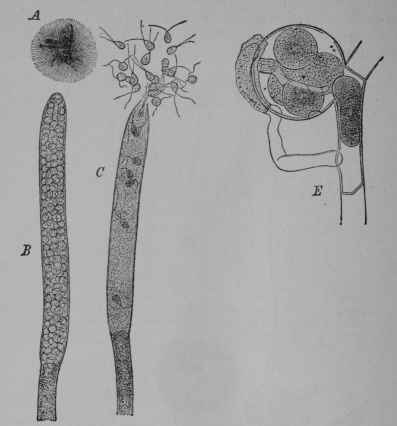
Fig. 327.-Water-mold (Saprolegnia Thureti, Water-mold Family, Saprolegniaceoe). A, dead fly attacked by water-mold, surrounded by radiating hyphse terminating in swarm-spore-cases, 1/1. B, swarm-spore-case in which the spores are forming, 200/1. C, same, discharging swarm-spores. E, female gamatangium containing four female gametes to which comes a projection from the male gametangium that arises as a branch hypha from below the female gametangium, 400/1. (Thuret, DeBary.)-Water-molds abound upon dead insects, etc., in water.
Continue to:


My Books

