


Part 182. The Spore Sac Fungi - Plant Life-Histories
Description
This section is from the book "Plants And Their Uses - An Introduction To Botany", by Frederick Leroy Sargent. Also available from Amazon: Plants And Their Uses; An Introduction To Botany
Part 182. The Spore Sac Fungi - Plant Life-Histories
Part 182. The spore-sac fungi, (Class Ascomycetes) may be illustrated sufficiently for our purpose by the "mildews." These, typified by the "powdery mildew" Erysibe, are parasitic upon the aërial parts of higher land-plants. As shown in Fig. 328 the feeding hyphae creep over the surface of a leaf, and at short intervals send out projections into the host. These projections by means of which the food is absorbed, are called haustoria.1 Another peculiarity distinguishing these vegetative hyphae from any previously studied is the presence of frequent cross-partitions. Dust-spores are formed at the tips of vertical hyphae by the separation of individual cells as shown at c. Each of the dust-spores thus formed is regarded as representing a degenerate spore-case containing but a single spore. Minute sac-like cases containing eight sac-spores are formed within a spherical envelope from the feeding hyphae.
1 Haus-tor'i-um - L. haustor, a drinker.
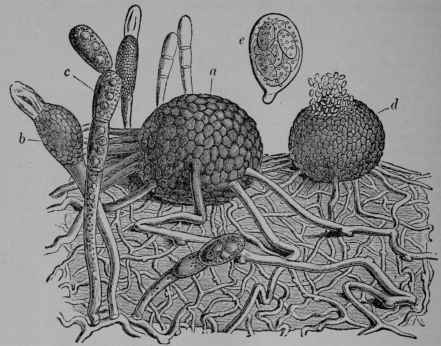
Fig. 328.-Powdery-mildew (Erysibe communis, Powdery-mildew Family, Erysibaceoe). The surface of a leaf upon which the fungus is parasitic, its horizontal hyphae spreading over the surface and attaching itself by sucking organs; and giving rise also to vertical hyphae producing dust-spores (c), and to fruiting bodies such as a, which contain sac-spore-cases such as e. The fruiting bodies b and d and the hyphae from which they arise belong to another fungus (Cincinnobolus) which is parasitic upon the mildew. Magnified about 450 diameters. (Tu-lasne.)-Powdery-mildews are all too common parasites upon the foliage of flowering plants both cultivated and wild.
What appear to be male and female gametangia arise where two hyphae cross (Fig. 329, a, b, c), the female coming from the lower hypha, the male from the upper. Fertilization has not been observed and all sexuality seems to have been lost in these plants; but from what we have called the female cell there are developed several eight-spored sacs or asci,2 as they are called, while from the supposed male grow up a number of enveloping branches consisting of many short cells so crowded and joined as to make a complete protective envelope.
2 As'cus - Gr. askos, bag.
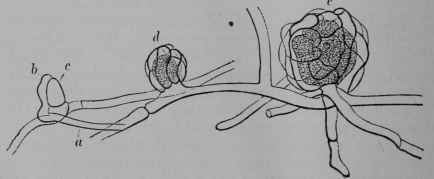
Fig. 329.-Powdery-mildew. Horizontal hyphae (a) from which arise "male" (b) and "female" (c) gametangia; the latter producing sac-spore-cases enclosed within a protective fruit-body (d, e). (Warming.)
Fungi related to the mildews and sometimes parasitic upon them, as shown in Fig. 328, b, d, produce very minute dust-spores which are crowded within a case resembling the envelope just described. When the sac-spores are set free under favorable conditions they germinate like the dust-spores.
Comparing Erysibe with Coleochaete we find some significant resemblances which make it comparatively easy to suppose that fungi of this sort have descended from such algae;-the multicellular creeping branches of the thallus becoming multicellular creeping hyphae; the sporangia, dust-spores; the female gametangium developing into a group of asci, while a neighboring cell, simulating the male gametangium, gives rise to an enveloping rind. These changes are such as might be expected in passing from the aquatic and sun-using mode of life to the aerial and parasitic. Ascospores characterize the Class Ascomycetes.
Continue to:


My Books

