


Part 185. The Spore Sac Lichens - Plant Life-Histories
Description
This section is from the book "Plants And Their Uses - An Introduction To Botany", by Frederick Leroy Sargent. Also available from Amazon: Plants And Their Uses; An Introduction To Botany
Part 185. The Spore Sac Lichens - Plant Life-Histories
Part 185. The spore-sac lichens (Class Ascolichenes). After long study and careful experimenting in the culture of lichens botanists have reached the strange conclusion that what were at first regarded as individual plants are in reality communities each consisting of a fungus (mostly spore-sac fungi), parasitic upon algae (commonly colonies of Pleurococcus), imprisoned by its mycelium. A lichen spore falling among Pleurococcus cells germinates, and the hyphae attaching themselves to the algae absorb food materials from them but not generally to an injurious degree. This is shown by the fact that the algae seem to thrive quite as well as before, dividing repeatedly, while the hyphae grow luxuriantly into a mycelium which soon envelopes the algae completely. A well-developed lichen such as "Iceland moss," for example, shows a compound thallus, in which a marked differentiation of parts may be observed (Figs. 161, 332-335). At the middle is a layer of loose cottony mycelium (Fig. 335, m) on the borders of which are irregular layers of algal colonies (g, g) mingled with the hyphae, and, covering all, a firm rind (r, r) consisting entirely of hyphae fused into a uniform tissue. Layers of spore-sacs arise near the tips of the thallus-lobes in Cetraria, and numerous projections inclosing dust-spores appear along the margin.
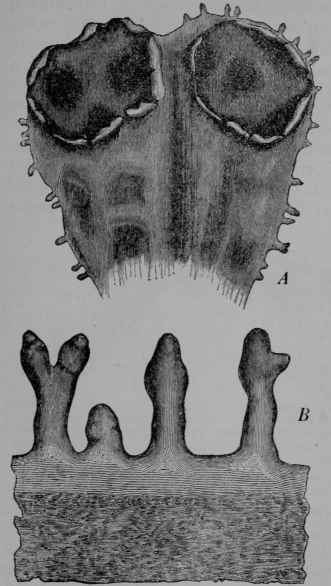
Fig. 332.-Iceland moss (see also Fig. 161). A, tip of thallus-lobe bearing two fruit-patches, called apothecia, and along the edge a number of projections, known as spermagones, which contain dust-spores, 5/1. B, edge of thallus bearing four spermagone-projections, 40/1. (Luerssen.)
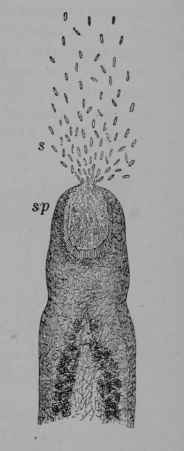
Fig. 333.-Iceland moss. A spermagone-projection, cut vertically to show the cavity (sp) from which dust-spores are discharged. (Luerssen.)
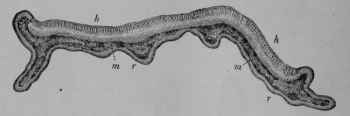
Fig. 334.-Iceland moss. Cross-section of apothecium through thallus-lobe, showing the thallus-rind (r, r), the cottony interior mass of hyphae (m, m), among which are green algae, and the layer of spore-sacs and paraphyses which form the hymenium (h, h); somewhat diagrammatic, 20/1.(Luerssen.)
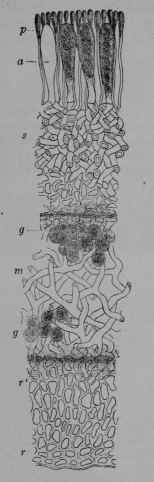
Fig. 335.-Iceland moss. A small part of the apothecium and thallus shown in Fig. 334, magnified 400 diameters; showing the spore-sacs or asci (a), the paraphyses (p), the compact layer of mycelium (s) from which they arise, the algae (Pleurococcus) known as "gonidia" (g), the cottony mycelium (m), and the compact protective rind (r, r'). (Luerssen.)
A singular method of reproduction very common among lichens is by what are called soredia,1 which are little masses of hyphae surrounding a colony of algae. Fig. 336, II shows the soredium of a lichen known as beard-moss (Fig. 336,I) nearly related to the "Iceland moss." Soredia arise through luxuriant development of the inner cottony layer at certain points where they rupture the rind, and force their way to the surface from which they eventually separate. Then being carried by the wind to some favorable spot each grows into a new compound thallus. The formation of soredia makes it possible for lichens to gain a foothold where no other living thing could grow. We find them clinging to the rocks of mountain peaks, or in arctic regions, or deserts. After a land-slide lichens are the first plants to appear upon the newly uncovered rock, thus beginning that slow accumulation of soil which after many centuries permits the growth of higher plants. For this reason lichens have well been called Nature's pioneers. Their wonderful power of living upon the air, with what the winds and rain may bring them, is clearly the result of a mutually beneficial co-operation between the algae and the fungi composing the thallus. Either alone could not grow where both together thrive. The algae of course are the food-making members of the little community; while the fungus, living upon the organic materials they provide, affords them protection against too intense sunlight, soaks up the rain and dew and retains it sponge-like for a considerable time; and, finally, keeps them supplied with all the carbon dioxid they need as a raw material for their food. Dissimilar organisms living thus together with benefit to both are called symbionts,2 and their co-operative mode of life, symbiosis.2 Plants which grow attached to some support from which they derive no nutriment are termed epiphytes.3 Lichens are aerial epiphytes or "air-plants."
1 So-re'di-um - Gr. soros, a heap.
2 Sym-bi-ont, Sym-bi-o'sis - Gr. symbiosis, living together; - syn, together; bios, life.
3 Ep'i-phyte - Gr. epi, upon.
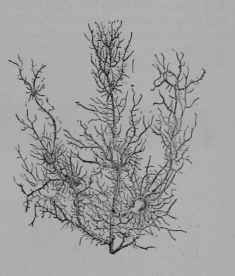
Fig. 336, I.-Beard-lichen (Usnea barbata, Beard-lichen Family, Usneacece). Natural size. Granules often appearing on the surface are soredia. (Baillon.)-Grayish or dull yellowish green throughout; often much longer than shown, with a tough central. Common on trees in various parts of the world.
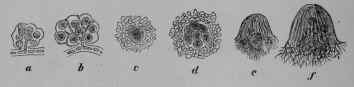
Fig. 336, II.-Beard-lichen, a, b, a group of eight gonidia among which a hypha is branching, c, a soredium consisting of a single gonidium surrounded by hyphae, viewed as if cut across, d, the same in which the single gonidium has multiplied into several, e, a soredium which contains but a single gonidium, germinating by developing below in contact with the bark of a tree fine hypha-branches which serve as organs of attachment, f, the same, older, showing the multiplication of the gonidia, and the upward growth of the hyphae to form a thallus. (Schwendener.)
Several aërial forms of Chlorophyceae besides Pleurococcus, and also a number of Cyanophyceae including species of Chroöcoccus and Nostoc, serve as the algal symbiont in various lichens. So little has their structure been modified by the symbiosis, they may almost always be referred to forms found living independently. The fungal symbionts, on the other hand, have become so changed in many ways, that usually much uncertainty attends the effort to find their near kin among non-symbiotic fungi. They may always be classified, however, as either Ascomycetes or Basidiomycetes, and it is to the former class that the great majority of lichen fungi belong. Ascolichenes are thus symbiotic Ascomycetes.
Continue to:


My Books

