


Part 189. The Liverworts Or Hepatics - Plant Life-Histories. Part 2
Description
This section is from the book "Plants And Their Uses - An Introduction To Botany", by Frederick Leroy Sargent. Also available from Amazon: Plants And Their Uses; An Introduction To Botany
Part 189. The Liverworts Or Hepatics - Plant Life-Histories. Part 2
Both generations are still more highly developed in the umbrella-liverwort (Marchantia, Figs. 340-342), a common species growing on the earth in moist localities. The spores germinate much as in Riccia, but the thalli are always bisexual. At first, however, both forms are essentially alike and resemble a brood-lobed Riccia. From the under side arise numerous unicellular pseudo-roots and many scale-like pseudo-leaves. On the upper surface are often formed numerous brood-bodies of the form shown in Fig. 342, which are produced at the bottom of little cups the whole suggesting a miniature nest full of eggs. By this peculiar form of vegetative reproduction the gametophyte is rapidly multiplied; for as soon as a brood-body is carried away by some current of rain water and comes to rest in a favorable spot it sends out pseudo-roots from whichever surface happens to be undermost, and begins to grow into a new thallus. After a while organs distinctive of the sex appear near the growing end, and curving upward become differentiated into a cylindrical stalk and an expanded top. In male plants (Fig. 340 I-IV) this top is a lobed disk on the upper side of which are pits, each containing a multicellular gametangium, from which come slender motile gametes like those of Riccia already described. Archegonia arise also on the top of what is at first a somewhat similar expansion (Fig. 341, I-V), but they come finally to lie underneath through the folding downward of the edges of the lobes. The female gametangia are thus protected by their position, and besides this they are covered by a hanging curtain (Fig. 341, V, p). When the plants are wet with rain or dew the flagellate male gametes are set free and swim or crawl from their elevated home down the stalk and to a female plant; then they climb up its stalk (doubtless aided by numerous hairs thereon) to the archegonia. The fertilized egg-cell gives rise to a spheroidal embryo which develops into a sporophyte resembling that of Riccia for a while but finally, by growth of the basal region of the capsule, producing a footstalk whose elongation pushes the sporangium through the top of the calyptra (Fig. 341, III). Meanwhile, elongated cells, called elaters 3 (Fig. 341, IV), having elastic, spirally thickened walls are being formed among the spores; and when finally the capsule bursts open these elaters, by mechanical movements due to drying, eject the spores and so help to scatter them. The sporophyte is fed entirely by the gametophyte and lives as a parasite, the foot or lower end of the stalk serving as an haustorium.
3 E-la'ter - Gr. elater, a driver.
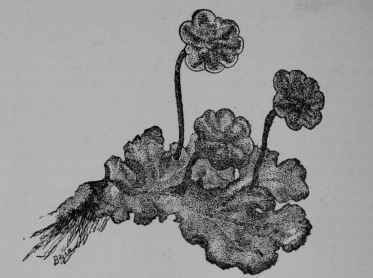
Fig. 340, I.-Umbrella-liverwort (Marchantia polymorpha, Umbrella-liverwort Family, Marchantiaceoe). Male plant bearing antheridia-carriers (antheridiophores) 2/1. (Atkinson.)-The plant is common on moist earth, rocks, etc., throughout the world.
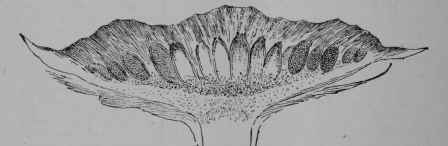
Fig. 340, II.-Umbrella-liverwort. Top of antheridiophore (6/1), cut vertically to show the cavities containing antheridia. (Atkinson.)
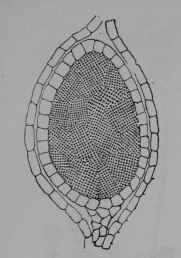
Fig. 340, III.-Umbrella-liverwort. Antheridium (50/1) showing the numerous cells within which produce spermatozoids. (Atkinson.)
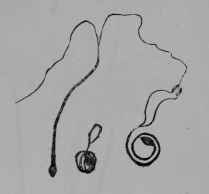
Fig. 340, IV.-Umbrella-liverwort. Spermatozoids, highly magnified. (Atkinson.)
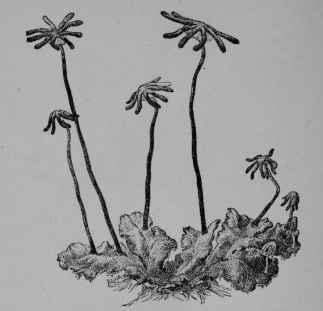
Fig. 341, I.-Umbrella-liverwort. Female plant (4/3), bearing archegonia-carriers (archegoniophores). (Atkinson.)
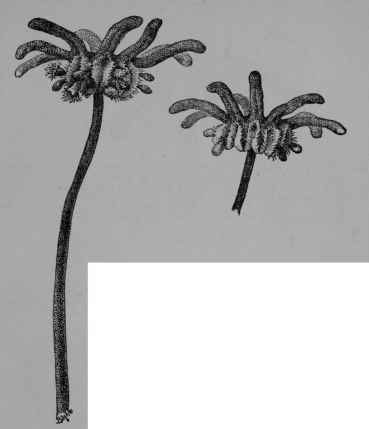
Fig. 341, II.-Umbrella-liverwort. Archigoniophores (3/1) bearing ripe "fruit" (sporophytes), the spore-cases of which are seen projecting beyond the curtains which protected them while young. Two of the spore-cases have burst showing the projecting elaters. (Atkinson.)
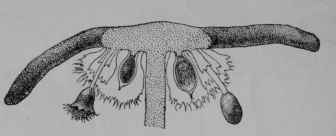
Fig. 341, III.-Umbrella-liverwort. Top of archigoniophore (4/1) cut vertically to show the stalked sporophytes of different ages: the two inner ones are still within the enlarged wall of the archegonium; the right-hand one has protruded on its stalk leaving the archegonial wall as a sheath (calyptra) at the base of its stalk; while the left-hand one has burst open and is shedding its spores and elaters. (Atkinson.)
Continue to:


My Books

