


Part 189. The Liverworts Or Hepatics - Plant Life-Histories. Part 3
Description
This section is from the book "Plants And Their Uses - An Introduction To Botany", by Frederick Leroy Sargent. Also available from Amazon: Plants And Their Uses; An Introduction To Botany
Part 189. The Liverworts Or Hepatics - Plant Life-Histories. Part 3
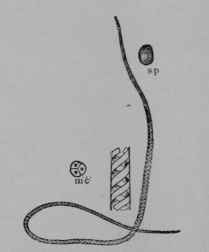
Fig. 341, IV.-Umbrella-liverwort, mc, cluster of young spores; sp, spore. An elater. A piece of the same, showing the elastic spring-like spiral thickening within. All highly magnified. (Atkinson.)
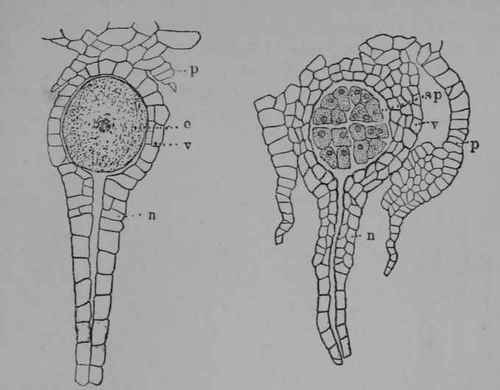
Fig. 341, V.-Umbrella-liverwort. Archegonium (at the left) containing an egg-cell (e); and (at the right) the same, later, containing a young sporophyte (sp). 300/1. The neck (n) of the archegonium, and its base (v), are shown in both; as also the protective curtain (p). (Atkinson.)
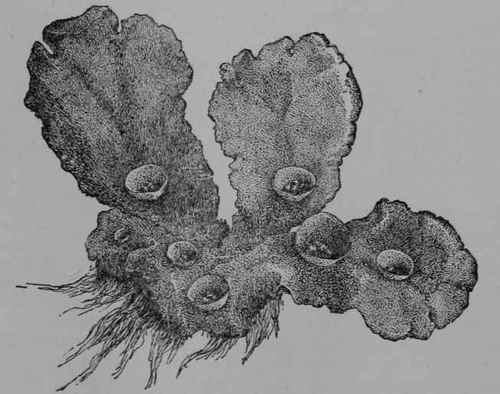
Fig. 342.-Umbrella-liverwort. Thallus (2/1) showing on the top seven brood-cups containing minute brood-bodies; and below numerous pseudo-roots. (Atkinson.)
Especial interest attaches to the genus Anthoceros (often called horned liverworts from the form of the sporophyte), because these humble plants have preserved structures which help us to understand how all the higher plants may have originated. The gametophyte develops from a spore in much the same way as happens with the other liverworts described. Even more than in Riccia it is like the thallus of Coleochaete, notably in possessing but a single chromatophore in each cell, and in having no trace of pseudo-leaves (Fig. 343). The gametangia are completely embedded in the thallus (Fig. 344). The embryo (E) develops a somewhat expanded foot which serves to hold the slender sporophyte in an upright position, and functions also as an organ of absorption. As the sporophyte continues to grow, however, it is plain that scarcely more than inorganic materials are taken in; for very soon, above the foot appears an elongating zone of tissue containing much chlorophyll; and this enables the sporophyte to photosynthesize and so, unlike our other liverworts, to be almost self-supporting. If an Antheroceros sporophyte should ever develop a root it would no longer need to be even a partial parasite, as now, but could lead an entirely independent existence. The elongating region connecting the capsule and the foot is morphologically a shoot, and thus we have in this little plant the beginnings of a differentiation into three members-sporangium, foot, and shoot. At the center of the shoot and extending into the capsule is a column of somewhat elongated cells, which is called the columella 4 (Fig. 345, c, c). Breathing-pores at the surface permit aération of the inner cells.
4 Col-u-mel'la - L. diminutive of columna, a pillar.
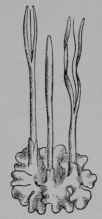
Fig. 343.-Horned-liverwort (Anthoceros loevis, Horned-liverwort Family, Anthocerotaceoe). Plant (2/1) with three "fruits" (sporophytes). (Luerssen.)-Rather common in moist soil.
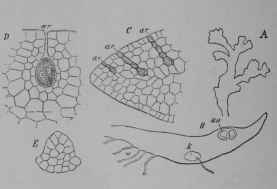
Fig. 344.-Horned-liverwort. A, branched thallus. B, thallus (27/1) cut vertically to show the antheridia (an), the pseudo-roots (w), and a colony of Nostoc (k) which sometimes lives in the interior of this plant. C, vertical section through tip of thallus (350/1) showing beginnings of archegonia (ar). D, section through older part of thallus (350/1), showing a fertilized archegonium in which the egg-cell has begun to divide. E, embryo of sporophyte showing shoot-part above and foot below. (Hofmeister.)
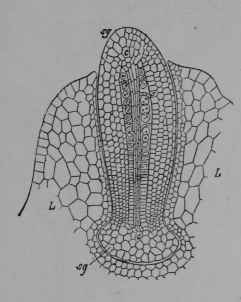
Fig. 345.-Horned-liverwort. Young sporophyte (sg, sg) showing the beginnings of a columella (c, c) and spores (s). L, L, calyptra, 100/1. (Hofmeister.)
Hepaticae are plants producing archegonia upon a mostly prostrate and thalline gametophyte which may be variously lobed or branched and often resembles a flattened leafy moss, but which generally has well-contrasted upper and lower surfaces; and there is a sporangium generally dehiscing longitudinally and discharging its spores by means of intermingled thread-like elaters. There are about 3,000 species.
Continue to:


My Books

