


Part 190. The True Mosses - Plant Life-Histories
Description
This section is from the book "Plants And Their Uses - An Introduction To Botany", by Frederick Leroy Sargent. Also available from Amazon: Plants And Their Uses; An Introduction To Botany
Part 190. The True Mosses - Plant Life-Histories
Part 190. The true mosses (Class Musci). The name "moss" is popularly given to any small, matted plant of soft texture whether it be a seaweed, a lichen, a liverwort, or one of the higher plants. In strictest botanical use it belongs only to about 5,000 species of small green plants which have pseudo-leaves usually arranged spirally on a pseudo-stem, and produce spores in urn-like cases opening mostly by a lid.
True mosses resemble liverworts except in having a mostly erect gametophyte with pseudo-leaves spirally disposed about a pseudo-stem which supports a sporangium dehiscing by a lid and lacking elaters. These peculiarities are shown in the peat moss (Sphagnum, Figs. 227, 346-349) and the cord moss (Funaria, Figs. 350-356).
The spores of Sphagnum (Fig. 346) germinate in water by sending out a branched thread which resembles a filamentous alga. Sooner or later this thread gives rise at several points to apical cells each of which by its frequent oblique divisions produces a pseudo-stem with pseudo-leaves. If, however, the spore falls upon moist earth, its germination is more like such a liverwort as Anthoceros or Marchantia, for the initial thread soon develops into a flat-lobed thallus, producing slender pseudo-roots below, and vertical moss-branches above (Fig. 347). In either case these vertical pseudo-leafy shoots are homologous with the ascending branches of Marchanda; but as seen in Fig. 348 they are much more elaborately constructed. At the surface of the stem are developed usually several layers of large cells with very thin walls which are kept from collapsing by ridge-like thickenings, and communicate with one another and with the exterior by pores (D) of considerable size. These cells soon lose their protoplasm and then form a sponge-like or wick-like envelope which draws water from below by capillarity, and stores it ready for use. The pseudo-stem is strengthened by a uniform thickening of the walls of an inner cylinder of cells. The pseudo-leaves are made up chiefly of large, thin-walled cells (B) like the outer cells of the pseudo-stem, similarly reinforced by ridges and similarly perforated. They supply water to a net-work of small cells containing numerous chromatophores in which the work of photosynthesis is carried on. Vegetative reproduction so far as known takes place only through the separation of branches by decay of the older part. Male gametangia (F) are borne on the side of special branches which may be recognized as having their leaves more crowded and often reddish (A and E). The numerous male gametes (K) are more elongated and more spiral than those of Marchantia, but are otherwise similar. Archegonia are produced at the tip of short branches surrounded by comparatively large leaves (Fig. 349, A). After the female gamete has been fertilized, the axis of the branch elongates into a stalk bearing at its tip the enlarging sporophyte enveloped in the calyptra (B, C). The sporophyte is differentiated into a short, thick foot (sg') and a capsule in which there is a central mass of large air-filled cells surmounted by a hollow dome-like mass of spores, and the whole inclosed in a firm wall of small, hardened cells. A horizontal ring of these becomes finally so brittle as to render the top of the capsule separable like a lid (C, d). As the capsule enlarges, the calyptra (c) is ruptured, and as the spore-case dries its form changes perceptibly from spherical to subcylindrical but without elongation. The result is that the inner air-filled cells below the spore-mass are so much compressed, that a degree of tension is soon reached sufficient to blow off the lid with a perceptible report and scatter the spores to a distance of several inches. Elaters are thus unnecessary.
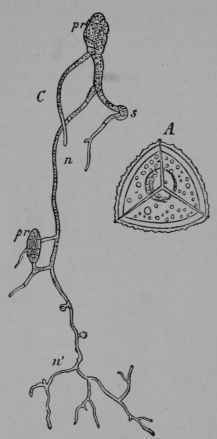
Fig. 346.-Peat moss (Sphagnum acutifolium, Peat moss Family, Sphagna-ceoe). A, spore, highly magnified. C, spore (s) germinating in water producing a green branched thread or protonema (n, n') from which buds (pr, pr) arise and produce gametophytes. (Schimper.)-Plant common in bogs.
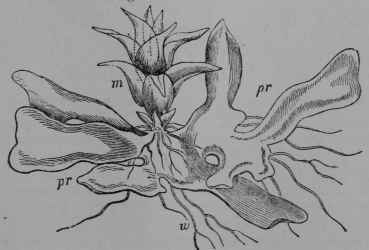
Fig. 347. - Peat moss. Flat protonema (pr, pr) produced on moist earth, giving rise to a gametophyte (m) and pseudo-roots (w) 120/1. (Schimper.)
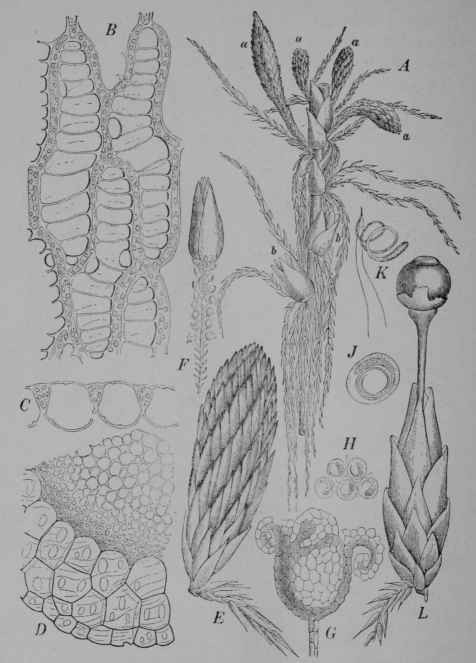
Fig. 348.-Peat mosses. A, part of a gametophyte, enlarged, showing male branches (a, a, a, a) and female branches (b, b). B, part of a leaf (S. cymbifolium), 300/1, showing the net-work of green cells surrounding the large ones which fill with water or air. C, vertical section through a small piece of leaf (S. cuspidatum) showing the small and the large perforated cells, 260/1. D, cross-section through outer part of stem (S. cymbifolium) highly magnified. E, male branch of S. acutifolium, with a vegetative branch at the base, 37/1. F, same, with many pseudo-leaves removed to show the male gametangia (antheridia), 30/1. G, an opened and empty antheridium, H, five cells containing young spermatozoids, 450/1. J, such a cell nearly ripe, 900/1. K, spermatozoid, 900/1. L, ripe "fruit" (sporophyte) with remains of the archegonium at its base borne on a stalk continuing the axis of the pseudo-stem which bears pseudo-leaves at its base; magnified. (Schimper.)
Continue to:


My Books

