


Part 196. Cryptograms And Phenogams - Plant Life-Histories
Description
This section is from the book "Plants And Their Uses - An Introduction To Botany", by Frederick Leroy Sargent. Also available from Amazon: Plants And Their Uses; An Introduction To Botany
Part 196. Cryptograms And Phenogams - Plant Life-Histories
Part 196. Cryptogams and phenogams. The highest development of plant life is associated with the production of seeds, which afford the best possible provision for the welfare of offspring.
There is abundant evidence to show that the earliest seed-plants differed but little from certain fernworts that had developed macrosporangia containing single macrospores. The first step toward converting such a macrosporangium into a seed might easily be taken if the macrospores remained attached to the plant until the archegonia were exposed, while the microspores, set free, were carried by wind to the attached gametophyte there to germinate and effect fertilization. The final step would come, when, after fertilization of an egg-cell thus doubly protected by nurse-plant and spore-sac, the nurse-plant itself should be further protected by continued growth of the surrounding parts and should be fed by the parent while it was in turn feeding the embryo. An embryo thus fed through a connection maintained with the parent plant, and protected by a sporangium wall which finally becomes detached from the parent for dispersal, is a seed; the macrosporangium with its inclosed macrospore and female gametophyte is an ovule; the micro-sporangia are anthers; and the microspores, pollen grains. When such highly differentiated spore-sacs are borne upon leaves we have sac-leaves which we call either carpels or stamens.
Pines and other gymnospermous plants (Figs. 258, 259, 260, 263) as we have seen, bear ament-like clusters of stamens or carpels each cluster forming what we may regard as a separate flower. A Selaginella which had certain cones producing microspores exclusively would thus be homologous with a staminate flower of Pinus, while an exclusively macrosporic cone would correspond to a pistillate flower. The morphology of the stamens and their parts in
Pinus and related genera will doubtless be sufficiently clear without further explanation, but the carpels and ovules call for more detailed examination. Each carpel, as we have seen, bears two ovules on its upper side near the base (Fig. 258, 8). When cut in half vertically such an ovule exhibits the parts shown in Fig. 378. A single macrospore organically connected with the surrounding tissue constitutes what is termed the embryo-sac (e). The rest of the ovule represents the macrosporangium, which is divided into a central part, the nucellus 1 (nc) in which the embryo-sac is embedded, and an outer layer, called the integument (i), which covers the nucellus except at the micropyle. Microspores, i. e., pollen grains, intrusted to the wind, are carried to the pistillate flowers. Caught by a spreading carpel, they come finally to the micropyle where the integument is often prolonged in such a way as to lead them directly to the tip of the nucellus. Here they germinate by forming a few cells, some of which, remaining within the spore, represent the vegetative part of the male gametophyte; while others, the male gametes, form a hypha-like tube which penetrates the soft tissue of the nucellus and feeds upon it like a fungus. Meanwhile the macrospore (or embryo-sac) has been developing some very simple archegonia (a), consisting only of a large egg-cell (o), and one or more very small cells (c) representing the neck. See also Fig. 379, A. Presently the tip of a pollen-tube bearing the male nucleus reaches the egg-cell and discharges its nucleus into the female protoplast (Fig. 379 B). The male and the female nucleus fuse into one (C) and move to the opposite end of the egg-cell, there to form a group of small cells from which one or more embryos arise, but only one develops, in each seed. As in Selaginella, certain cells form a suspensor which pushes the developing embryo into the storage tissue of the gametophyte. But in the pine and spruce this vegetative part of the nurse-plant, because of its long connection with the parent, is able to draw into itself a continued supply of nutritive material. Part of this nourishes the embryo till it develops root, stem, and leaves, while a surplus is stored around it as seed-food for the use of the plantlet when it has left the parent, and is ready to germinate (Figs. 379, 380). Not only is abundant food thus supplied to and for the embryo, but the sporangium wall (nucellus and integument) and the sac-leaf (cone-scale or carpel) are so well nourished after fertilization has taken place, that they grow enormously and become much hardened as organs of protection. The ripened ovule thus becomes a seed, and finally, as already described, separates from the parent and is aided in its aerial voyage to a home for life, by a wing derived from the carpel. The young sporophyte has simply to grow after the manner of its kind to become a tree and produce gametophytes which shall cooperate in the formation of highly favored offspring.
1 Nu-cel'lus - L. nucella, a little nut.
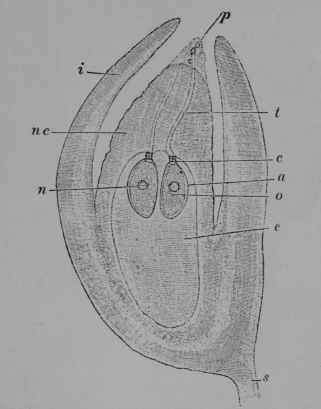
Fig. 378.-Norway Spruce. Ovule cut vertically and enlarged to show the embryo-sac (e) filled by the prothallus or endosperm and two archegonia (a), each with its neck (c) and swollen part (o) which contains an egg-cell with a nucleus (n); the nucellus (nc) surrounded by the integuments (i); pollen-grains (p) from which come pollen-tubes (t) extending to the archegonia; and a part of the seed-wing (s). (Strasburger.)
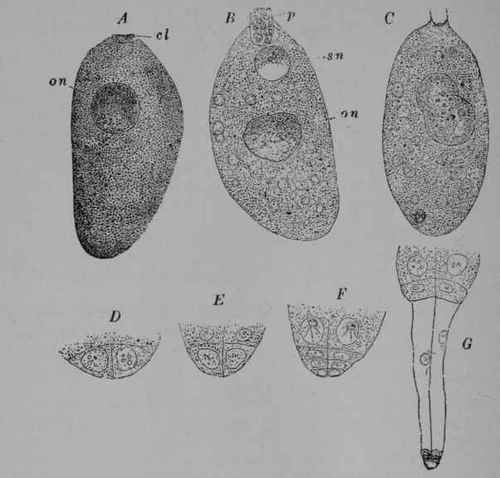
Fig. 379.-Norway Spruce. Fertilization of egg-cell. A, ripe egg-cell with nucleus (on) and lower neck-cell (cl), 72/1. B, same, later, the tip of a pollen-tube (p) having entered the egg-cell and discharged into it the male nucleus (sn) which approaches the female nucleus (on). C, same, later, the two nuclei having become fused into one, which soon divides into four nuclei that move to the lower end of the egg-cell. D, lower end of the egg-cell showing two of the four nuclei which have moved into it. E, same after division of the four nuclei into eight. F, same after further division has produced four tiers of nuclei, all but the uppermost four being enclosed in cell-walls. G, same, after the middle tier of cells has elongated to form a suspensor which has pushed the lower tiers of cell into the prothallus (or endosperm) where they give rise, by repeated cell-division, to an embryo which is fed by the endosperm. The nutritious materials left over in the endosperm when the ovule has become a seed constitutes the seed-food which supports the young plantlet during germination. (Strasburger.)
Continue to:


My Books

