


Of The Mechanical Division Of Bodies. Oxidizement Of Metals
Description
This section is from the book "The London Dispensatory", by Anthony Todd Thomson. Also available from Amazon: PDR: Physicians Desk Reference.
Of The Mechanical Division Of Bodies. Oxidizement Of Metals
This term signifies that process by which metals are converted into oxides, by absorbing oxygen from the air, when exposed to a certain degree of heat. The disengagement of the caloric and the light which oxygen gas contains, by the solidification of the oxygen in the oxide, is scarcely perceptible when the operation is conducted in atmospheric air: but if the oxidizement takes place in oxygen gas, it is rapidly effected, and caloric and light are very evidently extricated. This mode, however, of oxidizing metals is employed in small experiments only; but in all the processes of the laboratory for procuring oxides by the aid of heat, common air yields the oxygen. The metal, if it be not volatile at the temperature required for its oxidizement, is exposed to the heat of the furnace in a flat dish of baked clay, called a roasting test, and frequently stirred to present fresh surfaces to the air : but if the matter be easily volatilized, as is the case with zinc, it is thrown by pieces, at separate intervals, into a deep crucible, so placed as to admit the air and allow of the additions being made. If mercury be the metal operated on, it is generally put into a flat-bottomed matrass with a very tall narrow neck, the mouth of which is left open.
This matrass is placed in a sand bath, and kept at a degree of heat nearly equal to the boiling point of the mercury, for many days: but it is perhaps better to use a retort with the bottom flattened, and the neck only slightly bent, that the globules of mercurial vapour may be condensed, and the metal fall back into the vessel.1 In this process the atmospheric air furnishes the oxygen, which readily combines with the volatilized mercury, while theform of the apparatus is intended to permit a renewal of it constantly to take place, without allowing the escape of the mercurial vapour.
Deoxidizement of metals, or their reduction, is that process in which the oxygen of a metallic oxide is separated, and the metal recovers its metallic form and properties. It is seldom performed on a large scale in pharmacy: but in cases of metallic oxides having been taken into the stomach, and proving fatal, it is of importance, in ascertaining their nature, to be able to reduce them to the metallic state by means of the blowpipe and lamp; an apparatus by which minute substances may be almost instantaneously heated to a great degree, and their nature discovered with much accuracy.
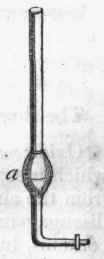
The most common blow-pipe is a tube of brass or iron, bent near one of its extremities, and drawn out sufficiently fine to keep up a constant stream of air when it is blown into by the mouth applied to the opposite end. This form of blow-pipe is liable to one inconvenience, from the condensation of the moisture of the breath, in the course of blowing; to remedy which, a hollow ball or bulb, a, is made near the small end of the pipe; and, to render it more portable, this is divided through the middle, and fitted with a screw, so as to be put together when used. Small separate jet-pipes, or caps, are frequently adapted to slip on the small extremity of the blow-pipe, by which means any size of bore may be had recourse to, as a larger and more moderate, or a smaller and more intense flame is required. The flame for blowing through is best obtained from a wax or tallow candle with a very large wick, which must be kept moderately short by snuffing it frequently, and it must also be turned a little aside from the pipe.
1 Higgin's Minutes. Aikin's Dictionary, ii. 75.
In using this apparatus with advantage and ease, a little practice is necessary. As the flame is often required to be. kept up for several minutes, the respiration must be carried on through the nostrils without interruption, and the stress of blowing performed merely by the compression of the cheeks upon the air held in the mouth. In subjecting any substance to experiment, it is to be placed either on a piece of charcoal or in a platina spoon. When charcoal is employed, a large, compact, well-burnt piece should be chosen, and a small shallow hole scooped in it for receiving the substance to be heated. The flame of the candle or lamp is then to be directed upon this by means of the blow-pipe. The charcoal soon kindles round the hole, which is gradually enlarged; and the heat being thereby augmented and kept up uniformly round the substance, the charcoal aids, by its chymical effect, the re-, duction of the substance, or its deoxidizement. Carbonate of lead, thus treated, is converted into a globule of metallic lead; and the phosphates are partially reduced to phosphurets.
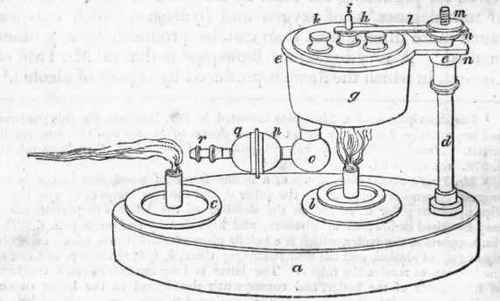
In many operations, much inconvenience arises in using the common blow-pipe, from both the hands of the operator being engaged; and therefore a double pair of bellows, which is fixed below the table, and worked by the foot of the artist, has been invented for giving the blast. Means have also been contrived for producing the blast by a stream of oxygen gas, or of mixed gases, as of oxygen and hydrogen, which excite a much more intense heat than can be produced by any other method.1 A very ingenious blow-pipe is that of Mr. Paul of Geneva, in which the flame is produced by vapour of alcohol.2
1 For descriptions of a blow-pipe invented by Mr. Newman for this purpose, and improved by Dr. Clarke and others, see Journ. of Science and the Arts, vol. ii. p. 104. Annals of Philosophy, vol. viii. passim. London Med. Repository, vol. vi. p. 376. vol. vii. p. 21.
2 Mr. Paul's alcohol blow-pipe, a, a hollow frame of wood, five inches in its longest dimensions, supporting the pillar d, and the two lamps b, c; the rim e, slips upon the pillar d, as low as the shoulder of the latter will permit, but it may be raised or lowered at pleasure, and kept fast by the screw-peg, /. The rim supports g, the boiler, which is a hollow piece of thick brass, which will hold about f ij. of alcohol, and has four openings; three, h, i, k, at the top, and one at the bottom, to receive the tube o. The latter is long enough to reach the level of the outside of the boiler, and consequently the alcohol in the boiler cannot readily boil over into the tube; and the opening, k, which corresponds with it, is coatings, cements, and lutes.
In many chymical operations, although the nature of the substances require that glass vessels be used, yet, from the degree of heat to which they are exposed, these must be protected on the outside by a coating; and in all operations where the products are in any degree volatile, it is of importance that the joinings of the parts of the apparatus should be perfectly secured; thence the necessity of coatings and lutes. Cements are requisite for repairing flaws and cracks.
Coatings are applied to the insides of furnaces, to prevent the too quick dissipation of the heat, and also to protect the iron and materials of which the furnace is made from being destroyed by the action of the fire. The coating used by Dr. Black has been already described; but another nearly as good may be formed by coarsely grinding fragments of pottery, and mixing the powder with moist clay in sufficient quantity to allow it to be moulded when wet. To render it more tenacious, some fibrous matter is generally added to the mixture, such as chopped cow-dung; the proportion of which, as recommended by Baume, should be one ounce to every five closely shut by a screw-stopper, hollowed out a little beneath, to allow the free passage of the vapour down the tube. By the contiguity of o to the lamp b, the vapour is prevented from condensing, and as it passes on through the globe p, q, into the jet tube r, it is directly kindled by the flame of the lamp c; and the united flames being violently propelled sideways, a long pencil of blue flame is' formed, and remains as long as any alcohol is left in the boiler.
The boiler is filled at the opening A. The central hole, i, is nicely fitted with a brass plug, kept down by a thin slip of iron, l, which is confined at one end between two flat screws, m, n, on the top of the upright pillar. This acts as a safety-valve, to prevent the vessel from bursting when the vapour cannot escape quick enough at the jet-pipe r.
ounces of the mixture. This is to be applied in the manner already described.
Continue to:


My Books

