


(16) Efficiency In Traversing A Right-Angle Maze
Description
This section is from the book "Human Vitality And Efficiency Under Prolonged Restricted Diet", by Francis G.BENEDICT, Walter R. Miles, Paul Roth, And H. Monmouth Smith. Also available from Amazon: Human Vitality and Efficiency Under Prolonged Restricted Diet.
(16) Efficiency In Traversing A Right-Angle Maze
In connection with another research, a complete description of which is not likely to be published, it was desired to provide a motor test in which the subject, while looking at something which corresponded to a map, would be required to cany out a series of movements in accordance with definite rules. For this purpose two identical right-angle mazes were constructed. From two aluminum sheets, 3 mm. in thickness, paths were cut 6 mm. wide and arranged as the black design in figure 54. The exact form of the pattern did not seem of prime importance; the one selected was a form which had been used by Boring in a learning experiment.1 The two longest paths in the pattern shown at the extreme left and bottom were each 16 cm. long. A particular effort was made to have the sides of the paths smooth and even. When completed, the two mazes, A and B, were mounted, one directly-above the other (see fig. 55). The lower maze, B, was completely inclosed, except for an opening in the front, which was so placed as to be convenient to the hand of the subject. As the subject looks down on the upper surface of the box the lower maze, and the hand when in position, were completely hidden from view. The vertical clearance space inside the box above the lower maze was 11 cm. This was ample space for the hand of the subject. A short blunt pencil P was fitted with a wide, stiff rubber shield S, 7 cm. in diameter, and this made it impossible, when the pencil was properly held, for the subject to place the tip of his finger at the tip of the pencil, which might otherwise be done for purpose of orientation. This pencil was taken in the right hand and placed in the center of the lower maze. The forefinger of the subject's other hand was placed in the center of the upper maze, A, the one which was visible to him. It was then explained that the two sets of paths were of identical pattern, but that the one below had been rotated 180°, so that every motion indicated in the set of paths above must be exactly reversed for the set below. The problem was to escape from the maze below as quickly as possible, being guided by watching and tracing the maze above. The subject was warned to let the movement above accompany or be in advance of the movement below and to keep the rule of reversal constantly in mind. The subject worked as fast as he desired, but if he got lost, instead of wandering on blindly (the typical method in solving the usual maze problem) he was instructed to ask for a new start from the center. The total time was taken from the first start to the successful finish. A paper beneath the lower maze was marked by the pencil and showed the subject's progress. This record was used solely for control to prove that the proper path was followed. The test has the added advantage that it can not be conveniently practiced outside the Laboratory, as can mirror drawing or writing. Thus we have here something different from a typical maze experiment, but for convenience of description it may be so classified. Naturally the test could be partially learned in successive trials. At each laboratory session the subject traced completely through one time. He was not allowed outside practice.
1 Previous to the reduced-diet research, finger-movements of the same nature were taken at the Nutrition Laboratory in other connections. These were recorded photographically, the arm and hand supportad by the adjustable rest shown at the left of the subject in fig. 22, p. 152. The fingers were connected to two light systems of levers, which may be seen in front of the camera. Electrocardiogram pulse records were taken at the same time and incorporated in the same records. Sample records of this character may be seen in other publications (Miles, Carnegie Inst Wash. Pub. No. 268, 1918. p. 96, fig. 11; Dodge and Benedict, Carnegie Inst. Wash. Pub. No. 232. 1915. p. 171. fig. 28).
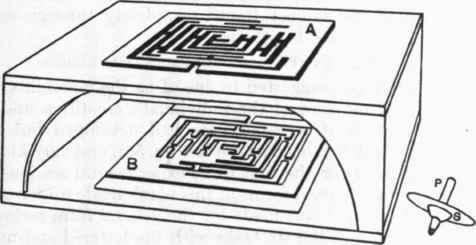
Fig. 55. - The maze-tracing apparatus.
A and B are two mazes of identical size and pattern. A is rotated 180° on B and mounted above B in position for the subject to take the test of tracing B while looking at A. The subject has full knowledge that he must move the pencil opposite to the directions indicated on A. S, a wide rubber shield on the pencil, P, makes it impossible to place the finger at the pencil's point.
1 Boring, U. S. Government Hospital for the Insane, 1913, Bulletin No. 5, p. 51.
Continue to:


My Books

