


2. Purin-containing Foods - The Dietetics Of Gout And Nephrolithiasis Urica
Description
This section is from the book "Part 9. Technique Of Reduction Cures And Gout - On the Pathology and Therapy of Disorders of Metabolism and Nutrition", by Prof. Dr. Carl von Noorden. Also available from Amazon: Clinical Treatises On the Pathology and Therapy of Disorders of Metabolism and Nutrition, Part 9
2. Purin-containing Foods - The Dietetics Of Gout And Nephrolithiasis Urica
Aside from the exceptions enumerated above, animal tissues alone need be considered as purin containing substances that lead to the production of exogenous uric acid. In the tissues the purin bodies are either present as such (hypoxanthin of the muscles) or they are split off from nuclein in process of digestion and absorption (see above). Tissues containing the largest number of cells are generally richest in nucleins, hence the glandular organs in which the cells are crowded closely together like thymus, pancreas, liver, spleen occupy first place. It is, hence, altogether rational both in gout and in nephrolithiasis to forbid altogether the use of internal organs. There is one exception to this rule, namely, the liver of fattened fowl (fat liver of geese) because there is relatively much protoplasm, full of fat, and comparatively little nuclear substance. The pieces of liver in Strassburg paté de foi gras of the first quality contain less purins than any kind of meat with the exception of fish meat. Among the varieties of meat proper (muscle meat) the flesh of young animals contains considerably more nuclein than that of older animals. This is due to the fact that the former contains more nuclei relatively per unit of protoplasm. This factor, however, is somewhat neutralized by the fact that the flesh of older muscular animals incorporates more hypoxanthin. The meat of fish, as a rule, contains less nuclei than that of mammals and birds, and also contains less hypoxanthin. However, fish is not very filling, hence a much larger quantity is usually eaten than of other varieties of meat; consequently if an unlimited amount of fish is allowed, probably as much of purin bodies is ingested as in the case of any other meat.
There has been much discussion in regard to differences said to exist between white and dark meats. For about 50 years the view has been gaining adherents, both among physicians and the laity, that there are such fundamental differences between these two varieties of meat that subjects afflicted with gout, nephrolithiasis, nephritis, etc., may eat white meat without reservation, but should carefully avoid dark meats. I have been opposing this idea for a long time, in fact, ever since my pupils, Th. Offer and Rosenquist, demonstrated that the purin content of light and of dark fresh meat is essentially the same. The flesh of different individuals of the same species; the flesh of young and old animals of the same species; even pieces of meat taken from different parts of the body of the same animal showed greater differences in the percentage of nuclein and purin than were found on an average between chicken on the one hand and beef on the other. These facts, it is true, have been denied by certain authors, for instance, Senator; but, nevertheless, they are true and irrefragable. The careful analyses of J. Walker Hall also corroborate our old findings. Recently Th. Offer has resumed these investigations with more careful methods that are altogether above criticism. This thesis has not yet been published, but Offer has permitted me to see his protocols, and they fully corroborate what I have said above. There are also a few experiments on record that I made with some of my pupils, and others performed by J. Walker Hall, in which meat of different species incorporating the same total amount of nitrogen was fed with the result that the uric acid production was the same whether white or dark meat was administered. All this is fully strengthened by clinical observations that I have now been carrying on for 10 years. I have learned to omit from my regulations any orders relative to distinctions between white and dark, and limit myself to regulating the total amount of meat allowed ; and I must declare myself altogether satisfied with the results obtained. One should not underestimate the importance of this step from the practical standpoint; for it is very convenient in treating these cases, not to have to separate the two kinds of meat, particularly veal and chicken on the one side, mutton and beef on the other; for many patients tire excessively of white meat if it is given daily, so that they not only eat less meat than they should, but also suffer from lack of appetite with resulting serious detriment to the general nutrition. It is high time that the old prejudice against dark meat should be abandoned and the true facts of the case be recognized.
Of course, the method of preparation is of the greatest influence upon the purin content of meat dishes. When meat is roasted, and especially when it is grilled, a hard crust immediately forms on the outside that effectually prevents an outflow of the meat juices; consequently all the nuclein and hypo xanthin of the meat is retained throughout its mass with the exception of the outermost layers. When meat is boiled or stewed, on the other hand, a large proportion, and possibly the whole quantity of the soluble xanthin bases are extracted. The latter substances are then found in the soup (meat broth) and in the gravy. When it is prepared as soup, meat loses so much of its purins, by the long process of boiling, that it compares favorably, as far as its purin content is concerned, with fish, that, as stated above, contains the smallest amount of purins of any flesh. Meat broths, gravies, and meat extracts, on the other hand, are forbidden. In pickling (ham, etc.) and in making corned beef the greater part of the soluble purin bases is extracted, whereas the nuclein, of course, remains behind.
The following is a table reproduced from J. Walker Hall. It relates to the amount of purin nitrogen (nuclein purin bases purin) contained in raw meat.
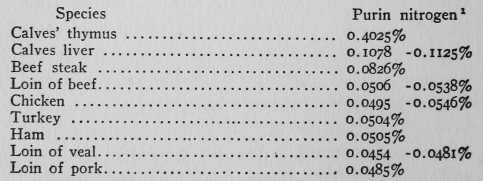
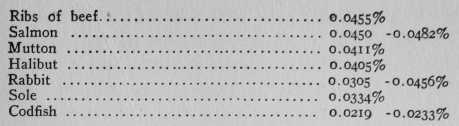
On the lower boundary, therefore, will be found certain varieties of fish, at the upper boundary (if we exclude calves' thymus and calves' liver that are absolutely forbidden) completely fat-free beef that is utilized for beef steak. Otherwise we find that white and dark meats are jumbled together. In particular, chicken under certain circumstances shows even higher values than ordinary beef used for roasting. Ribs of beef, that are very popular in the kitchen, occupy the same plane as the white meat of veal or pork. From the practical standpoint all the varieties of meat that stand between beef and salmon in the table may be considered equivalent as far as their purin content is concerned.
These data by no means exhaust the number of good analyses that we possess. The newer analyses, by Offer, that exceed all others that have been published in exactness, disclose facts that might militate in many ways against white meat (especially chicken). It would be very important to possessick more numerous determinations of the purin content of different varieties of meat, for upon such determinations should be based the dietetic prescriptions that we should give patients suffering from gout or from nephrolithiasis.
The basic diet must always remain the purin-free foods. As an accessory diet to this a certain amount of purin containing material may be added according to the peculiarities of each individual case. The amount of this purin containing material may approach the zero point (see Vol. VIII), or it may, on the other hand, amount to considerable quantities. All this is settled by determinations of the boundary of tolerance. The following articles of food must be considered about equivalent as far as their effect upon the increase of uric acid excretion is concerned.
200 g white fish,
100 g ordinary beef, veal, pork, mutton, chicken, turkey, pheasant, venison, ham, salmon, salmon trout,
70 g of beef steak, freed from all fat and connective tissues.
Continue to:


My Books

