


2. Sources of Uric Acid
Description
This section is from the book "Part 9. Technique Of Reduction Cures And Gout - On the Pathology and Therapy of Disorders of Metabolism and Nutrition", by Prof. Dr. Carl von Noorden. Also available from Amazon: Clinical Treatises On the Pathology and Therapy of Disorders of Metabolism and Nutrition, Part 9
2. Sources of Uric Acid
Only those substances that contain the purin nucleus discovered by E. Fischer can be considered sources of uric acid. From this purin nucleus are derived in addition to uric acid the bases adenin, hypoxanthin, guanin, and xanthin. The purin nucleus is a derivative of nucleinic acid that, in combination with proteid radicles, forms nucleoproteids. As purin-containing nucleoproteids occur almost exclusively in the nuclei of animal cells, this nuclear substance must be considered the most important source of the purin bodies of the urine. In addition, a certain amount of hypoxanthin found in muscles and no doubt derived from the nuclein of the muscle nuclei must be considered. It has never been definitely established whether or not uric acid is formed synthetically in the mammalian organism from other bodies than nucleinic acid.
We must distinguish:
1. Uric acid formed within the body itself and without the introduction of uric acid forming pabulum: endogenous uric acid.
2. Uric acid derived from the nucleinic acid and the purin bases of the food: exogenous uric acid.
a. - Endogenous Uric Acid
Even when uric acid forming pabulum is completely excluded from the diet the organism continues to excrete uric acid (and purin bases) because a continuous disintegration of cell nuclei occurs and because some of the hypoxanthin of the muscles is continuously eliminated and must be replaced from the nuclei of the muscle cells. During inanition this wasted amount is presumably not replaced, hence when the food supply is cut off the organism is exceedingly sparing with its store of nuclein (see first lecture, Vol. VIII). If nuclein-free pabulum, however, is ingested the organism promptly replaces the wasted purin material. For the present we do not know at all from which elements this synthesis occurs. So much is known that the body is capable of reconstructing the purin nucleus from material that does not contain the latter. The infantile organism possesses this power to a very great extent, for the nuclein substance of the infantile body increases rapidly even though milk contains only traces of purin material.
I also consider it probable that the adult organism constructs its nuclein exclusively from purin-free material and that this is due to the power inherent in the nuclear substance to construct the purin nucleus. I consider it, furthermore, exceedingly doubtful whether any of the purin bases of meat or any of the nucleoproteids ingested contribute in any way to the building up of the body nucleins.
The endogenous uric acid excretion is determined by administering a purin-free diet, for instance, milk, eggs, numerous fruits, and vegetables (see below).
Under these circumstances we find from 0.36 to 0.5 g. of uric acid in the daily urine. It is true that several days have to elapse before such low values are obtained and before the latter remain on a constant level.
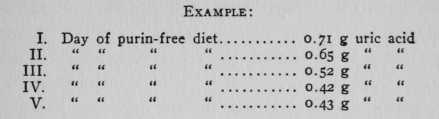
This endogenous value (in this instance 0.42 to 0.43 g.) can hardly be influenced, at least in a healthy subject. It must be considered a biologic constant of the individual. At the same time a few factors are known that can exercise at least a transitory effect upon the height of this excretion, some of them increasing, some of them decreasing, it:
Salicyic acid and its derivatives, mineral acids, thymic acid, possibly also saline mineral waters increase the values for endogenous uric acid a little, while alcohol decreases them. In the first instance we are probably dealing with better elimination, in the second instance with a certain amount of retention of uric acid. It is very improbable that any of these substances exercise any influence upon the formation of uric acid; it is possible, however, that alcohol occupies a peculiar position in this respect (see below). At the expiration of a few days the original values for the endogenous uric acid excretion seem to become re established, even though some of the above substances are being administered.
Under pathologic conditions the values for endogenous uric acid can increase considerably. This is the case when abundant nuclear substance undergoes degeneration. One finds, for instance, very frequently:
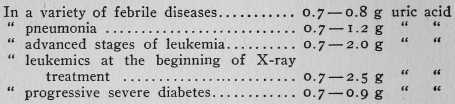
It is worthy of mention in this place that there are certain individuals who, although perfectly healthy, excrete large quantities of endogenous uric acid. In the case of a perfectly healthy man of 45 years, who was repeatedly examined in this respect in the course of the last 10 years, we never found values for the endogenous uric acid below 0.7 to 0.8 g. A very obese lady of about 35, who lived for 2 weeks exclusively on 2 liters of milk and 500 g. of apples per diem (reduction cure) excreted in the beginning of the treatment from 1.1 to 1.4 g. of uric acid. At the end of the 2 weeks' milk-apple period it was found that the uric acid excretion had only fallen to 0.85 to 0.9 g. This patient was afflicted with no disorder other than obesity. This observation was recorded in the year 1904 and the patient has remained perfectly well in the meantime. I will have occasion to mention below that in cases of nephrolithiasis very high endogenous uric acid values are occasionally observed.
In genuine gout the value for endogenous uric acid is, as a rule, reduced (0.28 to 0.4 g.), excepting in the acute stages (see below).
b. - Exogenous Uric Acid
As soon as purin-containing food is introduced into the body the excretion of uric acid increases. The bases contained in the diet (above all, quantitatively predominating, the hypoxanthin of meat) are presumably absorbed without undergoing any preliminary change. A portion is destroyed and transformed into urea; another portion is excreted unchanged or in the form of uric acid. It remains undetermined whether the bases that we ingest become an integral part of the organism (hypoxanthin of muscles or components of nuclein, see above). Nuclein is split in the intestinal canal into its component parts, namely, proteid and nucleinic acid. A portion of the nucleinic acid is sacrificed to the activity of intestinal bacteria. The bodies of the intestinal bacteria, together with disintegration products of desquamating intestinal epithelia furnish the purin bodies that are recovered in the feces. Another portion of the nucleinic acid is absorbed and presumably disassimilated to a great extent in the intestinal wall. Participating in the latter activity is a particular ferment, nuclease, that produces this splitting off of purin bases from nucleinic acid in the intestinal walls or in any other part of the body where this process occurs.
Inasmuch as a portion of the purin bodies of the diet escapes absorption altogether, whereas another portion is disassimilated to a point where urea is the end product, it is clear that the whole of the introduced material does not appear in the urine as uric acid (or purin bases). On an average 50% disappears, whereas the other half is recovered in the urine.
The values for the exogenous uric acid excretion, therefore, in contradistinction to the endogenous values and very fluctuating. They are generally dependent upon the quantity and the quality of the meat consumed. Beef on an average contains so much nuclein-and hypoxanthin-material that 0.18 g. of uric acid can be generated therefrom. Of this only one half appears in the urine. With a daily consumption of 100, 300, 500 g. of beef, the following uric acid excretion may be expected in an individual whose endogenous uric acid value amounts to 0.5 g. :

All these considerations lead to a fundamental axiom, viz.: that from urinalysis alone one can never conclude whether or not the uric acid excretion of a patient is normal, decreased, or increased. The amount of purin containing material that is ingested must always be compared with the output of uric acid. It is important to know rather the balance between these two factors than the absolute figures for the uric acid excretion.
Continue to:


My Books

