


Second Period of The Renaissance. Part 3
Description
This section is from the book "Dutch And Flemish Furniture", by Esther Singleton. Also available from Amazon: Dutch and Flemish Furniture.
Second Period of The Renaissance. Part 3
In his own country, he was called the king of architects. He may be called the Dutch Du Cerceau. He was contemporary with Du Cerceau; and was apparently greatly influenced by the work of the latter, or it may be that they both got their inspiration from the same Italian source. A comparison of the work of the two masters will show individuality in De Vries. His designs are not so light and graceful as the Frenchman's. Besides all kinds of architecture, gardens, wells, fountains, vases, armour and decorative work for goldsmiths, he designed Differents Pourtraicts de Menuiserie a scavoir, Portaux, Bancs, Tables, Escabelles, Buffets, Frises, Corniches, Licts de camp, Ornements d prendre a I'essuoir les mains, Fontaines a laver les mains. This collection of designs appeared about 1580, and forms a most valuable record for those who desire to study the style of the early Renaissance in the Netherlands. It is noticeable that the change is not so much in the general form of the furniture as in the ornamentation.
As an example, let us take the bedroom (Plate X).
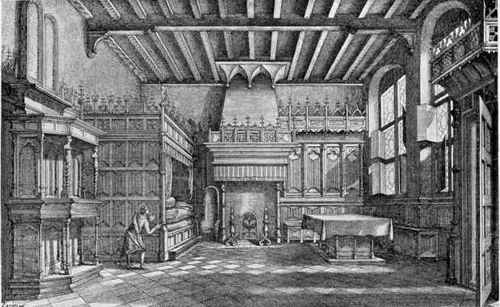
Plate X. - Bedroom, by De Vries - "Cubiculum.".
This was published in 1580; but it evidently belongs to the transitional period, since the furniture reveals almost as many Gothic as Renaissance features.
It will be noticed that De Vries expressly styles his design a modern bedroom; so that it deserves study as the latest novelty about the middle of the sixteenth century. The first thing that strikes one is that though the ornamental details of Gothic tracery have almost disappeared, yet the linen-fold in the panelling is everywhere. Even the dressoir on the left with its Classic columns and spiralled caryatides has Gothic panels; and the presses between the fireplace and the window have Gothic panels with a Renaissance dais. The long heavy chests that serve as benches also belong to Mediaeval days. The massive table looks transitional also. It is also to be noticed that the furniture cannot yet be designated as " moveables"; it is still an integral part of the carpentry work that lines the walls of the room. The chair beside the bed is the sole note that tones down its severity. At the time the plate was published (1580), the Renaissance was in full flower, and its interest for us lies chiefly in the disposition of the furniture and the evidence it supplies of Gothic tenacity. The floor is tessellated diagonally with squares of wood or stone. The chimney-piece with its funnel-shaped top is essentially the same as represented in miniatures of the fourteenth and fifteenth centuries.
The credence or dressoir is opposite to the door, the bed, well protected by woodwork and curtains against draughts, is close to the fireplace, and the table in front of the window. A general effect of coldness is noticeable, due to the almost total lack of upholstery; but this is doubtless owing to the artist's intent to emphasize the woodwork.
Though De Vries was the most important designer of furniture in the Netherlands during the sixteenth century, he was by no means the only one to influence the taste of the day. There were many architects, goldsmiths and engravers whose designs contributed to the development of the Renaissance style. One of these was Jacques van Noye. He was employed by Cardinal Granvelle, Bishop of Arras, to embellish the palace in Besancon, built by his father, Sebastian van Noye, also a notable architect.
In 1550, Van Noye became architect of Philip II; and called to Spain by the King, died in Madrid. One of his important works was the palace that the Cardinal erected at Brussels on the Coperbeke.
Other designers in decorative art who lived during the second half of the sixteenth century were Mark Geraerts (1530-90); Hendrick van Schoel; Martin de Vos (1531-1603); G. Tielt (1580-1630); Cornelius Grapheus (1549-?); Baltazar Silvius (circ.1554); Guilhelmus de la Queweelerie {circ. 1560); Peter Mirice-nis (1520-66); Hans Bol (1535-93); Abraham de Bruyn (1538-?); Crispin de Passe, the Elder (1536-?); Peter van der Borcht (1540-1608); Peter Baltens (1540-79); Paul van Wtanvael (circ. 1570); Nicholas de Bruyn (1560-1635); Clement Perrete (circ. 1569); Assuerus van Londerseel (b. 1548); Jerome Wierix (b. 1551); John Wierix (b. 1550); John Sadeler (1550-1610); Raphael Sadeler (1555-1628); AEgidius Sadeler (1570-1629); Dominic Custode (b. 1560); Ger. Gro-ningus; Cornelis Galle (1570-1641); Philip Galle (1537-1612); Theodore Galle (b. 1560); Cornelis Dankherts (b. 1561); John Sambuci (circ. 1574); Francis Sweert (circ. 1690); Judocus Hondius (1563-1611); James Hannervogt, and some anonymous engravers.
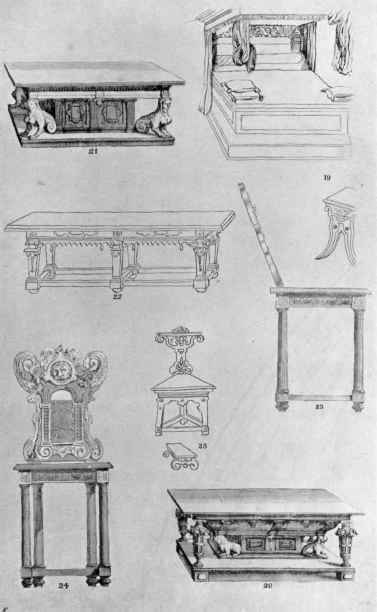
Fig. 19: Bed, by J. Straden; Figs 20-22: Tables, by De Vries; Fig. 23: Chair and Footstool, by De Vries; Figs. 24 - 25: Flemish Chairs.
Of the above, the most prolific were the Galles. They were particularly rich in frames, but their ornamentation already shows signs of the Decadence; and the work of Philip alone shows traces of the pure Renaissance. Most of these masters of ornamental design were natives of, or were attracted to, Antwerp; though some of them travelled far afield. Custode worked at Augsburg; AEgidius Sadeler died at Prague; Geraerts died in England; Cornelius Bos worked in Rome; and Crispin de Passe, the Elder, worked in Utrecht, Amsterdam, Cologne, Paris and London.
In the second period of the Renaissance, the general effect is more severe and geometrical; the projections are more restrained, and the general form of furniture more rectangular. The vertical lines are more conspicuous than the horizontal lines; and columns with elongated shafts and delicate flutings or grooves replace human figures that in the first period of the Renaissance act as uprights and supports. The bed on Plate XIV is a good example of the second period.
There is also during the second period a great, and often elegant, use of ceramics. Some pieces of furniture, particularly cabinets, are decorated with incrustations of stones, amber, enamelled work and even Venetian glass.
Gothic decoration still lingers for a time in the ordinary bedsteads (see Plate X) but those of the new fashion show all the popular ornaments of the Renaissance. Caryatides sometimes appear as columns; and sometimes and ever more frequently as time wears on, slender pillars cut in the form of balusters, lances or distaffs, often grooved, and more or less decorated with carving. Later in the century, the columns are frequently enveloped in the same material as the hangings, which become so important that the sculptor and joiner give place to the upholsterer and embroiderer. The beds are so high, or built so high with mattresses, that it is impossible to get into them without the aid of bed-steps.
Continue to:


My Books

