


Second Period of The Renaissance. Part 4
Description
This section is from the book "Dutch And Flemish Furniture", by Esther Singleton. Also available from Amazon: Dutch and Flemish Furniture.
Second Period of The Renaissance. Part 4
A glance at Plate II will inform us that the bed of the fifteenth century depends more for its effect upon the curtains and other draperies than on the framework. In the time of the Renaissance, we find the bedstead of supreme importance. It is carved in the richest fashion, and is often enriched with gilding and painting; it is also adorned with marquetry. The mattresses, bolsters and pillows are of down or feathers, the sheets and blankets of finest linen and wool, for which Flanders is famous; and the hangings are of silk, velvet, tapestry, serge, or gilded leather. The Renaissance bed is never allowed to stand in an alcove: it is far too handsome a piece of furniture for that. Its canopy, often richly carved, is rectangular and exactly the size of the bed, which is large; and it is no longer suspended by cords from the ceiling, but rests on carved or grooved columns. It is usually finished with a projecting cornice, variously ornamented, and to this cornice the curtains are attached.
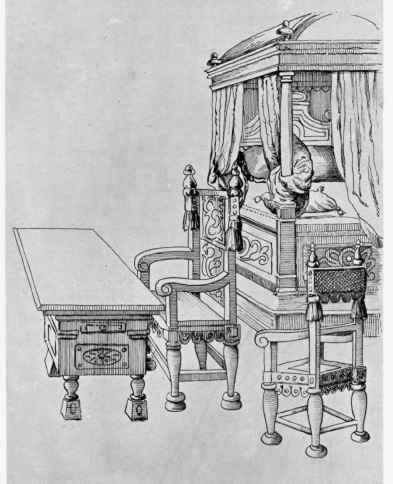
PLATE XII. - Bedstead, Chairs and Table, by J. Stradan,.
In Fig. 19 and Plate XII, we see exactly how these curtains were hung. These beds, from engravings by J. Stradan (1578), also show us how the curtains were looped up in the daytime, how the square pillows were placed formally at the foot of the bed, and the shape of the round bolster. These beds could be completely enclosed by curtains.
The bed in Fig. 19 is interesting as an example of a Renaissance bed without supporting corner posts. The canopy and curtains are evidently suspended from the ceiling by cords in the old style, for there is no woodwork visible above the carved headboard. This is very unusual and is doubly interesting as the bed in Plate XII, by the same artist, is massive in form, and the dome is supported by strong Classic columns. In the latter design the curtains are looped around the columns and a pillow is placed on the bolster at the back. The canopy is dome-shaped and the top of each column is decorated with a "pomme," destined to develop and survive as a decoration for the bedstead. The headboard is quite ornate, and the bedstead, like that in Fig. 19, stands upon a low platform.
A similar dome-topped bed appears in the inner room in the background of Plate XXIV.
One of De Vries' designs for a bed is reproduced on Plate XIII. It has a heavy panelled headboard surmounted by a pediment with pommes; and the four supporting posts consist of turned caryatides. The bedstead proper that holds the mattress and other bedding is supported independently by vase-shaped legs. The frieze of the canopy is decorated with scrollwork. In this style of bed, the curtains did not hide the elaborately carved woodwork; they hung from the cornice and feet inside the outer posts. The hangings could thus be very sumptuous without detracting from the effect of the carved woodwork. Plate XIV, which represents a beautiful bed of this period, massive and richly carved, shows the same arrangement of curtains. It should be borne in mind that wherever the framework is richly carved, curtains were never intended to hide it. This magnificent specimen, from the Rijks Museum, Amsterdam, is of beautiful proportions. The ornamentation is chaste and in perfect harmony, consisting of carved panels, cornice and Corinthian columns.
The woodwork is walnut and the hangings are pale blue damask.
The Plantin Museum in Antwerp contains an armoire and a bed after the designs of De Vries.
Another De Vries bed in the now dispersed Minard of Ghent collection had a canopy and balusters and the central part was arranged in the form of an armoire with two shutters decorated with low reliefs of religious subjects. Upon the upper gallery was a cartouche held by two angels, and on this cartouche the inscription, "Vriese inv. 1565."
An interesting example of Renaissance work is the bedstead on Plate XI. The distaff or lance-shaped columns shoot boldly upward from a floral calix that stands on the head of a mermaid at the foot, and the head of a merman at the head of the bed. A frame for a dome-shaped canopy is connected with the four posts by a tester. The bedstead is panelled and stands on four large square blocks. In the centre of the headboard is a cartouche for a coat-of-arms; in the centre of the footboard the head of a cherub is carved. The peculiar characteristic of the decoration of this piece of furniture is that the scrolls are all carved in the shape of the human ear. This is an early example of the genre auriculaire, which was destined to become popular in Flanders and Germany. On this piece of furniture the ear is omnipresent - on the head and foot board, on the sweeps of the canopy and on the square feet - wriggling, squirming and unrestful.
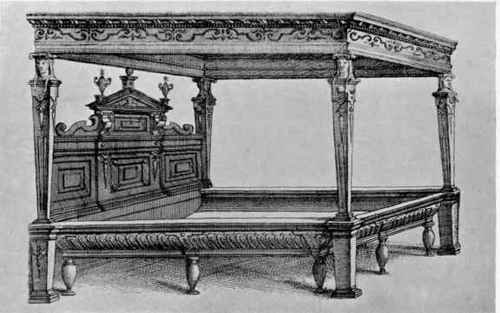
Plate XIII. - Bedstead, by De Vries.
Folding-beds are frequently mentioned in the inventories. Margaret of Austria (1523), had two wooden camp or folding-beds.
The Flemings were particularly skilful in the production of tables and chairs. We have now come a long distance from the simple board and trestles of the past, for we find dining-tables, writing-tables, bureau-tables, card-tables, chair-tables, bench-tables (tables a banc), round tables, square tables, oval tables, tables that stand on one foot, tables that stand on three feet, and tables of walnut, oak, maple,cedar, cypress, marble and even silver. We also find tables of mosaic work and of marquetry and tables beautifully carved and embellished with gold.
The drawing-table was much in vogue. It was composed of extra leaves superimposed on lower ones that could be drawn forward so that the top leaves could fall into the space they made and form with the lower leaves, thus lengthened, one continuous surface. The mechanism by which these leaves were lengthened and dropped was very intricate and ingenious. Jacques Wecker, a physician of Colmar, in his treatise De Secretis (Bale, 1582), says: "One must not despise the make of these tables that I have often seen in Ghent in Flanders."
The tables designed by De Vries and reproduced in Figs. 20, 21 and 22, are a great advance on the one that appears in his Cubiculum. (Plate X.) The form is much the same as those in Figs. 20 and 21, but the linen-fold has given way to panels and pilasters of pure Renaissance character and the corner supports of sphinxes and animals and vases have no memory of the Gothic age. Fig. 22 shows us a table of an entirely different character. It is much lighter and has drawers. With its foot-rails it is well adapted for a dining-table.
A much more ornate specimen of this period called a "fan-shaped table," ("table d l'eventail") is owned by the Dijon Museum. It is of Burgundian workmanship. The support, which still shows traces of gilding, is formed of an eagle with outspread wings standing between two winged chimaera with lions' paws, these paws connected with a straining-rail, or stretcher. The open-work shelf is ornamented with leaves and a mas-caron, and the two upper and lower straining rails are ornamented with a very clearly defined and handsome decoration. The top of the table is surrounded by a thread of marquetry.
Continue to:


My Books

