


Broken Lines
Description
This section is from the book "English Furniture", by Frederick S. Robinson. Also available from Amazon: English Furniture.
Broken Lines
The ordinary type of applied moulding of the early seventeenth century is well seen on the inlaid chest, with the swan in the centre panel, belonging to Mr. Seymour Lucas, R.A.1 As the century ended and the 'raised and splayed' panel was used, in which the centre rectangle projects above a bevelled edge - like that of plate-glass - there are, as a rule, less members in the mouldings, which usually consist of an ovolo and a fillet, or else an ogee, but Wren's mouldings at Kensington Palace and Hampton Court are quite as elaborate as those of the previous style.
1 Plate xxviii.
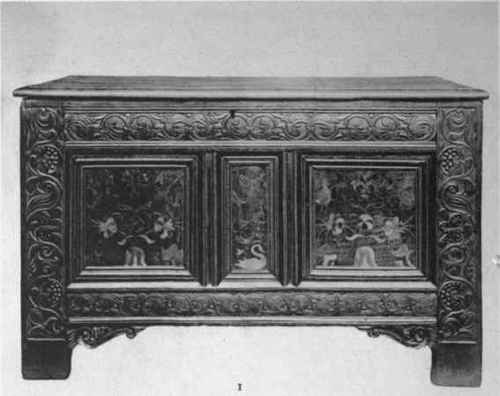
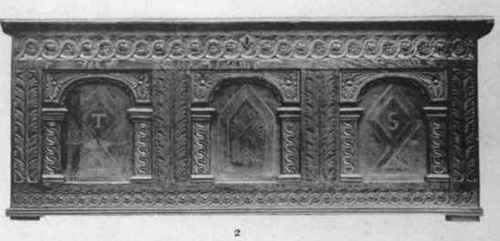
Plate XXVIII. 1 - Inlaid Oak Chest Early 17th Century 2 - Oak Chest, Inlaid With Geometrical Marquetry About 1600
XXVIII. (1) Chest, inlaid oak. Early seventeenth century. Seymour Lucas, Esq., R.A. (2) Chest, oak, inlaid with geometrical marquetry. About 1600. From Bishopthorpe, York. V. & A. M.
We may safely assert that, as in the case of the oak chair, very few chests exactly resemble each other. All have their peculiarities of dimension and detail, a fact which adds greatly to the interest of a study of them, but renders classification difficult. We can differentiate the early plain chests without panels, and with fronts made of three slabs of wood, the centre horizontal, the others upright. From these we can proceed to the frankly architectural with pointed arcading. Thence we turn to the Elizabethan and early Jacobean, with round arches planted in. Next come those in which the arch lingers as a reminiscence, and which are probably later seventeenth century. Another type is that with stiff geometrical ornament usurping the place of the flower and acanthus decoration. Then we find the change of the style of panel. The earlier has no bevelled edge where it fits into its framing, which, as we have seen, is moulded as to the stiles, while the transoms are bevelled only or stop-chamfered. The later panel is raised and splayed, and raised carving tends to disappear.
Along these main lines we can trace the development of the chest, until from having a drawer at the bottom it turns into a chest of drawers.
In spite of broad divisions there will always be exceptions, and one such I may mention in the case of a chest in the possession of the Rev. F. Meyrick-Jones, which is of comparatively late date, and very precisely dated too. This, of the years 1694/5, with initials R. P. on the front, is not panelled at all. The planks of which it is made are beaded or grooved at intervals with horizontal beads a few inches apart, so as to give the chest the appearance of being composed of narrow planking similar to that of common modern wainscot.
Continue to:


My Books

