


Decorated Ends
Description
This section is from the book "English Furniture", by Frederick S. Robinson. Also available from Amazon: English Furniture.
Decorated Ends
The chest to which I refer is at Newton Manor, Swanage, Dorset. As was to be expected, if the above conclusions are right, its lid is smooth. On the upper rail an S-curved ornament is carved, and the stiles which form the legs of the chest have two single S-curves. There are three panels ornamented with diamonds. The stiles which divide the panels are guilloched, and prettily diversified with squares. The lower rail is straight, with an incised bead. The particular feature of this chest is, of course, the ends, which are panelled and decorated with angular crossed and interlaced incised strap-work. The S-curve also runs round the side along the top rail (Plate xxx.).


Plate XXX.
1 - End Of Oak Chest With Ornamental Panel
2 - Oak Chest With S Curved Rail And Decorated Ends I 7th Century
xxx. (1) End of Oak Chest, with ornamental panel. (2) Front of the same, with S-curved rail. Seventeenth century. Sir Charles Robinson, C.B.
Dimensions: Length 43, Width 18½, Height 21½ inches.
Another smooth-topped chest in the same house, and somewhat larger than the last, has remarkably handsome and large leaf patterns on its panels, resembling the Greek 'Anthemion' or honeysuckle pattern. In this chest also the scroll pattern of the upper rail runs round the ends, but the end panels are plain (Plate xxxi.i).
A third smooth-topped chest has plain panels. The upper rail is decorated with a familiar pattern of alternate squares and circles. The stiles have the upright acanthus leaf upon them. The lower edge of the lower rail is shaped with curves and notches. This is not very common on chests, and is a welcome feature when discovered (Plate XXXI.2).
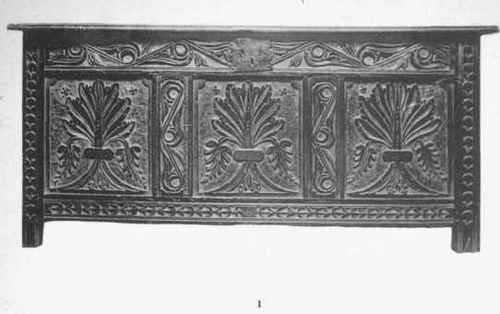
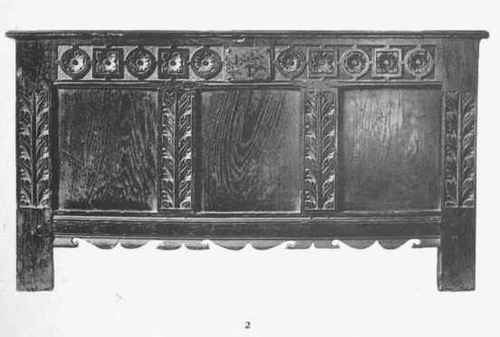
Plate XXXI.
1 - Oak Chest 17th Century
2 - Oak Chest 1 7th Century
XXXI. (1) Chest, oak, seventeenth century, with what is described in the text as a species of anthemion ornament on the panels. Sir Charles Robinson, C.B.
Dimensions : Length 54, Width 22½, Height 24 inches.
(2) Chest, oak, seventeenth century,with notched lower rail. Sir Charles Robinson, C.B.
Dimensions : Length 50, Width 20½, Height 27 inches.
Many chests are to be found in which the principal ornament of the panels is purely geometrical. Sometimes the work is incised, sometimes it is inlaid. Of the former, the chest belonging to Mrs. Rivers Turn-bull is an effective example, in which the sharply cut gadrooned upper rail makes with its curves an attractive contrast to the severe triangular shape below. Of geometrical inlay, the chest No. 7270 in the Victoria and Albert Museum offers a specimen (Plate XXXII.I).


Plate XXXII. 1 - Oak Chest, With Geometrical Carving 17th Century 2 - Late Linen-Fold Panelled Chest 17th Century
XXXII. (1) Chest, oak, with geometrical carving. Seventeenth century. Mrs. W. Rivers Turnbull.
Dimensions : Length 48, Height 24½, Depth from front to back 20½ inches.
(2) Late Linen-fold panelled Chest. Seventeenth century. Seymour Lucas, Esq., R.A.
From the excellent series of chests belonging to Mr. Seymour Lucas, R.A., an illustration is given of one with a late linen-fold pattern on the panels.1 The treatment of the edges of the pattern is such as to disguise the resemblance to a folded napkin, especially along the lower rail. The linen-fold was introduced probably from France about 1480. At first there is no mistaking its origin, as may be seen in the illustration of the panelling from an old house near Taunton (Victoria and Albert Museum, No. 539), where it is decidedly angular in shape. In the pair of panels with arms of the Blount family, which is of the sixteenth century, the folds are more flowing.2 Later panels are sometimes much elaborated, and there are Jacobean ones to be found with gouged work upon them, but these are isolated examples of its decadence. The real vogue of the linen panel was not for more than seventy or eighty years, though it is to be found in a debased style as late as 1650.
In chests with the planted arch, the pillars generally abut against a perfectly plain stile-edge; and in the cypress chest with incised arches, there is a reproduction or reminiscence in the flat of this way of fitting.8 Examination of the other illustrations of chests without arches will show a considerable variety of methods of beading or moulding the framing. Sometimes regular mitred mouldings are applied round the panels, as in the case of Mr. Seymour Lucas's inlaid chest with incised frame. The same treatment occurs in the handsome chest, with four inlaid flower panels (No. 69, Victoria and Albert Museum).4 Early, however, in the seventeenth century, it seems to have been a common practice to vary the sides of panels by having either the upright stiles moulded and the transoms or rails only bevelled with a chamfer, or else to treat them in the opposite way, moulding the rail, and leaving the upright stile-edges plain. Of the first method, the chest with decorated ends at Newton Manor offers a good example, and of the second the chest with plain panels and notched lower rail (Plate XXXI.2) is a specimen.
Plate XXXI.
1 - Oak Chest 17th Century
2 - Oak Chest 1 7th Century
XXXI. (1) Chest, oak, seventeenth century, with what is described in the text as a species of anthemion ornament on the panels. Sir Charles Robinson, C.B.
Dimensions : Length 54, Width 22½, Height 24 inches.
(2) Chest, oak, seventeenth century,with notched lower rail. Sir Charles Robinson, C.B.
Dimensions : Length 50, Width 20½, Height 27 inches.
Mrs. Rivers Turn-bull's geometrically carved chest (Plate xxxii.i) is a third variety, in which the stiles are nicely moulded, whilst on the upper rail there is a mere incised line, and on the lower rail a plain chamfer. In some of these cases there is an effect as though the workman had decorated his edges after the panels were framed up, and then had used some tool which was not adapted for going into corners, where his incised lines do not meet as they might be expected to do. Some of the panelling of the Abbey House, Waltham (Victoria and Albert Museum, No. 2011), is beaded in this manner, the transoms having a regular 'stop chamfer' on the edge. There is an artistic advantage obtained by the breaking of the straight lines, which to an observer is very noticeable. Large extents of small panelling of much the same shape and size have a great many rectangularly meeting lines, irrespective of those actually made by the beading. A few obvious breaks save the appearance from becoming entirely mechanical and monotonous. Even on the three panels of the lid of a chest the advantages of the broken line are manifest. There is also a constructive reason why headings should not completely meet at the angles of a panel.
Plate XXXII. 1 - Oak Chest, With Geometrical Carving 17th Century 2 - Late Linen-Fold Panelled Chest 17th Century
XXXII. (1) Chest, oak, with geometrical carving. Seventeenth century. Mrs. W. Rivers Turnbull.
Dimensions : Length 48, Height 24½, Depth from front to back 20½ inches.
(2) Late Linen-fold panelled Chest. Seventeenth century. Seymour Lucas, Esq., R.A.
Unless the woodwork was very thick, the incised line if carried over the parts where the mortice and tenon fit would tend to weaken the joint. A glance, however, at the Waltham panels will show how important is the artistic consideration alone (Plates XIV., XXXVII.).
1 Plate xxxii. 2.
2 Plate XIII.
3 Plate xxxiii.
4 Plate xxxv.

Plate XXXV. Coffer, Oak, Inlaid Early 17th Century
xxxv. Chest, oak, inlaid. Early seventeenth century. V. & A. M.
Dimensions : Length 70, Height 33½, Depth from front to back 26½ inches.

Plate XXXIII. Coffer, Cypress Wood Late 16th Or Early 17th Century
xxxiii. Chest, cypress wood. Late sixteenth or early seventeenth century. This chest has dragon-headed S-curves similar to those found on Welsh furniture. It is very probably an imported Italian chest, with design to suit the English market, and more likely to be of the sixteenth century. V. & A. M.
Dimensions: Length 50 ⅝, Height 22½ inches approximately.


Plate XIII. I-Oak Panelling, With Linen-Fold Pattern 15th Century 2-Tudor Panels, With Arms Of The Blount Family, Showing Linen-Fold Patterns
XIII. (1) Oak panelling, with linen-fold pattern. Fifteenth century. (2) Tudor Panels, with arms of the Blount family, showing linen-fold patterns. Oak. The left-hand panel is inscribed, 'Orate p[ro] bono statu Johanis Blount et Johane uxoris eis' [ejus]. Sir Charles Robinson, C.B.
Size over all, 27⅜ inches each way. The outer mouldings are later.
Continue to:


My Books

