


Humphrey Peckham
Description
This section is from the book "English Furniture", by Frederick S. Robinson. Also available from Amazon: English Furniture.
Humphrey Peckham
There is, indeed, the less ground for complaining of the anonymity of the furniture-makers of the oak period when we remember that the magnificent houses which contained their handiwork were the masterpieces of unnamed architects, or rather of no architect at all. The word 'architect' was hardly used at the time that the great Renaissance houses were built. A 'surveyor' was the most responsible person after the owner. He furnished a plan, but it was of a very different kind from those which are made to-day. If we imagine such a sketch as an architect might make upon a sheet of notepaper, by way of giving the first elementary form to the misty floating ideas in the head of a client who thinks of building, we shall have some notion of the surveyor's plans. Compared with the professional elaborations of the present time they would appear slight indeed. The surveyor gave no detailed schemes to the masons, no finished scale-drawings to the carpenter, no designs to the carver. The best documentary evidence as to the system of house designing and building in this period is the book of drawings by John Thorpe preserved in the Soane Museum, and in that, though there are many general plans of houses, the details for the joiner and the carpenter are remarkably few.
Authorities on architecture have not yet been able to settle how many of the drawings in John Thorpe's book are original designs for houses made by him, and how many are plans of existing houses built by other men, and only measured up by Thorpe after their completion. This lack of information may help to console us for our inability to name more than a single English furniture designer or carver of the period to whose work we can actually point. The name of one is preserved at St. Thomas's Church, Salisbury. Inside the porch, on the left hand wall, is a wood carving in relief, perhaps for a chimney-piece. The subjects appear to be the sacrifice of Isaac and Jacob's dream. There are cherubs and satyrs below. The top and side mouldings are an ovolo, decorated with a scroll pattern which includes a Tudor rose. An inscription in paint records the following: -
'Here under lyeth the Body of Humphrey Peckham who died the 2nd day of February Anno 1671 aged 83 yrs His own Worke.'
The carving is bold but not very refined, such, in fact, as might be inspired by the Flemish work which, as we shall presently see, came to England in great quantities at the end of the sixteenth and beginning of the seventeenth century. Yet it is good and elaborate enough for Peckham to take a legitimate pride in it, and an interesting record of one of the few named craftsmen who lived in the days of Elizabeth, and left actual proofs of their carving behind them. A careful study of the Hampton Court Palace accounts, and the work which they record, might enable us to assign their due share to many carvers of English birth whose names are preserved. Though we can specify no master mind such as later was found in an Inigo Jones or a Christopher Wren, we are very far from discovering that every man in those days was a law to himself. There is an extraordinary interchange of motives to be found amongst the productions of the stone-masons, the wood-workers, the furniture-makers, and the workers in metal and textile fabrics. To take a few concrete instances, though it is an exploded idea that houses with H and E shaped plans were built mainly in compliment to Henry VIII. and Elizabeth, yet there is not much doubt that the fancy played round the idea after the house was built.
It is true that the H shape is simply caused by the extensions of wings at the back and front of a house, and the E shape by wings and a central porch; but John Thorpe in his book gives a rhyme which goes far to prove that such conceits of letter-shapes were very much in the minds of men of the Tudor and Elizabethan periods:-
' These 2 letters I and T Joyned together as you see Is ment for a dwelling house for mee.'
'Bess of Hardwick' placed her initials, not as the plan of her house, but to grace the parapet and be in all men's sight at Hardwick Hall. The wood-carvers follow the masons and place the initials of the owner upon chests, of which Prior Silksted's1 is a splendid early instance, and sometimes the whole name, as on that of Esther Hobsonne,2 in the Victoria and Albert Museum. The tendency to letter-shape in design is found again on a smaller scale in the jeweller's art. Monogram pendants beautifully enamelled were fashionable at the period of Henry VIII. Anne Boleyn wears her initial on a jewel in one of her portraits; and on a unique medallion of Isabella of Castile, sixty years earlier in date, I have seen a head-band the ornament of which consists entirely of Gothic lettering. The silversmith is not above taking a hint from the mason for the steeples of his 'steeple cups,' which were very fashionable from about 1610 to 1630. On them and other cups of the end of the sixteenth century, as, of course, we might expect, we find the acanthus leaf, and the strap-work and masks of the cabinet and the panel with gadroons and flutes and reeds to match.
Then if we turn to the embroiderers we can discover that they too have taken their inspiration for panels and borders, worked in all the brilliancy of gold and silver thread upon brocades and satins, from the same common stock. The use of an ornamental motive seems almost to have depended upon its capacity for universal application. If a Bess of Hardwick builds a palace she employs a style of ornament which some humbler Bess finds adaptable for her dower-chest or court-cupboard. If a jeweller requires a dignified shape for a tiny pendant, he finds it as often as not in the forms of architecture.
1 Plate XXIII.
2 Plate XXIX.
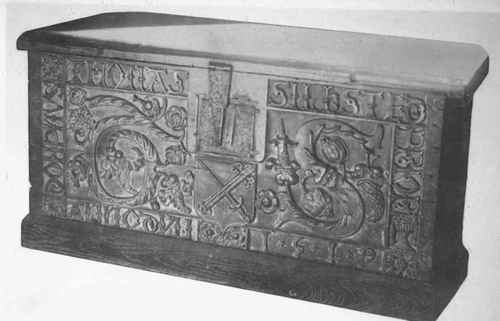
Plate XXIII. Chest Of Prior Thomas Silksted
XXIII. Chest of Prior Thomas Silksted. 1519. Oak, with new lid and plinth. Shanklin Church.
By kind permission of the Rector.
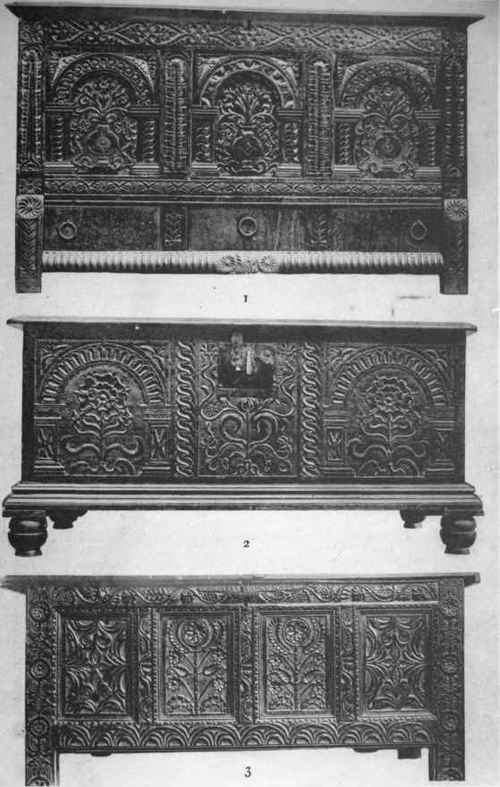
Plate XXIX. I - Oak Coffer, In The Lower Part Of The Front Are Two Doors Early 17th Century 2 - Oak Coffer First Half Of 17th Century 3 - Oak Coffer; "This Is Esther Hobsonne Chist, 1637 "
XXIX. (1) Chest, oak. In the lower part of the front are two doors. Early seventeenth century. V. & A. M.
(2) Chest, oak. First half of seventeenth century. V. & A. M.
(3) Chest, oak. 'This is Esther Hobsonne chist, 1637.' V. & A. M.
Continue to:


My Books

