


Varieties Of Foot
Description
This section is from the book "English Furniture", by Frederick S. Robinson. Also available from Amazon: English Furniture.
Varieties Of Foot
Another chair has no carving on the centrepiece of the back, but the wood which edges the cane oblong is lightly incised with a lattice pattern, which appears also on the wood of the seat.
A typical crown chair is also illustrated (Plate lxviii. I), and then we pass on to a typical convex and concave curved chair (Plate LXVIII.3), of which a specimen may be seen in the Victoria and Albert Museum. Very similar in form of arms and legs is the example shown, with fancifully shaped caning. The smallness of the mesh is remarkable. Somewhat recalling the leg-shapes of Mr. Vincent J. Robinson's chair is a walnut specimen (Plate LXIX.3) with semicircular ends to the caning, and a remarkably heavy bulbous cross-rail. This heavy turning is found upon Portuguese tables, and is accompanied in this chair by the species of projecting club-foot with flutes upon it, which by some writers is known as the 'Spanish foot.' That which ends in a volute projecting at the floor, as in the typical convex and concave curved chair of our illustration, is called Flemish. A glance through the whole series reproduced will show considerable varieties, scarcely one foot being quite like another. It would be difficult to classify that of the child's chair in the writer's possession (Plate lxx.i). There is an upper convex curve and the commencement of a concave, but no projecting volute.
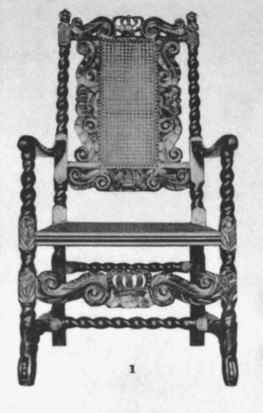
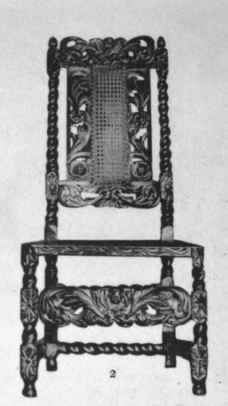
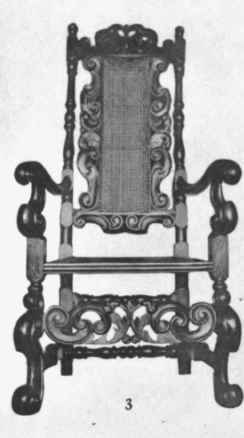
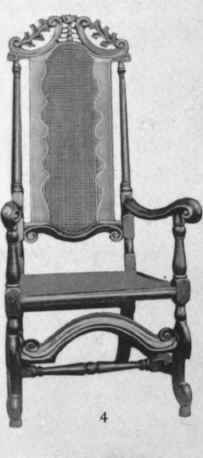
Plate LXVIII.
I - Chair, Oak 1660 Circa 3 - Arm-Chair, Oak 1690 Circa
4 - " " &Raquo;&Raquo;
lxviii. (1) Armchair, oak, 1660 circa.
Dimensions: Height 46¼, Breadth 23⅜, Depth from front to back 24½ inches.
(2) Chair, oak, 1660 circa.
Dimensions: Height 43¾, Breadth 19¾, Depth from front to back 21⅝ inches.
(3) Armchair, oak, 1690 circa.
Dimensions: Height 51⅛, Breadth 26, Depth from front to back 26½ inches.
(4) Armchair, oak, 1690 circa. E. Hockliffe, Esq.
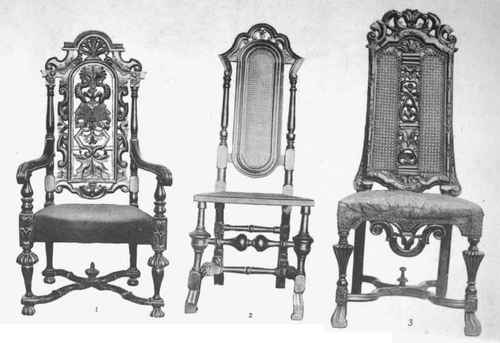
Plate LXIX.
I - Arm-Chair, Oak End Of 17th Century
2 - Chair, Walnut Late 17th Century 3 - „ ,. 1700 Circa
LXIX. (1) Armchair, oak. End of seventeenth century. Kingsbridge Church, Devon.
Height 51½ inches. By kind permission of the Vicar.
(2) Chair, walnut. Late seventeenth century.
E. Hockliffe, Esq.
Dimensions: Height 49¼, Breadth 18½, Depth from front to back 19 inches.
(3) Chair, walnut, 1700 circa. Vincent J.
Robinson, Esq.
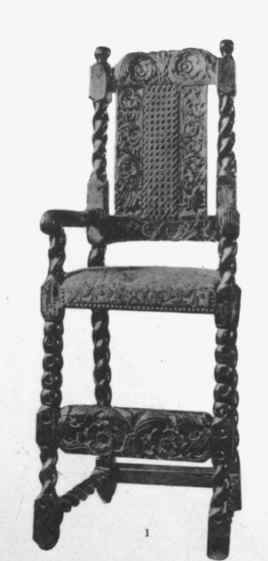
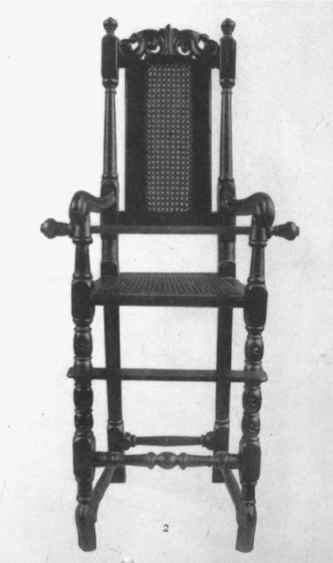
Plate LXX. I - Child's Arm-Chair, Oak 1660 Circa
LXX. (1) Child's Armchair, oak, 1660 circa. Rockingham Castle. Rev. Canon Went-worth Watson.
(2) Child's Armchair, walnut, 1660 circa. The property of the author.
Dimensions: Height 41¼, Breadth 14½, Depth from front to back 15¼ inches.
It most nearly resembles the foot of the typical crown chair belonging to Mr. E. Hockliffe. Mrs. Morse, in Furniture of the Olden Time, shows a very pretty child's chair with spiral turning and a crown. That has a plain rectangular member at the bottom, and so has the charming one of our illustration belonging to the Rev. Canon Watson, of Rockingham Castle (Plate lxx.2).
In Chapter xiii (Chairs Of The Late Seventeenth And Early Eighteenth Centuries)., on chairs of the late seventeenth and early eighteenth centuries, will be found a note (p. 191), as to a rare type of circular-backed and seated chair which has been ascribed to the period of Charles II.
Stools and couches follow the same rules of decoration. The stool is upholstered, and a more comfortable piece of furniture than its predecessor of the old oak period, which many people love to describe as a 'coffin stool,' as if to support a coffin was the sole reason of its existence.
Of the couches reproduced in Plate lxxi.i, 2, one from the Victoria and Albert Museum has a movable end which can be set at any angle. On the frame of the seat may be seen the incised lattice or diamond to which I have drawn attention on one of Mr. E. HocklifTe's chairs. The other, belonging to Miss Evans, of Forde Abbey, is rather exceptional. It is covered with embossed and painted leather. There are two folding ends with iron plates, and rods to secure them.1 The legs and straining rails are painted and gilt. Judging from the turning of its legs and general plainness, the date of this should be quite as early as 1660, to which period it was assigned in the Bethnal Green Exhibition. Mr. F. Litchfield in his History of Furniture figures a much more elaborate couch with legs and stretchers in the grandiose style of Louis XIV., which is at Penshurst, Kent. It recalls a chair of similar style which he illustrates from Hard-wick Hall, where are several very important pieces of furniture. Of stools there is no better storehouse than Knole in Kent, where they are found of every variety, both ordinary and cross-legged. Chairs, too, of this earlier kind are there to be seen, and additional interest attaches to them by reason of the portrait by Mytens of James I., representing him as seated upon one of them, which is placed below the picture.
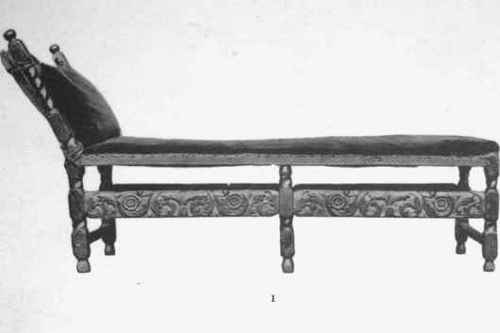
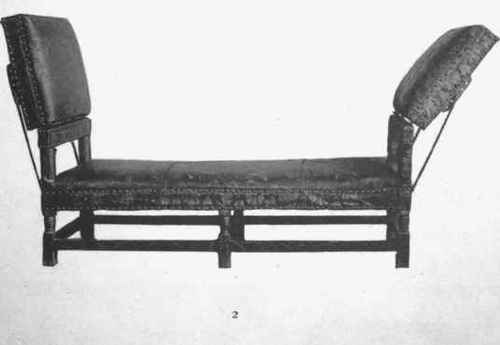
Plate LXXI. I - Couch, Oak 1660 Circa 2 - Settee, ,, „ 11
LXXI. (1) Couch, oak, 1660 circa. V. & A. M.
(2) Settee, oak, 1660 circa. Painted and gilt. Upholstered in embossed and painted leather. Forde Abbey. Miss Evans.
This cross-legged furniture is of Italian type. An early example is preserved in Winchester Cathedral, and is said to have been used at the marriage of Mary with Philip of Spain in 1554. It is of clumsy shape; the upper parts of the X-shapes, forming the supports of arms and back, point upwards like the prongs of a pitchfork. At the intersection in front there is a large five-petalled flower, perhaps a Tudor rose. A similar chair in York Minster has a shield at the front of the X, is upholstered with velvet or leather, and is more elegant than the Winchester example.
1 A fine folding couch exists at Knole.
Continue to:


My Books

