


Louis XVI. Period. Part 5
Description
This section is from the book "French And English Furniture", by Esther Singleton. Also available from Amazon: French And English Furniture.
Louis XVI. Period. Part 5
David Roentgen is often known as "David." He was born near Coblentz, and seems to have kept his shop there, visiting Paris to dispose of his wares; and, obtaining the interest of Marie Antoinette, he established a shop in Paris. He introduced a new kind of marquetry, in which the shadows and shading were actually done by pieces of wood; and, as a journalist of the period said, was done like "stone mosaic." The woods he used for his marquetry work were lighter and gayer than Riesener's. He employed various white woods, such as pear, lime, and other light-coloured woods, and frequently tinted them other shades by burning them, or by chemical processes. Like Riesener, he worked also in plain mahogany and letter-wood, and also veneered furniture with these woods. His productions were also brightened by Gouthiere's chased and gilt handles and key-plates. Roentgen was particularly clever about introducing mechanical devices into his furniture. His greatest period of activity was between 1780 and 1790.
Among other noted cabinet-makers were Leleu, Sau-nier, Carlin (who made many articles for Marie Antoinette), Levasseur, Avril, Pafrat (who worked with Carlin), Philippe-Claude Montigny (who copied the works of Boulle), Benman, Stockel, Weisweiler, and Schwerdfeger. Quite a colony of German cabinet-makers, attracted by the success of Riesener and Roentgen, as well as the hope of gaining the interest of the young Austrian Queen, settled in the faubourg Saint-Antoine.
Although some of the beds popular during the last reign survived, particularly the alcove and niche beds, many new varieties were introduced, and the books of such designers as Ranson, Delafosse, and Salembier, contain many drawings of beds. The canopy generally becomes smaller and smaller, until it dwindles into a crown or ring to hold the curtains, and is known as lit a couronne, - a variety that continued popular throughout the Empire. The great four-post bed and the lit en housse, occasionally recorded in inventories and sales, are survivals of the past; most of the new beds take some form of the sofa. The favourite lit a I'anglaise is really nothing but a square sofa. Indeed the dividing line between the beds and sofas is not clearly marked, for the "bed with three backs," as they still defined it, is draped and furnished with the customary two bolsters and a decorative canopy and curtains. The distinction was not very rigidly observed even at the time. For example, in 1773 we read: "For sale at M. Carre's, rue d'Enfer a lit a I'anglaise of yellow damask that forms a sopha 5 feet wide and 6 feet long; the frame of carved walnut." In 1785, "a cane bed with three backs that may serve as an ottoman in a summer drawing-room," is offered for sale.
Columns rarely appear now, and when they do, they are usually light. Sometimes, indeed, they are of iron, and covered with the same material as the curtains. It is preferred to place the bed sideways (yu de face) against the wall. In this case, the headboard and footboard are of equal height and exactly alike. (See Plates XLIV. and XLV.) Often the headboard and footboard are covered with the curtain-material; they are also left plain and printed, or lacquered or gilded. Natural wood ornamented with bronze gilt or moulu decorations is used. The use of veined woods gradually did away with the practice of covering the head and footboards. When the headboard was higher than the footboard, the head was placed against the wall (yu de pied), or it stood in the corner. Muslin, Persian, silk, and other materials were used for draperies, and these were trimmed with bows of ribbon, fringe, cords and tassels. The curtains and counterpane were subject to a formal arrangement of loops and festoons, and feathers still decorated the canopy. Among the most popular varieties were lit a la Polonaise, a la Turque, a la Chinoise, a tombeau, a double tombeau, and a I'anglaise. There was another new bed called a la daupbine, which did not long remain in fashion.
Ranson designed one in 1780. This was a lit a imperialle or a dome, which was light and rather graceful. Instead of being supported by columns the dome was held by an iron armature. The lit a I'ltali-enne, so named on account of the draping of the curtains, was very popular in 1775; and the lit a couronne had a round or oval canopy, surmounted by a festoon drapery, trimmed with ball fringe. Two curtains, similarly trimmed, fell from the canopy on either side of the bed to the floor.
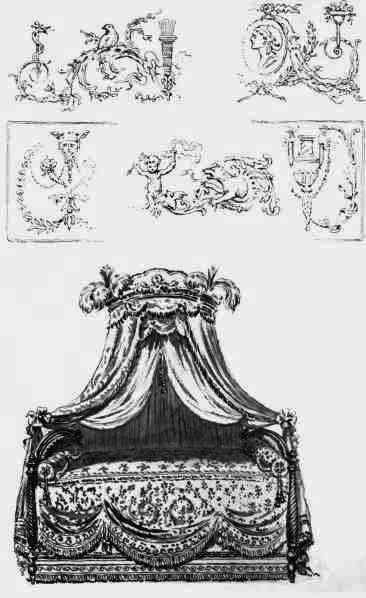
The forms, colours, and styles of the beds in use during the Louis XVI. period may be gathered from the following list: lit a housse, crimson velvet, trimmed and embroidered with gold, Marechal Due d'Estrees, 1771; lit a la polonaise, blue damask and moire, Boucher (the painter), 1771; lit a housse, green damask, Madame Favart, 1772; bed of embroidered muslin, the Due de Bouillon, 1772; lit de Perse, white background with various cut-out decorations, Duchesse de Brissac, 1773; bed of Indian damask, Chevalier d'Hestin, 1775; crimson velvet with gold braid, Duke of Saint-Aignan, 1776; yellow satin embroidered with gold flowers, Marquise de Courcillon, 1777; Indian damask, Mme. le president Talon, 1779; bright yellow damask (worth 24,000 livres), unknown, 1779; crimson damask, Marquise de Saint Georges, 1779; and crimson and white moire, la Comtesse de Berulle, 1779. In 1780, crimson seems to be the favourite hue, but there are also fine beds of blue and white damask, crimson and white brocade, and yellow damask, and in 1781 - 1782, yellow and white damask, green damask, blue damask, blue and white watered silk, blue and white brocade, Persian, tapestry and blue satin embroidered with gold and silk.
Yellow camlet and damask in three colours occur in 1784, and in 1787 Oriental stuffs and imitations of them are the rage. In 1787, the Marquis de Menars had a beautiful bed of embroidered blue moire; the Duc d'Or-leans, a lit a la duchesse of flowered silver velvet, trimmed with gold braid and fringes; and the financier, Beaujon, a large canopy bed hung with Gobelin tapestries.
Continue to:


My Books

