


Louis XVI. Period. Part 6
Description
This section is from the book "French And English Furniture", by Esther Singleton. Also available from Amazon: French And English Furniture.
Louis XVI. Period. Part 6
In addition to these, we may call attention to the following folding-beds: a "lit d' ante-chambre in the form of a secretary" was offered at the sale of the Marquise de Vigean's effects in 1783; and at the sale of Mme. Le Gros's articles in 1784 "a bed of crimson damask enclosed in an armoire en secretaire." A French newspaper also offered for sale in 1785 "a pretty bed enclosed in a secretary made of mahogany with trimmings of gilded ormoulu, 7 feet high and 3 1/2 feet wide, proper for both city and country"; and four years earlier a "bed in the form of a commode and garnished with copper" was also offered for sale.
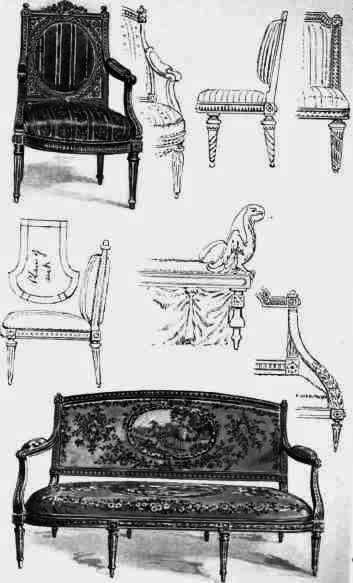
The lower drawing on Plate XLIV. represents a lit de repos, or "causerie," such as was used at Trianon. The wood is walnut, gilded all over. A carved garland of flowers decorated the top of the head and foot-board, and the grooved columns are surmounted by a carved pineapple. The drapery is a light Florentine silk, green in hue, trimmed with cords and tassels and fringe of white, green and pink.
The bed on Plate XLV. is from a water-colour design by Rousseau de la Rottiere.
The window-curtains and draperies have also changed, to be in sympathy with the furniture. They are far more studied than ever before, and it is the cutter whose abilities are required rather than the graceful draper. Every bit of material must count, and the shape is determined upon by the scissors. The straight line is insisted upon, and festoon, scarf and lambrequin are combined in a precise and formal manner. When a lambrequin is cut in denticulated ornaments, sometimes the teeth end in a point, and sometimes they are rounded. The cantonniere has entirely disappeared, and the scarf is now an obligatory accompaniment to bed curtains and window-curtains. The curtains are heavily wadded and lined, and beneath them thin muslin or taffeta curtains hang. The draperies are trimmed with braids, cords, fringes, small bell-shaped balls, and long or short but rather slender tassels.
Gilded and lacquered cornices are used, and cornices of white and gilt whose flowers and other ornaments are painted in appropriate colours. The latter style was known as camaieux. On Plate XLIV., Nos. 3 and 4, specimen cornices with the correct drapery are shown. The central ornament of each is a composition of garlands, quivers and burning torches. Another arrangement of window drapery appears in Plate XLIII.
The lyre clock (No. 3, Plate XLVII.), and the screen (No. 4, Plate XLVIII.), are also typical examples.
The commode becomes more popular than ever. The bomb'e commode of the preceding reign is succeeded by a piece of furniture in which the straight line predominates, and which usually stands on grooved feet. Some commodes have doors and others long drawers, with two simple handles on either side of the key-plate. When five drawers are placed one above the other, the feet naturally become lower than those of the Louis XV. period. Commodes were made of plain mahogany, amaranth and violet-wood. Marquetry work gradually yielded to plain panels bordered with a delicately chased bronze moulding, and the top was covered with a marble slab. Doors and drawers, however, were sometimes ornamented with inlays of flowers or trophies in the centre of the panel. Very few lacquered commodes were made. The commode on Plate XLVIII. is a transitional piece by Riesener. It is of marquetry, ornamented with chased gilt bronze mounts. The legs show the Louis XV. influence. Above it, on the same Plate, is another piece that retains sympathy with the former period.
This is a "demi-toilette." Its curving hind's feet are ornamented with a bronze gilt acanthus, and delicate metal-work decorates the moulding above the three drawers. (See detail No. 5).
The chiffonnier, or tall case of drawers, occurs in the inventories of this reign. It was used in the dressing and bedrooms.
The console, or pier-table, still holds its place under the mirror between the windows. It bears little resemblance to the superbly carved and decorative console of the former reign. It is composed of straight lines, a straight grooved leg, or a leg grooved and tapered, as shown on Plate XLVIII., No. 1. The ornaments are slight, merely a little gilded metal gallery around the top and base, a small ornament, a rosette or trophy, in the centre under the slab, and sometimes a little decoration on the legs. The straining-rails sometimes unite to form a sort of basket or tray to hold flowers or a piece of porcelain, and sometimes the legs are united by a solid piece of wood, as appears on Plate XLIII., which also shows the favourite style of standing upon it a single Sevres vase. The console was not only made of mahogany and brass work, but it was frequently painted in a light colour. Grey or celadon was a favourite hue. At the sale of the Versailles furniture, during the Terror, "two consoles, painted in pearl-grey, elegantly ornamented with carving and having very handsome slabs of Carara marble," were sold.
A console in which the characteristics of the approaching Empire style are evident is shown as No. 5 on Plate XLVII. In the original, a double eagle sits upon the straining-rail directly below the chubby cherub. The eagle is accompanied by a branch of laurel. It will not be long before the classic head of the term leg is succeeded by the sphinx.
Typical drawing-room tables are shown on Plate XLIII. It is very rarely that a table of gilded wood is met with in a drawing-room or petit salon. Solid or veneered tables of rosewood, amaranth, violet-wood or mahogany, decorated with brass-work or gilded copper, are the favourites. Sometimes the top consists of a marble slab, and sometimes a square of velvet or cloth is framed in a border of wood ornamented with a metal moulding; but the table-cloth is rigorously avoided.
In the boudoir, tables painted and lacquered in the Vernis Martin style are met with. In the boudoir as well as in the drawing-room, the "flower table" also occurs. This must have been a jardiniere, because Percier uses the word table a fleurs for his jardinieres. Growing flowers were greatly preferred to cut flowers for decoration, and were placed on tables or stands in vases and baskets made of gilded metal or gilded osiers. The flower table, however, was arranged purposely for growing plants. It resembled the pier-table, and was often ornamented with porcelain plaques. In 1777, a Parisian advertisement reads: "For sale, a beautiful table a fleurs, now being made, of satin-wood lined with lead, the four feet in scrolls ornamented with shoes gilded or moulu, as also the rings that form the handles; with a drawer also lined with lead to drain the water."
Continue to:


My Books

