


The Chippendale Period. Part 5
Description
This section is from the book "French And English Furniture", by Esther Singleton. Also available from Amazon: French And English Furniture.
The Chippendale Period. Part 5
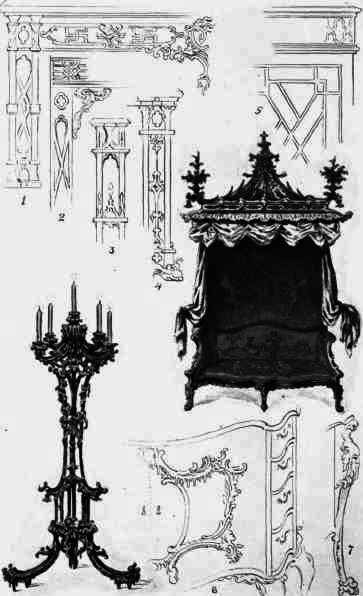
The full drawing to the reader's right on Plate XXXVIII. shows a Gothic chair. Nos. 5, 6, 7 and 8 are typical chair backs, No. 5 being "Chinese," as is plainly shown by its fret-work and mandarin hats. Nos. 3 and 4 are the legs of "Chinese chairs," and No. 9 the leg of a "French chair."
In not one of Chippendale's drawings of chairs does the simple ball-and-claw foot occur. In one or two instances, however, there is a lion's claw, or paw.
We find the straight, square leg; the straight leg carved with a chute of husks and resting on a square base; the cabriole leg, ending in a kind of scroll and resting upon a leaf; a leg resting upon a shell; a leg formed of a bunch of reeds wrapped with a ribbon; a leg ending in a hoof, with a ram's head carved on the spring of the cabriole knee, a lion's claw holding a very flat ball; and a leg upon which a curious sort of wingless dragon is crawling. (See Plate XXXVIII., No. 9.)
Another leg shows a dolphin's tail gracefully carved upon a cabriole curve, while his head is used for the foot. In another chair the dolphin's tail is used for the foot. Fret-work is used in the Gothic and Chinese designs.
The Chinamania had by no means subsided in Chippendale's day. The case or shelf full of choice bits of porcelain was to be met with in many rooms, and always in the lady's boudoir and dressing-room. In Chippendale's first book, a number of china cases, Chinese cases, Chinese hanging shelves and Chinese shelves standing on feet appear, and even one labelled "India cabinet" shows the same style of treatment, which is, of course, either fret-work or a conglomeration of pagodas, mandarin hats, Chinese figures, bells and turned-up edges mingled with leaves and scrolls and dripping water. In the first edition of Chippendale's book (Plates CV., CVI., CVIL, CVIII. and CIX.) are china cases. "The latter," he says, "is a very neat china case upon a frame, with glass doors in the front and ends; betwixt the middle feet is a stretcher, with a little canopy which will hold a small figure. This design must be executed by the hands of an ingenious workman, and when neatly japann'd will appear very beautiful." This is the china case that is shown on Plate XXXVIII., and is dated 1753. The glass doors are enriched with ornate vines thick with leaves and flowers and dripping water.
The ornaments of the top and sides are decorated with little bells, and there is a generous use of fret-work. Plate CX. of the first edition also shows a "china case with glass doors;" and Plate CXI. another, of which Chippendale seems to be very proud. He says it is "not only the richest and most magnificent in the whole, but perhaps in all Europe. I had a particular pleasure in retouching and finishing this design, but should have much more in the execution of it, as I am confident I can make the work more beautiful and striking than the drawing. The proportion and harmony of the several parts will then be view'd with advantage and reflect mutual beauty upon each other. The ornaments will appear more natural and graceful, and the whole construction will be so much improv'd under the ingenious hand of a workman as to make it fit to adorn the most elegant apartment."
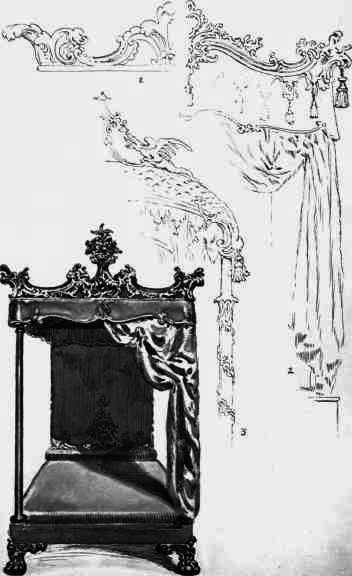
China cases on which to place the china are most elaborately carved; one of these in the Chinese style "may be soft wood and japanned, or painted and partly gilt." A china case very proper for a lady's dressing-room may "be made of any soft wood and japanned any colour."
Hanging shelves for china are shown in Nos. 3 and 4 on Plate XLII. The latter is confessedly "in the Chinese taste." In some of his highly ornamental cabinets the ornaments are intended to conceal the joining. He says: "They may be brass or silver finely chased and put on, or they may be cut in filligree work in wood, brass or silver."
Chippendale fills four plates with a variety of Chinese railings, "very proper for gardens and other places, and may be converted (by the ingenious workman) to other uses."
It is not likely that any confessed admirer of the French would neglect the commode. Sometimes he labels them "buroe dressing tables," "commode bureau tables" and "French commode tables." This is what he calls one design, dated 1753, which appears on Plate XLII., which has drawers at the top and in the middle and doors at the ends. "The ornaments should be carved very light," he remarks, and these are a delicate kind of fret-work below the three top drawers and a profuse display of dripping water with leaves in the ovals of the doors, while the bottom is ornamented with leaves and the feet are leafy scrolls. Nos. 6 and 7 (Plate XLI), are also portions of French commode tables, the former has drawers at the side and is enriched with the rocaille work of which Chippendale was so fond and the favourite dripping water. No. 7 shows only the leg.
The lady's dressing-table received much attention from Chippendale. As a rule, he made it of rosewood ornamented with rich brass-work, and further decorated it with festoons of drapery. One, dated 1761, is described as a kind of commode. On top was a glass that came forward on hinges, on either side was a cupboard plain or silvered (i. e. quick-silvered); inside were drawers and pigeon-holes. "Two have been made of rosewood, which have given entire satisfaction," adds Chippendale. All the ornaments were gilt and the dressing-drawer was full of compartments for all the little trinkets that are so necessary to women.
A Toilet, or Dressing-Table, for a lady is described as follows: "The Dressing Drawer under the glass should be divided. On the top is a large looking-glass which comes to the front with joint hinges, and over it a compartment, and on each side, and parts with doors that represent drawers. The ornaments should be gilt in burnished gold, or the whole work may be japanned and the drapery may be silk damask with gold fringe and tassels."
Continue to:


My Books

