


The Chippendale Period. Part 6
Description
This section is from the book "French And English Furniture", by Esther Singleton. Also available from Amazon: French And English Furniture.
The Chippendale Period. Part 6
Another toilet for a lady's dressing-room is thus described: "The glass, made to come forward with folding Hinges, is in a carved frame, and stands in a compartment that rests upon a plinth, between which are small drawers. The drapery is supported by Cupids, and the Petticoat goes behind the Feet of the Table, which looks better. The ornamental parts may be gilt in burnished gold or Japanned. A China case in the Chinese style, may be of soft wood and Japanned, or painted and partly gilt." A china case "very proper for a lady's dressing-room may be made of any soft wood and Japanned any colour." Chippendale's convenient shaving-tables, and basin-stands, dressing-boxes and all other furniture for the dressing-room with their folding glasses and compact arrangement of drawers and partitions, prove that many years before Sheraton's time there was a demand in England for such articles. Clothes-presses, wardrobes, chests, etc., also show that in Chippendale's book nearly every article of furniture for every kind of a room is to be found.
One of his shaving-tables has rigid, simple lines, very like Sheraton, with "a folding top and a glass to rise out with a spring catch." "There are places for soap, razors, bottles," and there is a device "to bring the glass forward when the gentleman is shaving." With it is a bason stand with a glass to rise on the shaving table. Three other bason stands are merely frames for the bason to stand in.
The bookcase received a great deal of attention from Chippendale. The "Gothic Library Bookcase," a good example of which is shown on Plate XXXIX., seems to be one of his favourite types. Others he describes as "a rich Gothic Library Book-Case, with Gothic columns fix'd upon the doors to open with them; the doors are different, but may be made alike if required. This design is perhaps one of the best of its kind and would give me great pleasure to see it executed, as I doubt not of its making an exceeding genteel and grand appearance. The upper doors are to be glazed."
Again we have "a Desk and Book Case in the Chinese taste: the doors are intended for glass, and will look extremely well. The small columns on the canopy above the cornice project forwards. The fret-work at the bottom of the Book-Case is for two small drawers." There is also "a small desk and Book Case in the Gothic taste."
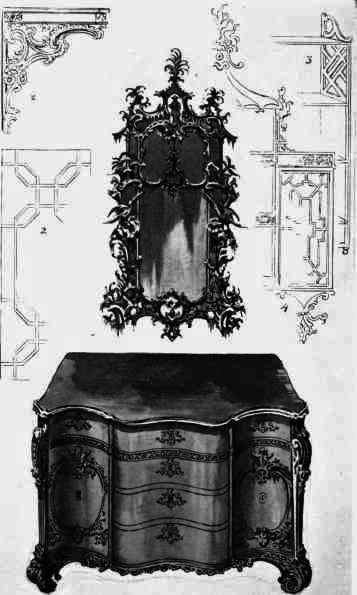
For these he gives numerous designs of trimmings for ornamental glass-doors, a specimen of which appears on Plate XLII., No. 2. Other bookcases were combinations of bookcases and writing-desks. Some of them he calls "bureau desk and bookcase." Two examples of "the desk and bookcase are shown as Nos. 2 and 3 on Plate XXXIX. One of these has many of the so-called "Gothic" characteristics, with its pinnacles and crockets, although the inverted C and shell-like scroll is in evidence, while the other is quite "Chinese," with its fretwork and umbrella - shaped ornaments despite the dripping-water decoration upon the glass doors. Sometimes another combination appears of a dressing-table with a bookcase, and a table and bookcase is not uncommon either. A writing-table and bookcase for a lady has "the middle feet come out with the drawer, which hath a slider covered with green cloth or Spanish leather for writing upon."
Chippendale designed convenient library furniture, the forms of which are solid and intended for comfort. His "buroe tables" usually consist of two square tiers of drawers hollowed out in the centre and covered by a large slab. Sometimes he makes a sweeping line as in No. 1 on Plate XXXIX. On the same Plate, No. 5 exhibits the knee-hole of another "buroe table" ornamented with a little carving. No. 5 on Plate XLI. shows one end of a "library table." Other tables are described as follows:
"A Gothic Table with different feet, the one solid, the other cut thro."
"A Gothic Writing-Table, with one long drawer at the top, doors at each end, drawers in the inside, and a recess for the knees . . . The columns are fixed to the doors and open with them . . . This table has been made more than once from this design, and has a better appearance when executed than in the draw-ing.
"A Gothic Library Table, the corners canted, and a Gothic column is fixed at each corner; that fixed upon the doors, and opens with them."
Another writing-table "hath a writing Drawer which draws out on one end and has Term feet to support it." The top "rises with a double horse to stand to read or write upon." Another plate shows a Library Table with circular doors at each corner.
A writing-table in the Gothic taste has a "recess for the knees, and the pillars are fixed to the Doors and open with them."
"A Library table" has "drawers and doors on both sides with upright Partitions for Books and Drawers for Works."
Of another Library table he says: "The ends form an oval with carved terms fixed to the Doors and which must be cut at the astragal, base mouldings to open with the Doors."
Another writing-table has drawers in the under part, small drawers and "pigeon-holes" and a place for books in the upper. In another writing-table "half of the front feet come out with the Drawer," and in one corner is a "quadrant drawer for ink and sand."
Another has a " flap on hinges in the top that rises to write upon."
Frames and brackets for marble slabs, picture frames and frames for looking-glasses, girandoles, sconces, etc., etc., appealed very naturally to the carver. The very charming bracket, No. 1 on Plate XLII. with its frets, its scrolls, shells, roses, and leaves, which was, of course, intended for gold leaf, is very simple when compared with the girandoles and mirrors, of which Chippendale has given so many examples. One frame for a marble slab (really a console table) he evidently likes. It is "supported by two piping Fauns, leaning against two vines, intermingled with foliage, etc. It will have a grand appearance," he adds, "if executed with judgment and neatly gilt." Æsop and mythology and Chinese subjects afford Chippendale plentiful suggestion for other consoles. The pier glass on Plate XLII. shows Chippendale when he is most himself. This is 44 inches high and 28 inches wide, and the frames fairly bristle with spiky tufts of grass, scrolls, leaves, flowers, dripping water and long-tailed, open-mouthed, excited birds, while at the top under a small canopy stands a Chinese holding a tray of fruit.
Continue to:


My Books

