


The Early Georgian Period. Part 4
Description
This section is from the book "French And English Furniture", by Esther Singleton. Also available from Amazon: French And English Furniture.
The Early Georgian Period. Part 4
"It is the first object that strikes the eye, on entrance and the most conspicuous part of the room, and for that reason, while he gives it the same air as the rest, let him make it somewhat richer. When the common mouldings of the wainscot have some sculpture, let those which are continued over the chimney have more, as well as be laid in greater number, and to whatever degree the rest is carried, let this part exceed it.
"Rooms that are hung are debarred by the rules of the science from the advantage of this ornament; but for all other kinds whatsoever, it is very well adapted. Where the walls are plain stucco, this upper part of the chimney-piece must have very little ornament; but even in that case, as the lower part will naturally be very plain, a light representation of its most conspicuous parts in the space above will be far from unpleasing.
"Let him (the student) not suppose this circumstance of room finished with plain stucco to be a parallel case with that of one hung with paper or damask, and in which we limited him to the use of a simple chimney. Here the space within the panel over the chimney being plain as the rest of the wall, at the same time it admits the grace of this addition, keeps up a similarity with the rest, without anything improper in itself; but, in the other case, the great contrast in the colour or figures of the paper or silk would break in upon the intended composure of the whole; and the mouldings, whether in wood or stucco, would appear to be stuck on the paper, not to rise from it, as they will certainly appear to do from the stucco-wall. The upper part of the chimney-piece, which in the case of our plain stucco-wall shews itself only what it is, that is, a light ornament continued from the lower work of the chimney, will, where there is paper or silk, have the aspect of a frame; and these will appear as pictures in it.
All know how poor this must look, since, in the reality, what could be so mean as the thought of framing a piece of the hanging?"
Having now learned from contemporary authorities the most approved styles of decoration of ceilings, walls and chimney-pieces during the Early Georgian period, we may proceed to say a few words concerning the Gothic and Chinese influence. The Chinese fad, which is often wrongly attributed to Sir William Chambers, was no new thing, as we have already seen. In the preface to his book of designs he had made in Canton, he clearly states that his object is to correct the absurdities that were daily produced for the public as "Chinese." He says:
"It was not my design to publish them, nor would they now appear, were it not in compliance with the desire of several lovers of the arts, who thought them worthy of the perusal of the publick, and that they might be of use in putting a stop to the extraordinary fancies that daily appear under the name of Chinese, though most of them are mere inventions, the rest copies from the lame representations found on porcelain and paper-hangings."
Towards the middle of the century, many books appeared by Johnson, Edwards and Darly, Halfpenny and others, giving designs for Chinese temples, arches, garden-seats, bridges, palings, etc. When Chippendale brought out his book, as we shall see, he felt compelled to bow to the prevailing taste, and give designs of Chinese character.
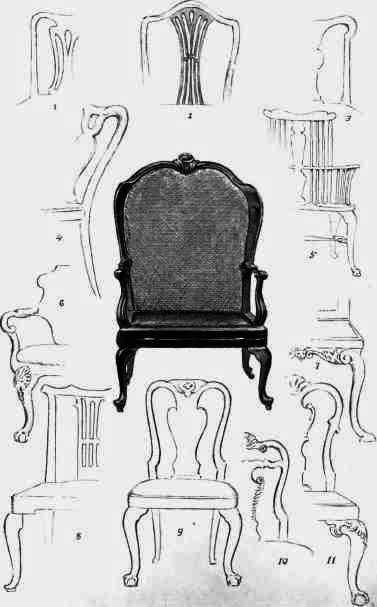
Just as the Chinese fashion is attributed to Chambers, so the Gothic revival is frequently erroneously attributed to Horace Walpole. It is true that he greatly liked to encourage that form of architecture, but the taste was reviving before he had any influence.
In 1742, Langley published his Gothic Architecture. He says it is "restored and improved by a great variety of grand and useful designs entirely new in the Gothic Mode for the ornamenting of buildings and gardens exceeding everything that's extant." The subscribers to this work included eighty-one of the nobility, two bishops, nine judges, two ladies of title, sixteen gentlemen, three carpenters, one smith and one mason."
This list shows that it was already fashionable to take interest in "Gothic." Horace Walpole was one of the subscribers, but the claim made for him of having originated revived interest in Gothic architecture is disposed of by the fact that he was not yet in possession of Strawberry Hill, and it was not till 1750 that he wrote: "I am going to build a little Gothic castle." In fact, in 1756, Isaac Ware calls it a "late taste" and implies that it is already on the wane. He writes: "The Gothic is distinguished from the antique architecture by its ornaments being whimsical and its profiles incorrect. The inventors of it probably thought they exceeded the Grecian method, and some of late have seemed, by their fondness for Gothic edifices, to be of the same opinion; but this was but a caprice, and, to the credit of our taste, is going out of fashion again as hastily as it came in. . . . The error of the late taste has been in attempting to bring the Gothic into use in smaller buildings, in which it can never look well."
The Englishmen of taste had adopted the French fondness for ruins in decoration, and real and artificial ruins in their gardens. It is said that some even dismantled their castles to have respectable ruins of their own.
In Langley's Principles of Gardening, published in 1728, this taste is catered to. Among his plates is "an avenue in perspective, terminated with the ruins of an ancient building after the Roman manner "; and eight plates are devoted to "views of ruins after the old Roman manner for the termination of walks, avenues, etc." These ruins, some of which are of a false Gothic style, are to adorn "such walks that end in disagreeable objects," and "may either be painted upon canvas, or actually built in that manner with brick, and covered with plastering in imitation of stone."
We get a faint hint of the rococo also from the following advice: "When figures of shell-work are erected in the midst of fountains, we receive a double pleasure of a fountain and cascade also by the waters agreeably murmuring down the rocky shells."
Continue to:


My Books

