


The Early Georgian Period. Part 5
Description
This section is from the book "French And English Furniture", by Esther Singleton. Also available from Amazon: French And English Furniture.
The Early Georgian Period. Part 5
Langley was far more responsible for the "Gothic" craze than Walpole was. Besides writing books on the subject, his services were engaged by the latter, doubtless on account of his being the authority of the day on that subject. Walpole's good sense, however, soon taught him dissatisfaction. When we look at the Gothic chimney-pieces and other features that adorned the rooms of Strawberry Hill, we cannot wonder at his dissatisfaction. We learn from the Gentleman:'s Magazine:
"Through the inability of his architects, particularly of Langley (who, though esteemed capital in his day, knew nothing of the art of constructing modern Gothic), his ideas were never properly executed. Mr. Walpole often complained they were rather Moorish than Gothic; however he could not at that day procure better assistance. He was always, however, among the first to depreciate his own architecture."
Mrs. Delany's letters afford evidence of the prevailing Gothic taste. In 1754, we hear: "I am working stools in worsted chenille for the Gothic cell." In 1756, she mentions a great Gothic hall in her description of Lady Oxford's house. She also says:
"The chapel is to be new built in the same taste; the alterations Lady Oxford made in this place cost above 40,000 pounds, and her apartment is the prettiest thing I ever saw, consisting of a skylight antechamber or vestibule, adorned in the Gothic way. The rooms that encompass it are a library, a dressing-room, a room fitted up with china and Japan of the rarest kinds, and a Gothic room full of charming pictures, and embellished with everything that can make it look gay and pleasant; it is lighted by a window something of the Venetian kind, but prettier, and the whole breadth of one side of the room." Then, in 1758:
"My closet is just hung with crimson paper, a small pattern that looks like velvet; as soon as dry, I shall put up my pictures; and I am going to make a wreath to go round the circular window in the chapel, of oak branches, vines and corn; the benches for the servants are fixed, the chairs for the upper part of the chapel are a whim of mine, but I am not sure till I see a pattern chair that I shall like it; it is to be in the shape and ornamented like a Gothic arch."
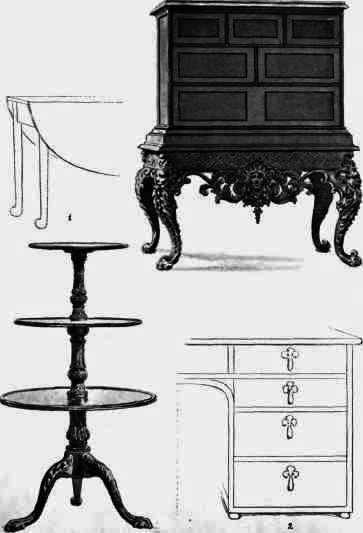
Hogarth should be a very valuable guide to the furniture of this period. As a rule, however, he seems to care very little about the delicate details and generalizes the forms, giving an impression of excessive heaviness and clumsiness. However, occasionally we get a good hint, as in the bed in the scene of the countess's toilet in Marriage a la Mode. One of Hogarth's tables is shown on Plate XXVIII., No. 1. It will be noticed how little trouble he has taken to indicate the special kind of foot, whether hoof or ball-and-claw. An escritoire from one of the plates of the Industrious Apprentice is shown on Plate XXVIII., No. 2. The ball-foot and drop-handles are clearly shown in this. One of Hogarth's chairs, which was a very common pattern during this period, is that of No. 4, Plate XXVII. The models also numbered 9, 10 and 11 are generally known as Hogarth chairs. No. 7 is one of Halfpenny's designs for a Chinese chair. Nos. 1, 2, 3, 6 and 8 are also types of chairs in use before Chippendale brought out his book. No. 5 is an early model of the "Windsor chair," which came into favour during the reign of Queen Anne and maintained its place for a century and a half.
This chair dates from about 1710. The central drawing represents a folding chair-bed.
The frame is of mahogany and the back filled with cane. The back is curved at the top and straight at the sides, which have two curved pieces, or wings, projecting forward. The arms are curved and the four cabriole legs end in club feet. The backs of Nos. 9, 10 and 11 on this plate curiously agree with the form of the fireback No. 3 on Plate XX. This general model appears in the inventories as the "Crown-back chair." With the exception of the Windsor chair, which was very often made of cheap wood, the chairs on this plate were made of walnut or mahogany and upholstered with velvet, cloth, leather, Turkey-work, leather, or haircloth plain or figured.
The seat is movable, and no upholstery nails or braids were used, the frame of the wood giving the necessary finish. The dumb-waiter on Plate XXVIII. dates from about 1740: it is of mahogany decorated with incised floral pattern in outline. No. 2, Plate XXVI., shows a toilet swinging-glass dating from about 1730 which exhibits a little of the French influence. It has a wood frame carved and gilt with flowers, foliage and scroll ornament. Nos. 1 and 3 are other common forms of mirrors of this period. The frames are frequently of mahogany picked out with gold.
The general proportions of the room shown in Plate XXIV. are taken from Hogarth's Marriage a la Mode.
As a rule, the bed was the four-poster of oak, walnut or mahogany draped with upper and lower valances and curtains. The window curtains always matched those of the bed, and unless the chairs were of cane, or leather, they were also covered with the same material.
These hangings were of silk or worsted damask, serge, flowered or figured russell, harrateen, camlet, mohair, or chintz. Numerous products in silks and cotton from India were also used. The Early Georgian bedroom was seldom draped in white: the different bedrooms frequently are described as the "Blue," the "Yellow," the "Red," or the "Green Room."
Sometimes a room contains an alcove and an alcove bed after the French style, and the field-bed is not unfamiliar. The latter, however, is chiefly reserved for the unimportant bedrooms.
The furniture includes small chairs and easy chairs, chests-of-drawers, cases-of-drawers, chests-upon-chests, sometimes a press, a secretary, and almost invariably two or three tables. One small table always stood by the bed for such conveniences as a candlestick, etc.
The dressing-table was a case-of-drawers, such as is seen to the right in Plate XXIV. Upon this is spread a toilet and over it hangs a mirror. This is, of course, a species of commode. This piece of furniture of late years has been called improperly a "low-boy," as the high case-of-drawers that sometimes stands on cabriole legs and sometimes on six spindle-shaped legs joined by stretchers, has been called a "high-boy." Another variety is the chest-upon-chest consisting of a double case-of-drawers.
These pieces are made of mahogany, walnut, cherry, or they are japanned, painted with Chinese or Japanese subjects and lacquered, or painted and lacquered in imitation of the French work of the day. The tall clock is also frequently japanned and brightened with brass mounts. The frames of looking-glasses and pictures are also frequently lacquered.
Engravings and mezzotints, which are very much in vogue, are framed in this style, or in black. Although the grate is rapidly gaining favour, the brass andirons have not been banished. In either case the hearth furniture, tongs, shovel, etc., is of brass, more or less ornate.
Two bedrooms described in 1738 will give an idea of the appearance of the sleeping-rooms of the age. One was a Green Room; the bed-curtains, window-curtains, and chair coverings were of green harrateen. The floor was covered with a Turkey carpet, and the chimney-piece was bright with brass andirons and other hearth furniture. A pier-glass was hung between the windows, and the rest of the furniture consisted of twelve chairs and a couch, a dressing-glass and drawers, a bureau-table and three large sconces with arms.
The other room was furnished in yellow mohair. There were six chairs, a large chair, two stools, a desk and bookcase with glass doors, a dressing-table and glass, a chimney-glass and sconce, a bed and brass andirons, etc. The window curtains and window cushions matched the bed, whose bolster and counterpane, as well as draperies, were of yellow mohair.
Continue to:


My Books

