


The Renaissance. Part 3
Description
This section is from the book "French Furniture", by Andre Saglio. Also available from Amazon: French Furniture.
The Renaissance. Part 3
If, however, in spite of the reasons we have urged against it, the belief is still retained that the remarkable decorations of these palaces were to a great extent the work of Italians who were living in France, no one will be disposed to deny the simple character of the chest in the Carnavalet Museum, see Plate XVIII., page 74. The boldness of the carving recalls the broad treatment of the best Gothic period, and there is no doubt that it was designed by a Frenchman of good taste. Of the armoire, too, of which we also give an illustration, the same thing may be affirmed, enriched as it is with groups of goddesses in landscape scenery, foliage and flowers, eagles and sirens set in a background of graceful, well - proportioned architecture, resembling Lombard damascening on Parisian armour. Lastly, as a final and clinching argument, have we not the fine doorway of the Cathedral of Beauvais? all the ornamentation of which is in the antique style, and the author of which we know to have been a true Frenchman, Jean le Pot, who has actually stamped his work with a souvenir of the old masters he would have been the last to disown, by representing Jerusalem as a Gothic church in one of his bas-reliefs.
The national art of France, then, continued its development without a break, like a strong chain some of the links of which were of gold whilst others were of alloy. The century we have just been considering is one of the latter, but if the metal was not quite pure, never was its workmanship more delicately skilful. The costly expeditions to Italy had as happy results for the cultivation of French taste and the refinement of French manners as had the Crusades in a more barbarous age. It was in the reign of Charles VIII., that the word "courtesy," derived from "court," first came into use, and that the nobles, back again from their warlike expeditions on the other side of the Alps, began to look upon military virtue, not, as did Charles the Rash, as skill in fleecing others, but as a pledge to keep the word once given, to be true to king and flag, to merit the title of a loyal servant, of a knight without fear and without reproach, won by Bayard under Louis XII. and Francis I. The moral progress of the aristocracy was reflected amongst the people, and resulted in the springing up of the elite cultivated class of the bourgeoisie. Mixing with Italian society had taught the lesson that talent should be honoured, however lowly the position of its owner.
Francis I., a highly educated king, of artistic tastes, visited Leonardo da Vinci on his deathbed, delighted in the conversation of Guillaume Bude, provost of the merchants, who advised him to found, the College of the Three Languages, out of which grew the College of France, encouraged Robert Estienne to develop the art of printing, then recently discovered by Gutenberg, enriched Amyot, the translator of Plutarch, and protected with his powerful friendship the admirable audacity of Rabelais.
However foreign to our subject these considerations may appear, they are, in our opinion, indispensable to its complete comprehension, for they explain the promptitude with which the nation, flooded with so many new revelations, accepted an art suggestive of a refinement hitherto unknown. On the other hand, lavish display seemed to be more than ever a necessity even to commoners. In the reign of Louis XII. Charles Seyssel wrote: "Throughout the kingdom great buildings are being erected on every side, public as well as private, covered with gilding, not only on the wainscotting and the walls of the interior, but also on the outside, the roofs, the towers, and the statues; the houses are furnished, too, with all mannerof costly things, such as were never seen before. Moreover, silver dishes are used by all classes to such an extent that it has been necessary to issue an order to check this superfluity" - it was annulled two years later on account of its uselessness - " for there is a certain set of people who will not be content unless their cups, goblets, ewers, and spoons are of silver at least."
What would the historian of Louis XII. have said if he could have seen what the luxury of France became under that monarch's successor I The Field of the Cloth of Gold, a city, enduring but for a day, on which the treasury of the kingdom was squandered; the Court of Fontainebleau, where the young Catherine of Medici, the daughter-in-law of the King, at the head of fifty ladies chosen for their beauty, organised incredibly lavish fetes; and those other almost as luxurious courts such as that of the Marshal of St. Andre, who on his estate of Vallery surpassed even his sovereigns in the magnificence and beauty of his rare and exquisite furniture, or that of Bonnivet who had the weapons of all the soldiers of his army engraved and gilded.
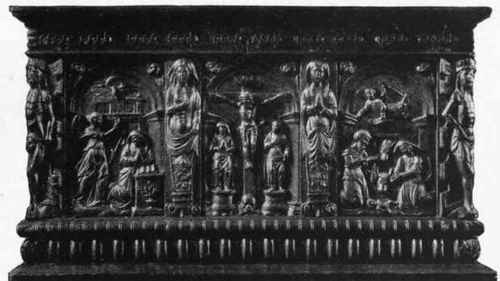
Plate IX. CHEST. Beginning of XVI Century. Cluny Museum, Paris.
Continue to:


My Books

