


How To Make A Climbing Vine Trellis
Description
This section is from the book "Furniture A Girl Can Make", by William W. Klenke. Also available from Amazon: Furniture A Girl Can Make.
How To Make A Climbing Vine Trellis
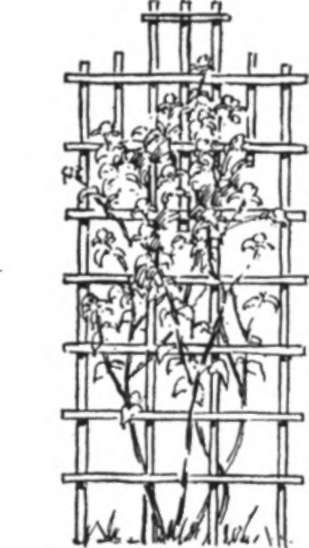
This trellis is designed to support all kinds of climbing vines, such as honeysuckle, clematis, trumpet vine, climbing nasturtiums, roses, etc. It is intended that this trellis be fastened against a wall or fence of some kind to give it the necessary support. Space however, must be allowed between the wall and the trellis, so that the vines can weave their way in and out, through the lattice work.
The best woods to use for a trellis are cypress, genuine white pine, red wood, spruce and fir.
The strips are of stock sizes—that is 7/8"x13/4", sometimes sold as 3/4"x15/8", and come in all standard lengths. This lumber is not expensive to buy, but a still cheaper job and a very satisfactory one can be worked out by using common spruce furring lath, such as is used for roofing and the like. Of course, this material may be rough on one side and will have a few knots. Paint will cover up many of these defects.
A good size to make a trellis of this kind is 3' 6" wide and 7' 6" high. Allow the ends of the horizontal pieces to project about 21/2" beyond the upright pieces.
Method Of Procedure
Step No. 1: Cut all pieces to the desired lengths. Place all the vertical pieces together and all the horizontal pieces each in a separate group. Now mark off at one time (each group separate) where the other member will cross these pieces.
Step No. 2: Use common wire nails, either 5 penny or 6 penny, depending on the thickness of your wood, and nail the members together. The nails should be long enough to go through both pieces and project so that the nail can be clinched over (bent over) on the back and thereby securely holding the pieces together.
Step No. 3: Paint this trellis with at least two coats (three would be better) of a good quality of outside oil paint, using white or a light cream color so that the wood work will show between the green vines. After the first coat of paint, putty all holes or open joints. If you prefer to mix your own paint instead of purchasing same, it is an easy task and is done in the following manner.
The first coat should be made with about one-half turpentine and one-half raw linseed oil with a little drier. The second coat should contain less turpentine and more oil and just a little drier. The third coat should have no turpentine at all; use nothing but raw linseed oil and a small amount of drier. Color of course, is added to all coats, if you wish to use a color.
Block out the trellis from the wall or fence before fastening it in place. Use screws for this purpose.
Continue to:


My Books

