


Chapter VI. English Furniture Of The Eighteenth Century
Description
This section is from the book "How To Collect Old Furniture", by Frederick Litchfield. Also available from Amazon: How To Collect Old Furniture.
Chapter VI. English Furniture Of The Eighteenth Century
The term Georgian - Dutch influence on English furniture, the use of mahogany - Gillow established. Thomas Chippendale - Early work - "The CabinetMaker and Director" - Influence of Sir W. Chambers - Chippendale's second period - The Society of Upholders and Cabinet makers - Chippendale's designs. Haig and Chippendale - An old account quoted. Ince and Mayhew - Their book of designs. Contemporary Manufacturers - Thomas Johnson, Mathias Lock, Manwaring. A Heppelwhite and Co. - Book of designs and list of patterns - Influence of Robert and James Adam. Gillows - Popular fancies. Thomas Sheraton - " The Cabinet maker and Upholsterer's drawing book " - Designer rather than Manufacturer - Some particulars of his career - His designs and criticisms on his contemporaries. Painted and Enamelled Furniture - The Adam influence - Contemporary artists who painted furniture - Wedgwood's plaques inserted - Process of finishing painted furniture - Old and new work - Museum references.
IT is a curious instance of the whirligig of fashion that the term " Georgian," which thirty years ago was applied to architecture and clumsy and massive buildings, affecting the classic style of the ancient temple, but lacking its proportions and dignity, should lately have become a term to denote a fashionable period of taste. The word was one of reproach and contempt, as if to say, making a vulgar pretence, "Georgian!" Now we have rooms, chimney-pieces and furniture, advertised and recommended as " Georgian," by which it is meant that they are of the time including the reigns of the four successive English kings, from 1714 to 1827, and therefore the period of the history of furniture which covers the careers of Chippendale, his contemporaries and immediate successors.
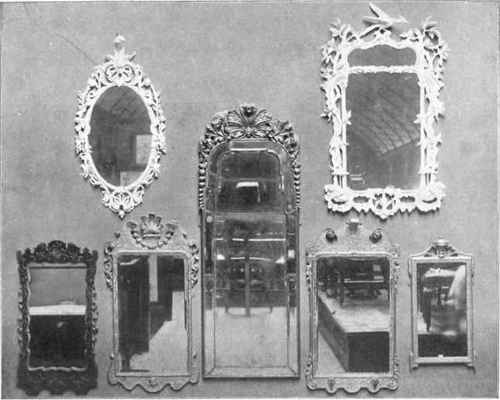
ENGLISH MIRRORS IN WALNUT WOOD, ALSO CARVED AND GILDED EARLY EIGHTEENTH CENTURY.
In the chapter on Dutch furniture I have endeavoured to show that at the end of the seventeenth, and during the early part of the eighteenth century, that is, from the accession of William and Mary to the death of Queen Anne, a strong Dutch influence was impressed upon our English furniture. To this time belong the early specimens of our "grandfather" clocks, the old-fashioned bureau-bookcase, the chair with cabriole leg and claw-and-ball foot, and a flat-shaped "splat" in the back; mirrors with narrow walnut-wood moulded frames, the larger ones having the glass in two or three divisions, chests of drawers inclosed by two doors of walnut wood, veneered in patterns formed by the figure of the wood running different ways, and such smaller articles as the tripod stand for a basin, and the work table fitted with contrivances for winding silks, and other ladies' accessories: the harpsichord and spinet, the quaint card table with cabriole leg, sometimes ornamented with an eagle's head; and English lacquer made in imitation of that which originally came from China and Japan. These form a rough list of some of the articles of furniture about this time.
The use of mahogany was becoming fashionable, for, although discovered as a rare wood more than a hundred years previously, it was not until the first quarter of the eighteenth century had turned, that it was extensively used in the manufacture of furniture. The house of Gillow was founded in Lancaster at the end of the seventeenth century, although the London branch was not opened until 1765, and this firm's reputation for well-made solid mahogany furniture was then established.
Continue to:


My Books

