


Dutch Furniture. Continued
Description
This section is from the book "How To Collect Old Furniture", by Frederick Litchfield. Also available from Amazon: How To Collect Old Furniture.
Dutch Furniture. Continued
The "sea weed" pattern marqueterie, which has been so called on account of the holly-tree pattern resembling a marine plant, was a favourite kind of inlay in Holland, and is still found in tall clocks, bureaus and tables now generally called "Queen Anne" furniture. Another peculiarity of Dutch marqueterie of this time and later, was the enriching of the floral pattern inlay by adding ivory and mother-of-pearl to the design, which generally consisted of holly-wood leaves and flowers stained a yellow tint on a dark coloured ground, sometimes walnut-wood and sometimes a West Indian veneer the colour of teakwood.
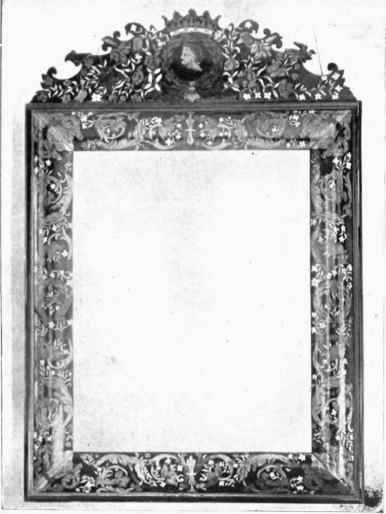
DUTCH MARQUETERIE MIRROR FRAME EIGHTEENTH CENTURY.
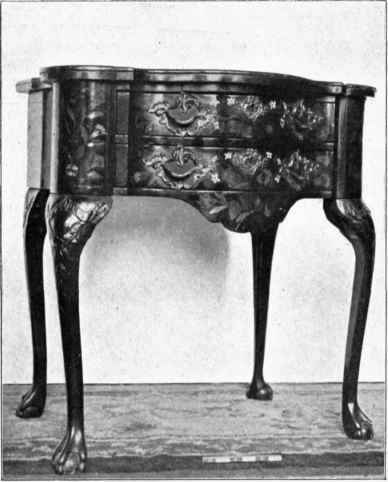
DUTCH MARQUETERIE TABLE EIGHTEENTH CENTURY.
Some of the Dutch furniture is particularly massive and cumbersome, the huge wardrobes, slightly bombe in front, and with scroll pediments, have doors and drawers so thick and heavy that only a huge room can accommodate them. The oak armoires or presses of Dutch make, are generally straight-fronted, and a feature of their design is an arrangement of three fluted pilasters or half columns, with a carved base about a foot high, the rest or upper part of the column or pilaster being fluted and having a carved capital of Ionic or Corinthian character. Between these pilasters are panels, the rails of which are moulded, and the centres carved with flat scrolls in low relief. Not infrequently some small centres of black stained pear-tree and some lines of the same colour give a relief to the oak, and this by the way is not so richly figured as is the English wood of the same period.
About the time of Louis XVI in France and of George III in England,when the rococo style gave way to a more severe school of design, the Dutch made a great deal of excellent mahogany furniture, often mistaken for Chippendale and Heppel-white work. The wood itself is well-selected and rich in figure, the construction is sound and workmanlike, such carving as there is corresponds rather to the work of Heppelwhite than to that of Chippendale, but the pieces themselves are more massive than was the English work of the period.
Wardrobes with column supports having capitals and bases of brass work, the cornices dentelled and surmounted by triangular pediments, often broken in the centre for the introduction of a flat-shaped vase; some festoons of carved drapery in the upper parts of the doors, and a neat carved enrichment running round the drawers, are some of the salient features of a good old Dutch piece of about 1770-1780, probably very familiar to many amateurs of old furniture.
Card tables of solid plain mahogany, bureaus, and tall clock cases, tripod vase or lamp holders, napkin or linen presses, and cabinets for holding Delft ware and old Chinese porcelain, were all made in this good old mahogany.
If I may add a word of advice to the reader, it is that this class of old Dutch furniture is well worth attention. Now that old English cabinet work of the time has reached a price that only the very wealthy can afford, this good honest work of the latter part of the eighteenth century of Dutch make is excellent value if judiciously bought, and is certain to attain a much higher price as really well-made old furniture becomes more scarce.
About a hundred years later, that is, some forty years ago, the marqueterie furniture made in Holland deteriorated - several dealers in Amsterdam, Rotterdam and Utrecht bought up quantities of inferior furniture, and, to use a trade term, "smothered it with marqueterie;" flowers, birds and butterflies cut very coarsely, and of crude and vivid colours, were applied carelessly and in the cheapest manner for shipment to this country and periodical sales by auction. The inlay started and split, sometimes the body of the piece acted in a similar manner, as soon as it was placed in a hot room. These sales were carried on for several years, the marqueterie sent over being sold for very low prices by auction, and then being " done up " by the trade and made the best of, but after a time the fabrication or meretricious decoration of this kind of furniture became unprofitable and ceased. One cannot help wondering what has become of the shiploads of Dutch marqueterie which from twenty to thirty years ago used to pass through the hands of Messrs. Jones and Bonham at those frequent sales. Some, no doubt, has survived by reason of expensive restoration and partial reconstruction, but much must assuredly have perished. It is this kind of work which for a time gave to Dutch marqueterie such a bad reputation that to be "Dutch" was to signify inferiority.
Belgian work must come under the heading of Dutch furniture, and although much of the older oak work, in panelling and furniture, is of good quality and workmanship, the desire to provide the English consumer with a cheap article, has damaged the reputation of the Belgian manufacturer.
During the past forty or fifty years sideboards with florid trophies of fruit and dead game, chairs of a floral pattern, all made in the poorest quality of oak and carved in the most atrocious manner, have flooded our markets. The price has been almost incredibly cheap - fifteen shillings and even less for a high-backed chair with legs, stretcher and frame covered with carved work. Bookcases and buffets with scrolls and lions' heads ending in foliage, stained a more or less "antique" colour,sold "in the white," that is, unstained, for a few pounds, have unfortunately fostered a considerable trade in this very undesirable kind of merchandise, which has declined in popularity as the taste of Englishmen, even of the middle class, has become more refined.
In the South Kensington Museum the reader will find some good representative specimens of old Dutch furniture of the different periods and classes noticed in this chapter, and it will be seen from these that Holland has been a very important factor in the history of the furniture of Europe, and particularly in shaping the taste and traditions of English furniture of the last two hundred years.
This is so much the case that in dealing with our great English makers of the eighteenth century, I propose to pass over the early part of that period, because practically the history of that time would be mainly a repetition of what has been said in this chapter under the heading of the Dutch furniture of the same period.
Another class of old Dutch furniture, of which one finds specimens occasionally, demands a short notice. About the middle of the eighteenth century there was apparently a fashion for painting some of the furniture. Sometimes it was prepared much in the way that the Vernis Martin work was done in France, and not unlike in appearance the finished panel of a carriage, with pictures of ships and portraits of native statesmen or celebrities on horseback or seated in council.
This work is said to have been more prevalent in the north of Holland, where it was also the custom to pick out some of the oak furniture with colours, generally red and green, which, with parts of the oak left a rich warm brown tint, has a pleasing effect. One has seen folding tables of this kind of decoration, in form not unlike the one which is illustrated in my Jacobean chapter. A few years ago when some demand set in for old Dutch painted furniture, the dealers bought up the old sleighs, and snow chairs which had good painted work, and made them up into cabinets.
Similar painted work was also made in Norway and Sweden, and when both are of similar date, it is almost impossible to say which is Dutch or which Scandinavian, unless there be something in the character of the painted panel subject to help the distinction.
Continue to:


My Books

