


Jacobean Furniture. Part 3
Description
This section is from the book "How To Collect Old Furniture", by Frederick Litchfield. Also available from Amazon: How To Collect Old Furniture.
Jacobean Furniture. Part 3
Another ornament characteristic of this period is that which for want of a better description has been called "the split balustrade ornament," on chests, presses, and tables. These turned and split balustrades, or short sections of them, are laid on to the flat surface, generally on the rail of a panel, the panel itself being carved somewhat richly.
Bombay and Indo-Portuguese furniture, made of ebony or "blackwood," was imported from one of the new queen's possessions, given as part of her dowry by the King of Portugal. Some of this furniture is at Penshurst Place, and a famous chair of the kind is in the Ashmolean Museum at Oxford, having been given to Elias Ashmole by King Charles. The furnishing of Hampton Court Palace for the reception of the new queen was, according to Evelyn the famous diarist, a very extravagant and costly business; the bedstead and hangings cost £8,000, and other furnishings, tapestries and accessories, were in accordance with this lavish outlay. We may gather from these and other signs that the time of Charles II was one of much more comfort and luxury in the furniture of the upper classes than had previously been the case.
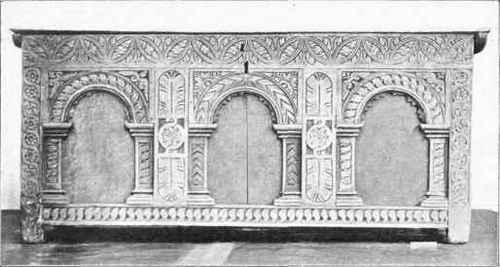
JACOBEAN CHEST IN CARVED OAK SEVENTEENTH CENTURY.
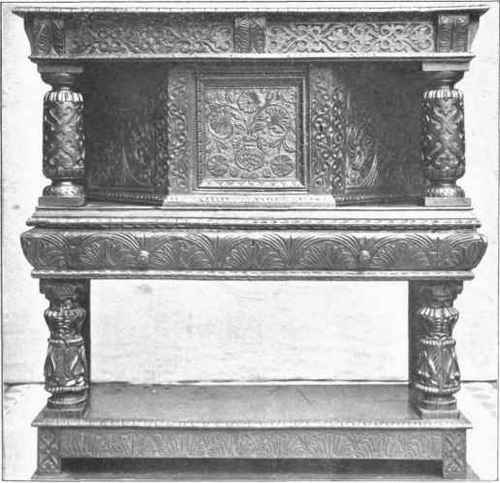
JACOBEAN COURT CUPBOARD IN CARVED OAK SEVENTEENTH CENTURY.
It is a sad pity that the Great Fire of London, in 1666, destroyed so many public buildings, and with them the ancient Halls of the City Guilds, which would otherwise have preserved to us so much valuable and interesting furniture. Some few of these were only partially destroyed, and were rebuilt and furnished within a few years of the great catastrophe, amongst them being the Brewers' Hall and the Stationers' Hall, the Mercers' Chapel, the House of the New River Company, and some others. These contain furniture dating from the latter half of the seventeenth century, which the reader should take an opportunity of examining if he can obtain the permission of the clerks of the companies to do so. The Master's chair of the Brewers' Hall, is massively carved and characteristic, showing the heavy swags of fruit and flowers which were coming into our English carvers' scheme of design at this time.
To the reign of Charles 11 belongs the introduction of Grinling Gibbons, who doubtless influenced our school of carving. Evelyn is said to have discovered him about 1670, and brought his work to the notice of the king, who gave him an appointment in the Office of Works, favoured him with orders for Windsor Castle, Hampton Court Palace, St. Paul's Cathedral, and other palaces and churches. Gibbons became the fashion, and with his pupils, Samuel Watson, a Derbyshire man, Drevot of Brussels, and Lawreans of Mechlin, carved and decorated the interiors of Chatsworth, Petworth, Burleigh, and many other country houses. Grinling Gibbons used pear-tree wood for his work, which nearly always consisted of groups of fruit and flowers very elaborately carved, with a great amount of undercutting and in full relief. It is a highly realistic kind of ornament and has great merit, but the difficulty of keeping such fragile work in a fair state of preservation is a great drawback, and, moreover, the most highly-carved panels are so elaborate that they seem somewhat out of place as part of the woodwork of a sub-stantial building.
The reign of James II was too short to leave any particular record of change in the style of woodwork, and we are now approaching the time when the Dutch influence, which had already shown signs of power during the reign of Charles II, was to become more strikingly predominant when William III came to the throne.
Another very important factor, which has been noticed m the chapter on French furniture, was the importation from the West Indies and from America, of a great variety of woods available for the manufacture of ornamental marqueterie. Mahogany, although discovered, was not in general use until after the first quarter of the eighteenth century, but walnut was used largely in Holland, and furniture of this material was being brouoght over to England at the end of the seventeenth century Jacobean furniture other than that gilded or upholstered, was made of oak of English growth, tough in fibre and rich in figure. It was designed, as we have seen, in the earlier part of the century on severe and restrained lines, gradually increasing in ornament and comfort as the customs and habits of the people required, and as importations from other countries influenced our native craftsmen. Writers and connoisseurs are, however, agreed in regarding the English joiners' work of the seventeenth century as the best of its kind, good, honest work, which, owing to the quality of the oak and the sound principles of construction, will enable those who possess examples to hand them on to future generations. Besides the difference in the appearance of the oak itself, its grain and figure, which is so much better than the oak now imported from the Baltic and from America, there are signs of good Jacobean work missing from modern joinery unless placed there for the purposes of deception. Nearly all the mortise joins are riveted with oak pegs, the ends of which are generally to be seen where the tenon has been put into the mortise. The colour of good old Jacobean furniture should be of a rich warm tint, not the dead black of the modern so-called "antique" rubbish, but a fine surface obtained by the coating of beeswax and turpentine with which the wood was originally dressed, and to which two hundred years of rubbing and wear have given a fine surface, that can scarcely be imitated, and with which it is very important the amateur should make himself quite familiar.
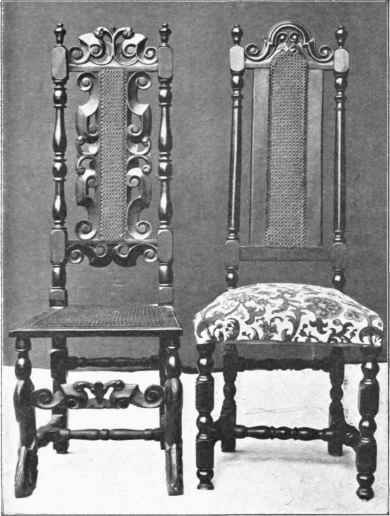
JACOBEAN CHAIRS IX CARVED WALNUT.
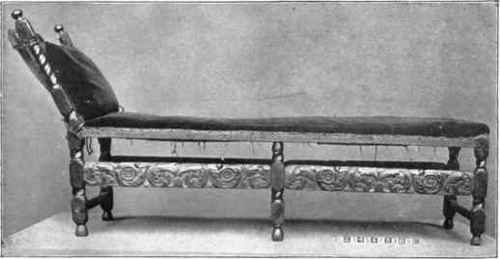
JACOBEAN SOFA IN CARVED OAK LATE SEVENTEENTH CENTURY.
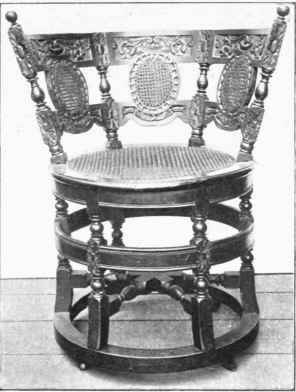
JACOBEAN CHAIR IN CARVED OAK DATED 1640.
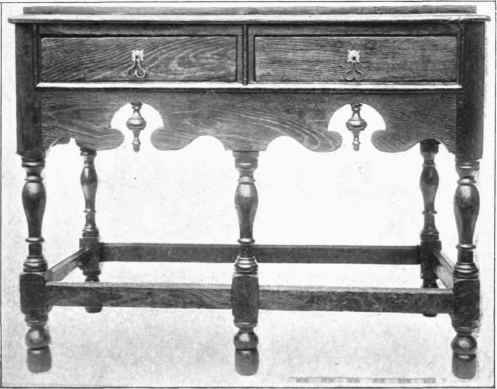
JACOBEAN SIDE TABLE IN OAK.LATIi SEVENTEENTH CENTURY.
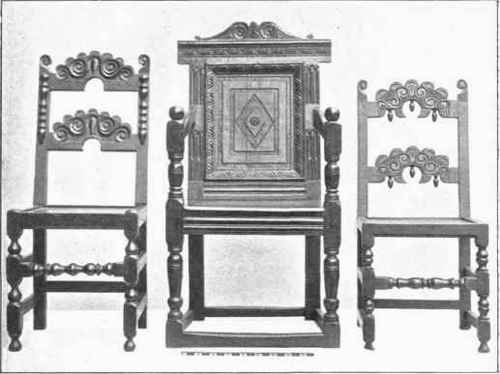
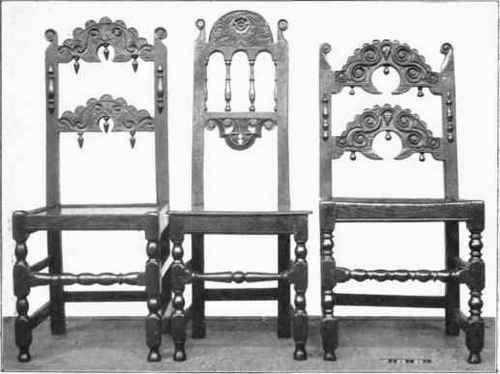
JACOBEAN CHAIRS IN OAK LATE SEVENTEENTH CENTURY.
It is also the period during which, as we have seen, richly upholstered furniture was made in England, velvet, tapestry and needlework being used. In addition to the chairs, sofas, and stools at Knole, there are some exceedingly handsome settees, originally carved and gilt, with beautiful velvet coverings, embroidered with the reversed "C" cypher of Charles II, to be seen at Holy rood Palace. They are in a dilapidated condition, but serve to show what handsome furniture of this kind was in use.
In Dalkeith Palace there is also some beautiful furniture of the Jacobean time. This place has a peculiar interest, because some of the best pieces were given by Charles 11 to his son, the Duke of Monmouth, and after his rebellion and execution, the house was built and furnished by his widow, who married into the Buccleuch family, and it has remained there ever since.
The illustrations from photographs of the collection in the Victoria and Albert Museum, South Kensington, give an idea of the oak-work of this important period.
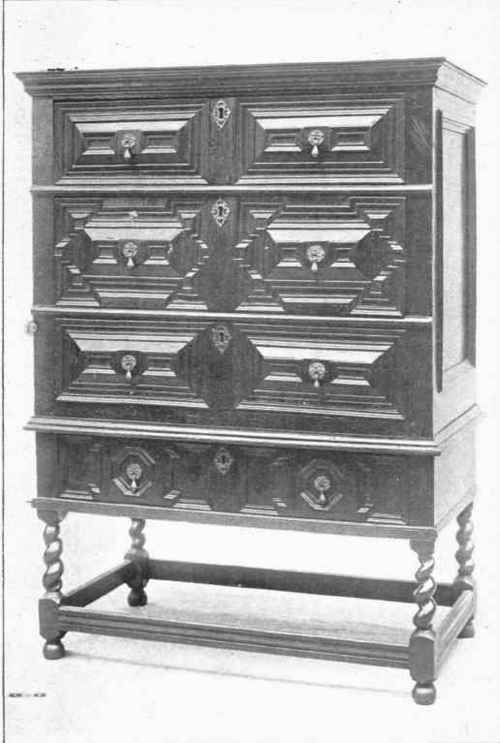
JACOBEAN CABINET IN OAK QUEEN ANNE PERIOD.
Continue to:


My Books

