


Chapter III. French Furniture
Description
This section is from the book "How To Collect Old Furniture", by Frederick Litchfield. Also available from Amazon: How To Collect Old Furniture.
Chapter III. French Furniture
Change from Gothic to Renaissance - Furniture of LouisXIII period. Louis Quatorze - Public collections of French furniture of this period - Berain and Lebrun - Andre" Charles Boulle, his work and methods - Boulle's successors - Reproductions by eminent makers, premiere et contre partie - Marqueterie of West Indian veneers, designs of Riesener - Chinese lacquer used for furniture. The Regency Period - Change in style and characteristic ornaments of the time. Louis Quinze - Change in French manners and customs - Caffieri and his work - The subjects of tapestry used for furniture - Introduction of lighter articles, and descriptions of them. Louis Seize and Marie Antoinette - Influence of the Queen - Change of fashion - Pierre Gouthiere and his work - Vernis Martin - Style of panels and difference in treatment of interior decorations. The Directory - Changes brought about by the Revolution - Pseudo-classicalism of the period - The National Convention. The First Empire - Napoleon as Caesar - Introduction of Egyptian ornament - Characteristic features of furniture of the time - Massive carved and gilt chairs - Furniture subsequent to the time of Napoleon. Reproductions - Different kinds of reproductions of the best pieces - Remarks and suggestions.
IN France, as in other countries, the mediaeval period of art gave way to fifteenth-century Gothic. In such beautiful monuments of delicate tracery in stone-work as Rouen Cathedral, we can see to what perfection of design and intricate detail, the French architect and craftsman could manipulate the stone of Caen. The woodwork interiors, and such furniture of a movable kind as were in use in those early days, followed the lines of the stone-work, and French Gothic wood-carving was unsurpassed. Unfortunately very few examples remain after the lapse of nearly five hundred years, and it is only by studying such fragments of panels, mouldings and carved ornament, as are to be found in the collection of Emile Peyre, very wisely purchased by the Victoria and Albert Museum a few years ago, that we can estimate the merit of wood-carving in France of the fifteenth century.
In the chapter on Renaissance furniture, some reference has been made to the great change that came about in Italy during the fifteenth century,and was carried to France during the reign of Francois Premier. During the lifetime of this king- and his successors, the Renaissance movement in art, and particularly in stone and woodwork, held sway with varying taste, from pure to debased, but for the purpose of this handbook we can only give a rapid glance at this century of art progress, and hurry on to a time nearer our own, of which there are more examples preserved to us.
For those who would study the furniture of the French Renaissance, there are excellent works by able authors, and the Cluny Museum contains beautiful specimens of the best and also of the later periods. Besides those which are in such public collections, there are few pieces of really authentic furniture of this time to be found. Occasionally what appears to be an old buffet, chair, or credence comes to light, but a careful examination will generally reveal the fact, that, while a panel or a piece of carved ornament is of the period, the remainder has been made in the style of such a piece of furniture as was evidently suggested by the genuine old fragments.
During the reign of Louis Treize, furniture became more comfortable, and there was more variety. The chairs were high-backed, and were, for the first time, made with arms; the legs and stretchers were visible and were of oak or walnut wood, the high backs and seats were covered with tapestry from the looms of Beauvais. There is a kind of marqueterie which we now identify with this period; it is rich in tone and full of design - the scheme of decoration being a number of panels or cartouches with baskets or bouquets of flowers in each panel; the mountings, if there be any, are of carved and gilt wood, instead of the cast and chased gilt bronze which came into fashion some fifty years later. In the Victoria and Albert Museum there is a cabinet of this style and period deserving careful attention.
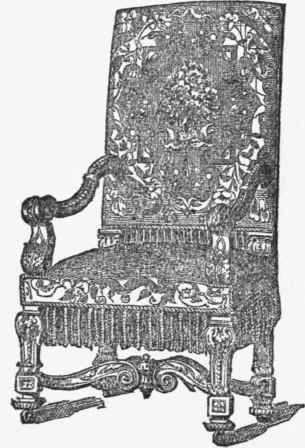
ARMCHAIR IN TAPESTRY (EARLY LOUIS QUATORZE).
Continue to:


My Books

