


The First Empire
Description
This section is from the book "How To Collect Old Furniture", by Frederick Litchfield. Also available from Amazon: How To Collect Old Furniture.
The First Empire
Then followed the Napoleonic period. As first Consul and afterwards as Emperor, Napoleon I loved to pose as Caesar; his portraits by Canova in marble represent him as a Roman Emperor crowned with a garland of bay leaves; and in war and politics the role of a Roman conqueror seems to have possessed him. The imperial stamp is on everything, and we find the idea of copying the models and shapes of antique Greece and Rome developed and more pronounced than during his consulate. In 1798 Buonaparte, as the general of the Directory, had fought the battle of the Pyramids, and this gives us a date for the introduction of the sphinx and other Egyptian ornaments into French decorative art; later on we find this Egyptian influence, together with the Greek and Roman ornament, paramount. Stiff-winged figures holding garlands of victory, their feet close together like those of the Egyptian bronzes; animals' feet adapted to ornament the legs of chairs and tables; the conventionalized honeysuckle ornament, which originated in Egypt and was adopted by Greece, used as a frieze for table or cabinet; these are all favourite decorative emblems of this time. The furniture itself was generally made of simple but richly-figured Spanish mahogany, stiff in form and classic in type; mahogany columns formed the legs of tables, and had capitals and bases of gilt bronze. Stiffly-draped figures of Terpsichore or her sister Muses, winged female figures, garlands, chariots of Roman conquerors or eagles, Roman fasces, griffins or sphinxes were salient ornaments. Lions' heads formed the handles and their feet adorned the bases of furniture. Whatever difficulty there may be in deciding between some of the earlier styles, there need not be much hesitation in assigning French furniture of this type to that of the late time of the Directory or to that of the First Empire. There is one great merit that this rather aggressive kind of furniture possesses, and that is the excellent quality of the work itself: cabinet work, chasing, gilding, all are good of their kind. The more ordinary and domestic furniture followed the lines of the richer descriptions. Instead of the mounts being many and rich, they were fewer and less ornate, sometimes made of carved wood instead of metal, and painted a colour to imitate green bronze.

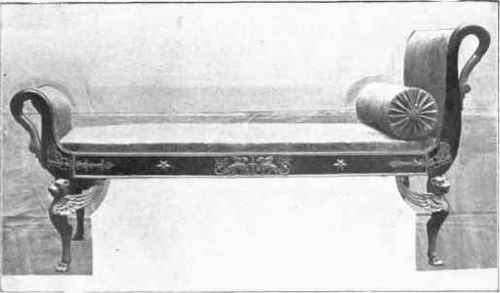
FRENCH CHAIR AND SOFA OF THE FIRST EMPIRE PERIOD.

A MASSIVE CARVED AND GILT CHAIR OF THE FIRST EMPIRE, DESIGNED BY LECONTE.
The coverings of the chairs and sofas of the period corresponded, and carpets, curtains, and also the decoration of walls and ceilings. Red, green and yellow silks embroidered or woven with wreaths, lyres, or the conventionalized honeysuckle in silver and gold were suitable for the richer kinds of seats.
The carved and gilt furniture was particularly splendid, and some of the massive throne-like chairs we still occasionally find, seem to remind us of a triumphant Marechal of France during Napoleon's successful campaigns.
The Palace of Fontainebleau, about forty miles from Paris, is very rich in specimens of the best kind of Empire furniture, it was furnished by Napoleon in the days of his prosperity.
Since the First Empire there has been no pronounced style in French furniture. As fashion has changed it has been the mode to reproduce Henri Deux or Louis Quatorze, Louis Quinze or Louis Seize. Military expeditions and conquests have, from time to time, left their mark, as when the Tonking campaign caused the revival of a taste for Chinese models and shapes for furniture. Blackwood cabinets, tables and chairs were inlaid with mother-of-pearl and carved with fantastic designs; and later on there was an Algerian and Tunisian influence on some of the more fanciful articles of furniture, but the different epochs of taste which I have briefly referred to in this chapter are those which are the classic styles for French furniture and decoration.
Continue to:


My Books

