


Bedsteads And Cradles. Part 3
Description
This section is from the book "Old Oak Furniture", by Fred Roe. Also available from Amazon: Old Oak Furniture.
Bedsteads And Cradles. Part 3
The shock of the disgrace killed the old man, who, absolutely blameless in the matter, had published in all good faith these precious documents; but, glorying in his baneful cleverness, the son produced several pamphlets on the subject, in one of which, his 'Confessions,' he gives a most picturesque narrative of their visit to Clopton. He describes his discovery in the cock-loft of the house of piles of broken, mouldering furniture of the time of Henry VII., and relates that he saw in one of the rooms the identical bedstead given to Sir Hugh Clopton by the King, and that it was 'hung with a fine cloth of dark brown, with a rich fringe of silk about 6 inches deep.' All this is very possible, but on his own showing William Henry's veracity was hardly equal to his powers of invention, and his description of the King's present is given here for what it is worth. Nevertheless, some such bedstead with a legend attached to it might have been there at the time of Ireland's visit. The latest reference to it I have been able to discover is in Britton and Brewer's 'Beauties of England and Wales,' published in 1814, but it should be added that Brewer, who wrote the Warwickshire section, implies a doubt of the genuineness of the story of its presentation.
Most fables, however wide of the truth, have some foundation on fact, and a legend attached to a bedstead in Littlecote Hall, Wiltshire, the seat of the ancient family of Popham, is founded upon a dark, mysterious tragedy, which was actually threshed out in the Law Courts during the reign of James I. There is a fondness nowadays for pulling to pieces and discrediting ancient traditions, but in this case evidences of the crime and its consequences are too strong to admit of the story being successfully refuted. Up to the time of the discovery of the crime the estate of Littlecote was possessed by the Darrells. The story of their dispossession is a long one, and has been most graphically 16 summed up in a note to the poem of Rokeby, from particulars supplied to Scott by Lord Webb Seymour. The weird evidence of the midwife given at the trial-as to her mysterious visitor on the dark November night; the blindfold ride, followed by her introduction to the magnificent chambers of the unknown mansion; the brutal murder of the newborn child (on whose mother's account she had been summoned), by its being thrown on the live embers on the hearth; of the struggles of the infant, spurned fiercely back on to the fire by the boot-heel of the inhuman murderer - all present a picture which has no parallel.
The old midwife, however, with a cunning perhaps partly bred from the horrors of the scene, planned within her to unravel the mystery enveloping the crime. As she sat by the bedside, she had, 'with a view to discover the place, cut out a piece of the bed-curtain, and sewn it in again.' As she descended the staircase she counted the steps, and these two clues, weak as they were, proved sufficient to trace the crime to its origin. Darrell, the then proprietor of Littlecotes, was apprehended and tried at Salisbury on the capital charge, but Sir John Popham, the Judge, was, from all accounts, corrupted, and Darrell escaped scot-free, only to break his neck a-hunting some few months later; and, in the meantime, the Littlecote estate passed into the hands of the Pophams. John Aubrey, the distinguished Wiltshire antiquary, who was born in the year 1629, and in whose time, therefore, the memory of so scandalous a crime would be still fresh, gives the following account of the occurrence among other particulars respecting Sir John Popham:
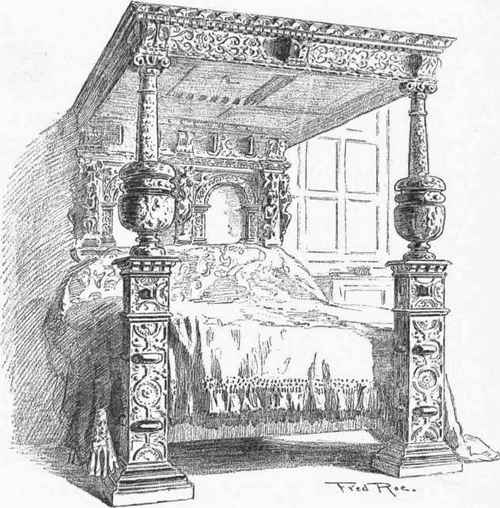
ELIZABETHAN BEDSTEAD IN THE POSSESSION OF SIR CHARLES. LAWES-WITTEWRONGE.
' Sir ------ Dayrell of Littlecote, in coun Wilts, having gott his lady's waiting-woman with child, when her travail came, sent a servant with a horse for a midwife, whom he was to bring back hoodwinked. She was brought, and layd the woman, but as soon as the child was born, she sawe the knight take the child 16 - 2 and murther it, and burn it in the fire in the chamber. She having done her businesse, was extraordinarily rewarded for her paines, and sent blindfolded away. This horrid action did much run in her mind, and she had a desire to discover it, but knew not where 'twas. She considered with herself the time that she was riding, and how many miles she might have rode at that rate in that time, and that it must be some great person's house, for the room was 12 foot high; and she should know the chamber if she saw it. She went to a Justice of the Peace, and search was made. The very chamber found. The Knight was brought to his tryall; and to be short, this judge had this noble house, parke and manner, and (I thinke) more, for a bribe to save his life.
'Sir John Popham gave sentence according to lawe, but being a great person, and a favourite, he procured a noli prosequi'
A striking curiosity in the way of a bedstead exists in that old-world home, Rufford Abbey, Notts, the seat of Lord Savile. It is a highly decorative and beautifully finished production, with borders of strap-moulding on the cornice and pillar posts splaying out on to excessively broad bases. The back, which is inlaid with late strapwork, has a centre panel representing the view of a classic building, whilst the foot-board possesses boldly-raised and faceted panels. Nearly the whole of the interior of Rufford Abbey was remodelled in 1679, and the bedstead, which was probably made about that time, is a most valuable illustration of the transition from the Elizabethan outline to the later style.
One of the features of the earliest types of bedstead with which we are acquainted is the lowness of the canopy and the framework on which the mattress rests. The Great Bed of Ware is, of course, an exception, but, generally speaking, it was not until the reign of Charles II. was reached that bedsteads assumed the lofty proportions which we are accustomed to associate with the types existing at Hampton Court, Holyrood Palace, Haddon Hall, Hardwicke Hall, and other great houses. These latter, with their elaborate rococo cornices, their pall-like hangings, and their funereal plumes surmounting the corners of the canopy, are the types on which Dickens drew for his description of the Maypole state bed in 'Barnaby Rudge.'
Continue to:


My Books

