


Bedsteads And Cradles. Part 4
Description
This section is from the book "Old Oak Furniture", by Fred Roe. Also available from Amazon: Old Oak Furniture.
Bedsteads And Cradles. Part 4
A great many of the more unpretentious oak bedsteads, made for the commoner class in the Jacobean times, had no bed-posts or hangings, but were wonderfully picturesque withal. The writer recollects seeing, some few years ago, at Lympne Castle, in Kent - that wonderful old fortified farm-house overlooking the sea - a couple of these low, postless bedsteads standing in a large linen-panelled apartment, and was much struck with the picturesque appearance which they presented with their snowy linen, illustrating as they did the continuity of life in some of our old country houses.
Such bedsteads as the lofty and hideously ornate structures which are to be seen at Hampton Court Palace or Hardwick Hall do not come within the scope of the present work. They are seldom constructed of oak, belonging as they do to no earlier date than the latter part of the seventeenth century. 'Queen Mary's bedstead' at Holyrood has been already alluded to in Chapter VI (Oaken Chairs And Stools From The Renaissance To The End Of The Seventeenth Century) (Oaken Chairs And Stools From The Renaissance To The End Of The Seventeenth Century)., and there are many instances of legends being tacked on to these funereal couches by the ignorant equally absurd as the Holyrood fable. There is a tall bedstead of this type at Haddon Hall, with an extravagantly elaborate canopy, upon which appear the initials 'K.R.' Of the wild legends locally prevailing about this structure it would serve no good purpose to speak. It is, however, probable that the cipher is that of Katherine of Braganza, the consort of Charles II., though what connection that lady had with Haddon Hall can only be a matter for conjecture.
Old oak cradles are highly interesting pieces of furniture, though they are scarcely ever used nowadays, through their want of adaptation to modern requirements, but they may occasionally be found in cottages in remote rural districts. Henry Shaw, in his excellent book on 'Specimens of Ancient Furniture,' gives a fine plate of a Gothic cradle in which, it is said, Henry of Monmouth, afterwards Henry V., reposed when an infant. This statement he supports by a well-authenticated pedigree of the piece in question. The cradle is suspended on a single upright at each end, the uprights being buttressed with spandrels decorated with a conventional vine-leaf, and surmounted with carved representations of the dove. There can be little doubt that the cradle is of the time assigned to it by Shaw, the decoration being particularly pure and characteristic. Too much praise cannot be bestowed upon Shaw's fine work, not only on account of the faithful representations of the objects which he gives, but for the pains which he took to hand down to posterity records of past times, which were not sufficiently cared for in his own day.
For instance, he mentions, in his account of this plate, 'the beautiful foliage which fills the space between the uprights and stays of the stand of this cradle were never before engraved, although Bonner, in his Itinerary (The London Magazine for 1774), and Bingley, in his tour through North Wales, pretended to give representations of this interesting piece of antiquity.' The 'Monmouth cradle' is described as being then (1836) in the possession of Mr. G. W. Braikenridge, of Brislington, near Bristol. It is to be hoped that this beautiful and unique example of fifteenth-century art is still in existence.*
Of historic cradles we have indeed not a few remaining, though no other so early as that just mentioned. The cradle of King James VI. of Scotland (James I.) is in the possession of the Earl of Mar and Kellie. It is a fine piece of work, though greatly decayed. It has a turned rocking-post at each corner, a broad, semicircular band of gold jewel-moulding, and sides inlaid with dark and light wood.* At Hatfield House is a carved oak cradle having panels decorated with strap-work and 'rockers' similar to those of the example last mentioned. This cradle is traditionally said to have been used by Queen Elizabeth when an infant, the basis of the fable evidently being the initials 'A.R.,' which appear boldly carved on the ends, these presumably indicating 'Anna Regina.' Unfortunately for
* I am informed that the cradle mentioned is most probably the so-called Henry V.'s cradle at Monmouth Castle.
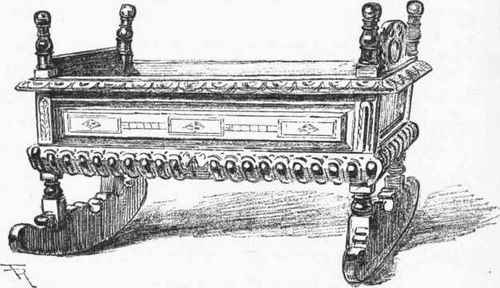
CRADLE OF JAMES VI. OF SCOTLAND (JAMES I.).
In the possession of the Earl of Mar and Kellie the truth of this tradition, the cradle belongs to a period some sixty or seventy years subsequent to the time of Anne Boleyn, and could not possibly have been carved in her time.
But, just as in the case of the Holyrood legend it is possible with some assurance to associate Queen Mary of Modena with the bedstead popularly supposed Hatfield House was settled on Anne of Denmark, though she afterwards exchanged it in 1607 with Cecil, Earl of Salisbury, for the Palace of Theobald's. None of Anne of Denmark's children were born on the English side of the Border, but it is probable, considering her connection with the Hatfield House, that the cradle in question may have been used for one or all of her first three children, though the presumption is that it could not have been used for the infant Charles, who was born two years after the exchange had been made with the Cecil family.
* This historic relic was exhibited at the Stuart Exhibition at the New Gallery, 1889., to be that of Mary Queen of Scots, so, in regard to the Hatfield cradle, it may be suggested with confidence that the initials it bears are those of Anne of Denmark, consort of James I., and not those of Anne Boleyn.
It is an unpleasant and difficult task to attack the legends which connect great personages of the past with existing objects, but I cannot refrain, in the Hatfield instance, from attempting to dissipate an unsound but popular belief. To anyone who has studied styles or periods in the changes of decoration of furniture, it must be evident that the cradle of James VI. of Scotland is really earlier than the so-called Queen Elizabeth's cradle at Hatfield House.
Later oak cradles exhibited very little difference from those of which we have been treating save in the character of their decoration, in which respect they followed the fashion of the day, assuming the changes which came about in other forms of oak furniture.
One addition, however, appears to have been made, and that was the provision of a hood over the head. Cradles which exhibit this feature usually belong to no earlier period than the latter part of the seventeenth century, and usually have the plain raised centre panel.
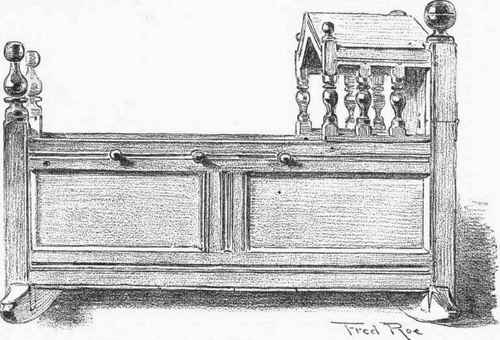
CRADLE. In the Victoria and Albert Museum.
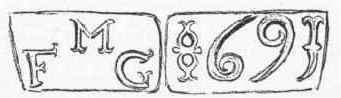
INSCRIPTION CARVED ON THE BACK.
There is a very characteristic Carolean oak cradle in the Victoria and Albert Museum, which possesses the prototype of the hood in a raised back at the upper end. * This cradle bears the inscription:
'October C. B. 1641 14 Dai M.B.'
Another cradle in the same Museum exhibits a peculiarity in the shape of a hinged and movable hood. On the outside end of this hood appears the date 1691, accompanied by the letters 'F. M. G.'This piece has plain panels with lightly-grooved stiles, and the sides of the hood have turned rails instead of being panelled, as in the accompanying specimen, made fifty years earlier.
* No. 527, 1892.
Continue to:


My Books

