


Curtains And Portieres. Continued
Description
This section is from the book "Home Furnishing, Practical And Artistic", by Alice M. Kellogg. Also available from Amazon: Home Furnishings, Practical And Artistic.
Curtains And Portieres. Continued
When lace curtains are bought by the pair any amount of money may be expended on the handwork and materials. The refinement of a room, however, is not increased by heavy ornamentation of a thin fabric.
Point Arabe lace has been a favourite for some years in high-class curtains, and its deep colour and cord effect suit the furnishings of handsome houses. The Marie Antoinette lace, in which a pattern is made with braid, is graceful and simple. Sometimes a mixture of the two styles is adopted. Cluny lace makes so durable and sensible a curtain that it has held its own through a series of changes in curtains. Brussels lace is the daintiest hanging for a drawing room and one of the oldest varieties. Irish Point is disappearing and many novelties are coming into vogue.
Lace curtains need not appear at all in the chambers, unless it is advisable to repeat the selection that is made for the first floor on the upper stories. White muslin in embroidered dots or patterns, or with the tambour edge, are the most practical curtains for bedrooms. Or, a fine white nainsook edged with lace or with a hemstitched edge may be used. These may be caught back one-third of the height of the casement with cotton loops and tassels. A three-quarter-inch brass rod may be put up across the top of the casement, and slipped through the muslin, which is hemmed at the top with an inch and a half heading.
Another way of dressing a window is to make a ruffle twelve or fifteen inches wide, according to the length of the casement, and hang this across the top of the window. Underneath, two straight lengths may be hung, one at either side. A double brass rod is made for this purpose. The flounce is shirred on the front rod, and the straight lengths are sewed to brass rings on the under rod to permit drawing across the glass. Such a treatment looks its best on a wide window.
Over curtains may be put up for the winter months for their comfortable exclusion of drafts and their additional contribution towards the furnishings. As these are most conspicuous by evening light the test of artificial lighting should not be forgotten in making a choice.
The lack of artistic materials for draperies in the middle part of the nineteenth century was so acutely felt in England that in Betting up a home at that period a writer says: "What a rummage there was for anything tolerable! Two or three friends of mine were in the same plight. On the whole, I remember that we had to fall back on turkey red cotton and dark-blue serge."
In vivid contrast nowadays here in America is an unlimited assortment of beautiful goods for the home. The choice, and not the lack, is the problem with us, making taste and discretion necessary factors for happy results.
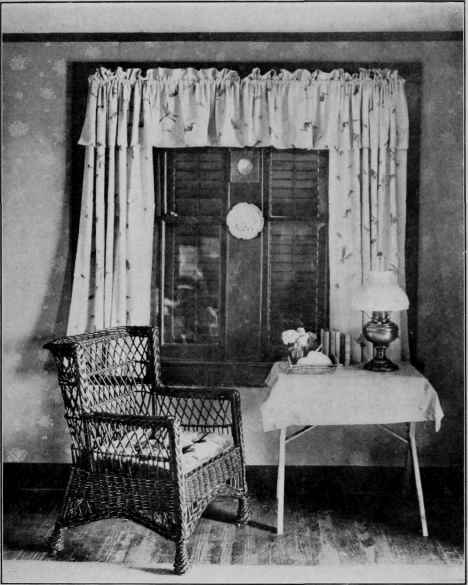
CURTAINS FOR A WIDE WINDOW.
Among the three general departments in textile fabrics (i.e. materials wrought in the loom) are three kinds. The first, the plain surface in which the warp and weft alternate equally; the second, in which a pattern is produced by the warp and weft mingling in different proportions (as in all figured cloths or tapestries); third, plain fabrics which are enriched by the needle or printing, as embroideries and printed stuffs.
At the present day no department of house furnishing is so comprehensively supplied as that of loom-made materials. The splendid effects reached in the old times are perpetuated in reproductions; the historic designs of important periods may still be secured for houses treated in those styles; and the strenuous desire of our own day for artistic expression, whether it be on a small or a large scale of expenditure, is abundantly met.
In selecting material for over-curtains some unity of tone with the woodwork in which they are framed and the walls against which they hang may be Bought for. A double-faced material does not need a lining, but if a lining is used one of cream-white, linen colour or a neutral shade will stand the light better than a colour. Lining silks and sateens for curtains are found in the fifty-inch width.
A figured material will not need trimming, but a plain one is often given a crisp style by the addition of a tapestry or antique braid.
If the expense that is often put into loopings and festoons, which are unnecessary for an over-curtain, were put into first-class mechanical contrivances for hanging and adjusting - pulley cords, rings, cords and tassels - with plain, solid hardware, a better end would be attained.
The subject of doorways is second in interest to that of the windows. In tracing the history of doors we find that in the Italian palaces of the fifteenth century not only the door itself received a decorative treatment, but also the space above, called the "over-door." At first this wall space was painted; later it was covered with a panel of wood carving, stucco or marble work. At a still later period the wall decoration was omitted, and in its place a pediment was supported on carved brackets over the doorway.
This form of decorative over-doors appeared also in France and England, and the American colonists of the wealthier class, in perpetuating in their new homes the interior effects of the old, adopted the pediment over the door.
Modern doorway treatment in houses of moderate cost does not always make use of the opportunities that are available for rendering this portion of the room attractive, and the appearance of an apartment is often seriously marred by an imperfect understanding of the importance of this feature. The position of the door must be such as to give balance to the other parts of the room, and it is also essential for practical reasons that the doorway should not cut into wall spaces needed for the larger pieces of furniture - bedsteads, sideboards, sofas and pianos.
An error that is fortunately not often com-mitted is the hanging of a door so that it opens outward instead of into the room; but one frequently finds a door hung so that it does not shield the major part of the room from observation. A device for overcoming this defect is a swinging crane that supports a rod and curtain.
The proportions and design of a doorway arc inseparably associated in making an artis-nsemble. If the architectural rule of making the height of the doorway not less than twice the width is unobserved, the effect will be too low and broad. The lines of the room must also accord with those of the doors, or the latter will appear too large or too insignificant. The framing of the door and its panelling should be unified in design, simple, clear-cut and expressive.
A door that has objectionable details may be altered if it is not possible to make a complete change. The framing, being stationary, may have to be retained, but the door itself may have new or a different panel work.
In rented houses, where no alteration is permitted, there is still an opportunity for improvement in making some arrangement over the door that will carry the attention from the imperfections below to something attractive above. In effect, the old Italian over-door treatment may be modified to suit the modern home, perhaps by the introduction of a narrow shelf on which to place some pieces of pottery or brass pieces. In arranging a shelf of this character above the eye-line of a person standing in the room, the choice may be given to plates and vases that are decisive in outline and convincing in colour.
A doorway that is permanently closed presents an uninteresting surface, which, however, may be used as a background for a picture or to hold a mirror. Or, some narrow shelves may be fitted within the casing and filled with books or pottery. In summer cottages an unused, recessed doorway is of practical value as a wardrobe when it is fitted with hooks for dresses, a low shelf for shoes, and a high shelf for hats. A curtain will be needed to hang as a protection from the dust In a doorway where a portiere is used Instead of the swinging or sliding door, the curtain pole may be placed twelve inches or more below the upper frame and a shelf fastened above the pole to hold jars and vases.
The portiere or door curtain was first brought into use to exclude drafts. In city houses where contracted spaces have made openings in the wall take the place of the swinging door the portiere is essentially useful. A portiere should not be put up without a definite object of utility, but, like everything else in the house, it may be chosen to do its share towards beautifying the home. The colours of the material should not contrast too sharply with the walls or the woodwork, nor should the pattern conflict with that of the wall paper.
In making up a portiere of double-faced goods the hems may be turned towards the room where they will show the least. Two single-faced goods that are sewed together need a cord or binding to cover the edges. If the materials are thick no interlining of canton flannel is needed. A hem is basted at the bottom of each piece of goods and the tops and sides are sewed together and the curtain hung to determine the length. The material should just escape touching the floor. When the curtain has been given a few days or a week to adjust itself, the two hems at the bottom may be stitched together. The hem at the top of the curtain may have a ring sewed every four inches instead of plaiting the material.
The supply of double-faced goods is not over-large, but many additions have been made during the past few years in mercerised cottons, velours, reps, jutes and silk tapestries. In single-faced goods the variety is wide in price, colour, texture and design.
A portiere, to do its perfect duty of utility and decoration, requires to be hung only in straight lengths without loops or festoons, but with traverse rings and pulley cords to prevent its being dragged out of shape by careless handling.
Continue to:


My Books

