


XIV. Furniture, New And Old
Description
This section is from the book "Home Furnishing, Practical And Artistic", by Alice M. Kellogg. Also available from Amazon: Home Furnishings, Practical And Artistic.
XIV. Furniture, New And Old
Although an eminent English architect has said, "The art of our houses should speak the language of our own day, and not be a reproduction or imitation of the art, no matter how beautiful, of other days, in which the conditions of life were totally different," to follow out his theory would be to limit us, at times, to inferior styles not worth perpetuating and to deprive us of much from the past that is too good to be lost.
The household arts are always closely associated with prevailing conditions of life, and a study, however slight, of the first should, to be at all comprehensive, embrace a history of the times and the people. With both these points well-defined the application of the old styles to modern usage will be better understood.
In the latter part of the eighteenth century cabinet making in England was conspicuously active.
Mahogany began to be used and its adoption marked a new era for furniture, and drew forth a set of designers whose ability carried their names down, even to our own times, with favour.
There is much discussion about the authenticity of chairs called by the name of Thomas Chippendale, one of the most popular of the English furniture designers. The confusion in regard to his models seems impossible to clear up, as Chippendale not only made original and curious designs to order, which have been preserved in printed form in his book, but also made the general line of furniture called for during his life-time. His patterns show a mixture of the French, Gothic and Chinese, which he combined with wonderful facility into an artistic whole. In recording his own ideas on the subject he speaks of mahogany as little used by himself, of inlay as not employed at all, and of carving and gilding as his favourite field of decoration.
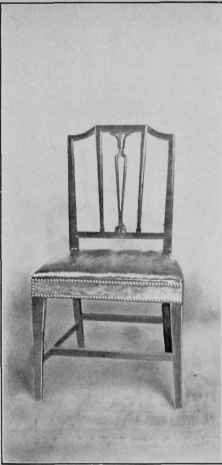
ONE OF SHERATON'S DESIGN'S.
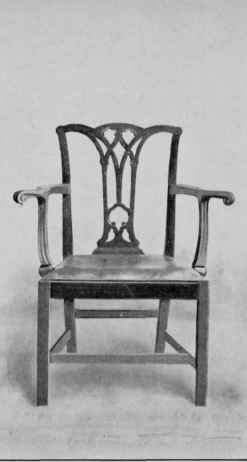
A CHIPPENDALE PATTERN.
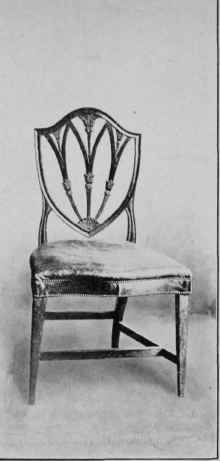
HEART-BACKED CHAIR DESIGN ED BY HEPPELWHITE.
Thomas Sheraton, another of these celebrated eighteenth-century designers, excelled and delighted in inlaid work, which he applied on simple, tapering models. "The making of chairs," says Sheraton, "requires a particular turn in the handling of the slope to make them graceful and easy." Modern builders of chairs unfortunately do not always attain the "particular turn" of Sheraton's ideal, as the chairs, many of them, of our present time are neither graceful nor easy.
Heppelwhite, whose wide range of chair patterns made him the prince of inventors, created a light graceful style that at once became the fashion and quite put aside his contemporaries' attempts in the same line. The heart-back or oval-back chair with curving spindles and delicate carving is the best-known of Heppelwhite's designs.
The work of these men was naturally transferred to America by the well-to-do families who came over with all their movable household effects. Although it represented the Georgian period while it was in England, it became so identified with our colonial times that it is generally associated with that date. Its tasteful, dignified lines have been in the last quarter-century revived with enthusiasm, and copies of the old chairs, sofas, tables and sideboards are in demand. The genuine pieces are very scarce and are rarely seen except in museums, but when they are put on sale they command high prices.
The opening of the nineteenth century brought a concluding phase to French household art which had been diversified by the influences of the different sovereigns of a preceding century. The artists of this period, in seeking inspiration for the new Empire, studied old Rome and antique Greece, and reproduced the classic art with Egyptian details. A formal stiffness was the general effect, and the ornamentation was chiefly rosettes, a laurel wreath tied with bow-knots, or swans and sphinxes made in copper bas-relief, and set on the furniture.
Two architects of Napoleon's time, Percier and Fontaine, who were practically the originators of the Empire style, became world-famous. They designed every article that pertained to the houses they built - stuffs and wall papers, table services, lamps, stoves, clocks, frames and footstools. They restored and added to the Louvre, Saint Cloud, Tuiler-ies, Compiegne, Versailles, Fontainebleau and Elysee. They also designed and built the Arc de Triomphe and Arc de Carrousel in Paris, and their work extended even to royal residences in Belgium, Germany and Italy.
So pervasive was this school of art that it was repeated in our own country in furniture that, if not brought directly over from France, was copied here from French models. The original examples are more numerous than those of the century preceding it, and although its use succeeded the days of the English colonies it is often classed with colonial furnishings.
A Continental attempt to introduce a new household art, called "L'Art Nouveau," has bed us, but has not received sufficient encouragement on this side of the water to make it an established success. Its flowing curves, delicate ornamentation and exquisite workmanship demand special accompaniments in wall papers and floor coverings, and when tarried out with fidelity some charming interiors have been produced.
The "mission idea" has, on the other hand, made a powerful impression in American homes, and the substitution of the straight line for the curved, the absence of applied ornament, and a simple in place of a complex construction have made a distinct advance in furniture. In its original setting - in the mission buildings in California - this furniture was most primitive in pattern, but by various modifications it has been rendered comfortable and fills a field for which hitherto there had been either inadequate or inartistic provision.
The mission furniture, too, has made an opening for a simpler fashion in the accessories of furnishing and decoration - rugs, wall coverings, curtains, pottery. The permanent hardware also is given to designers who can contribute to the atmosphere of the mission in-terior, and andirons and firepieces are selected with regard to their specific fitness. Even the small item of a table mat or a flower holder is recognised as a successful adjunct or a disappointing feature in a room pervaded with mission principles.
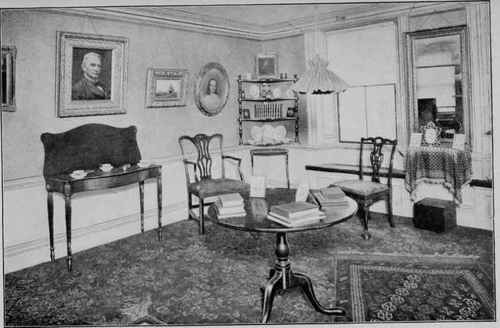
SOME ANTIQUE CHAIRS AND TABLES.
The uninitiated often ask, half-skeptically, if furniture of this kind has "come to stay," or, if it is "more than a passing fad." Perhaps its most cordial commendation comes from the fact that those who have tried it never question its permanence of style. When suited to its environment it at once becomes, without aggressive insistence of its rights, a part of the establishment, contributing a reposeful atmosphere that is a part of its charm.
The sphere of the lighter-weight furniture made from reed, cane, bamboo, rattan and willow, is not limited to the summer season or Cottage service. In certain latitudes, and with some conditions, it may he a desirable addition for continued service. Each variety offers its specific advantages, but for the all around accomplishment of utility and beauty the hand-made willow pieces stand foremost. Their adaptability to every need of the house has not until lately been fully recognised, but the willow furniture has now a wide area of usefulness.
The natural tone of this material may fit into places where a colour would be obtrusive; but sometimes a paint or stain brings it into better accord. Cushions and pillows for the chairs, and covers for the tables, increase the attraction of this furniture when each item is well selected.
Continue to:


My Books

