


Chippendale. Part 5
Description
This section is from the book "Style In Furniture", by R. Davis Benn. Also available from Amazon: Style In Furniture.
Chippendale. Part 5
As to this filling in: a close and careful examination of the backs illustrated, comparing one with another, will result in the discovery that a certain class of shaping, closely resembling two capital C's placed back-to-back in all manner of positions - frequently inverted, sometimes "frilled," and generally terminating in scrolls or foliations - was very much favoured by this designer. The precise nature of the detail referred to is made perfectly clear by the sketch given opposite, and the method of its application may be seen by reference to the two chairs on Plate I., and others on Plates II., III., and IV. To a greater or less degree, it recurs in nearly every one, the curves being more or less accentuated as occasion demands in order to fill the space to be so decorated.
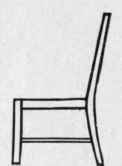
Showing shaping of back and legs as viewed from the side
It is interesting to note, in passing, the light in which this detail was regarded by Isaac Ware, a King's Surveyor, who was contemporary with Chippendale. He wrote: "It is our misfortune to see, at this time, an unmeaning scrawl of C's, inverted and looped together, taking the place of Greek and Roman Elegance, even in our most inexpensive decorations. It is called the French, and let them have the praise of it; the Gothic Shafts, and Chinese, are not beyond it, nor below it, in poorness of imagination." Ware, I need hardly say, was a disciple of the Inigo Jones school.
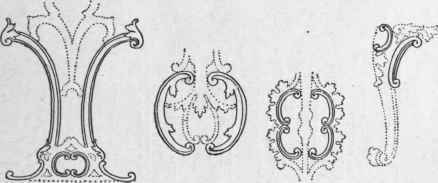
Showing employment of the C-form of detail (See page 106 for reference)
Having briefly summed up the salient features of the "Chippendale-French" chair back preparatory to the examination of individual examples, let us now. turn for a short space to the matter of legs. The belief is entertained by many people that Chippendale employed the square leg chiefly, to the exclusion of other forms. The prevalence of this erroneous impression is to be accounted for by the fact that, in his less expensive chairs, he usually did so; and those, of course, constitute the class most frequently to be met with nowadays, as the number manufactured, in the natural order of things, far exceeded that of the more costly type. But the square leg was by no means his favourite; twelve of the examples selected for illustration here are conclusive proof to the contrary. As a matter of fact, we are justified in asserting that the "cabriole" form, inspired, of course, by the "Louis-Quinze," ranked first in his estimation. The shaping of the "Chippendale cabriole," however, is generally less pronounced, and consequently more subtle, than in the French originals, though more often than not it is enriched with carved detail of one kind or another which is borrowed either from the "Louis-Quatorze" or the "Louis-Quinze." It should be noted, moreover, that this detail very frequently includes the C-like shaping, carved on the corners of the inside of the knee, as shown in the sketch. This recurs constantly.
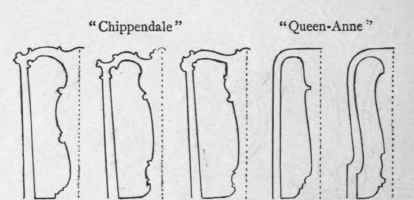
Showing relationship between Chippendale and Queen-Anne Chair Backs (See below for reference)
I have remarked, as may be remembered, that there are some few points of resemblance between the "Chippendale" and the "Queen-Anne": the introduction of the "cabriole" leg is one. As to this point, it may be explained that, in reality, the one employed by Chippendale is more closely akin to the "Queen-Anne" form than to the French. Apart from this, there is yet another mark of resemblance in the two styles, which will be seen by reference to the backs illustrated in this chapter and those appearing in the chapter on "Queen-Anne." A comparison of the two series will show that the outlines of the centre "balusters," or "splats," in some of the "Chippendale" backs are nearly related to many which were common to the preceding style, though the details with which they are enriched, and, indeed, the general treatment, are vastly different.
"Chippendale." I. Plate 32
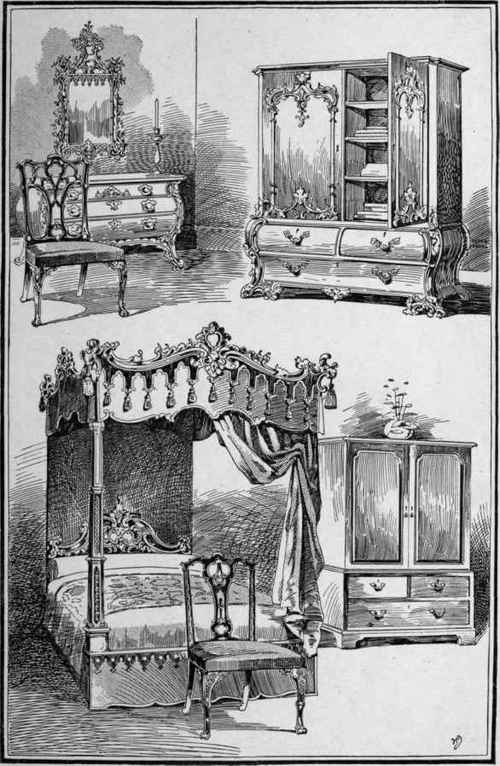
Reference In Text
Page | ||||
Chairs. | See | 79, | 105, | 106 |
Commode. | " | 109 | ||
Upper wardrobe. | " | 109, | 124 | 245 |
Page | ||
Wall mirror. | See | 111 |
Bedstead. | " | 120 |
Lower wardrobe. | " | 122 |
As regards our preliminary summing-up of the "Chippendale" chair, it must be noted finally that the frame of the seat seldom, if ever, forms a rectangular figure, but is wider at the front than at the back. By the adoption of this form, ample seating accommodation is provided without necessitating a back of clumsy and ungainly width - a most important point where grace of shape is a desideratum. Coming now to the "Chippendale" cabinet work which shows the strongest evidence of French influence, we find that, in truth, there is very little which does not reveal this designer's passion for the Rococo in one guise or another, though there are some few pieces - to be considered later - which are altogether innocent of it. Those, however, as we shall see presently, are simple almost to the point of severity. In the construction of his "carcase work" Chippendale did not adopt French lines to any very great extent; that is to say, not so far as general outward shaping was concerned. Instances in which he departed from that rule, however, and emulated the "Louis-Quatorze " and "Louis-Quinze" in that direction are not unknown; indeed, two are illustrated in Plate I., where we have a chest of drawers, or " commode," and wardrobe, in which the bombd form is introduced. Such examples, however, are most rare and command very high prices when obtainable at all.
Continue to:


My Books

