


Chippendale. Part 6
Description
This section is from the book "Style In Furniture", by R. Davis Benn. Also available from Amazon: Style In Furniture.
Chippendale. Part 6
This designer more generally, in fact almost invariably, contented himself by building-up a solidly-made, and, usually, unpretentious, "carcase" of sensible proportions; when that was accomplished, he set about planning his scheme for the embellishment of the surfaces of the doors, drawer-fronts, and other available spaces, imparting a definite character to the simple foundation or basis by drawing upon his stock-in-trade of rococo detail; and no one can deny that he made pretty free use of it.

Plan of typical Chippendale chair seat
This detail, it must be understood, was not always carved into the solid wood of the drawer - fronts, doors, or other places for which it was destined, as, in the opinion of many critics, it should have been. It was in most instances cut out and carved separately, and then "pinned" and glued on, and was, therefore, simple to conceive and carry out, involving, at the same time, a very insignificant outlay. By the means described, the most intricate and elaborate schemes, whose execution in solid carving would have been terribly costly, could be turned out to the heart's content of the maker. Some exception may be taken to the instability of this class of enrichment. "Pins" are liable to rust, snap, and work loose; the best of glue will perish in time; and when any of those eventualities come about the security of this applied carving has vanished. It can be "stuck on" again, of course, but the performance of such repairing, in nine cases out of ten, has been deferred until the recalcitrant pieces have disappeared never to return.
In this detail once more we have a persistent repetition of the inevitable C's, accompanied by leafage, "shells," scrolls, "frilling" or "scalloping," "stalactites," and almost every other variety of rococo detail. In the more elaborate pieces they are thrown together in such profusion and with such a total disregard of any consistency that the result is far from pleasing or decorative. These rococo extravagances are not confined by any means to the situations I have indicated. They break out again with renewed vigour in the pediments, many of which are fearful and wonderful to behold, and cause us to sigh longingly for a return to the dignified simplicity and restraint of the good old "Queen-Anne," with something closely resembling which, by-the-bye, Chippendale does favour us occasionally, but all too rarely. But it is not my province to indulge too freely in criticism of this point; my aim is simply to make as clear as possible the main characteristics of the style itself "with all faults as lotted."
"Chippendale." II. Plate 33
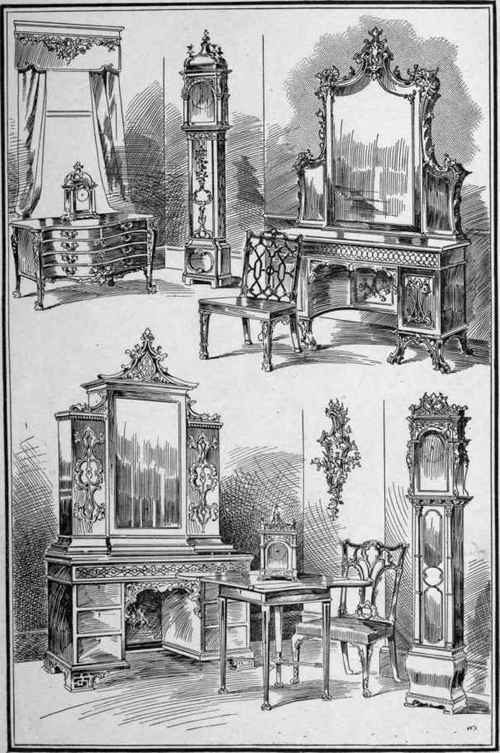
Reference In Text
Page | |||
Chairs. | See | 105, | 106 |
Girandole. | " | 111 | |
Page | ||
Commode. | See | 112 |
Clock cases | " | 126 |
As a further illustration of the extent to which this cabinet maker sometimes allowed his leaning towards the Rococo to carry him beyond the bounds of all reason, and to lead him to the perpetration of all manner of absurdities, I may refer to the frame of the wall-mirror, Plate I., girandole (candle-bracket) Plate II.; mirror, Plate III.; and other similar pieces in the following plates. Apart from their unredeemed ugliness these examples are constructionally open to very grave objection, and for the following reason. Much of the pierced and carved detail is really too delicate to be produced in wood, for, obviously, a great deal of it must unavoidably be cut across the grain; this being the case, as anyone who possesses the smallest knowledge of the nature of wood will be well aware, a very slight pressure is sufficient to cause breakage. If cast or forged in metal no serious objection could be urged against them on the score of construction; but in brittle wood they invite disaster, and are, therefore, to say the least, undesirable as articles of furniture for everyday use.
No review of "Chippendale" would be complete without special mention of his famous "ribbon-back " chairs, which have time and again been singled out for particular praise by writers who are looked up to by a certain section of the community. I have, therefore, included a couple of examples of that type, which will be found on Plate IV. Here we have constructional ornament with a vengeance! Whether it is to be defended or condemned is a question which opens up great possibilities of discussion, and many supporters of both sides would be found. In the types under review, however, I say most emphatically, and my opinion may be accepted for what it is worth, that this constructional ornament is absolutely and utterly indefensible. An effort has been made by one writer of some repute to justify the employment of the fluttering and knotted wooden ribbon as a support for the back by claiming it as a direct descendant of the old Celtic interlacing. That argument is as far fetched as it could well be, and will not stand the test of proof. The Celtic knots and interlacing were purely conventional and decorative, being kept entirely subservient to construction; while Chippendale's "ribbon " is ostensibly as close an imitation of the real thing as it is possible to produce in wood; it does not decorate construction, it is constructive in itself. We can only account for the popularity of the "Ribbon-Back," so far as I can see, by remembering that it belongs to what may be described as the "Pretty-Pretty School," which, I need hardly say, is always certain to be popular, especially with the fairer sex.
We have observed that Chippendale, even when he was borrowing from and adapting the French modes most extensively, generally stamped his productions with the mark of his own individuality, but I must not omit to point out that there are exceptions to that rule. The little commode by the window on Plate II., the screen on Plate IV., and two of the arm-chairs on Plates VII. and IX., though they appeared in "The Gentleman's and Cabinet Maker's Director," are not "Chippendale" but pure and unadulterated French. It would not be at all surprising to discover that they were copied direct from some Parisian originals, or perhaps from a French cabinet maker's design sheets or books.
Continue to:


My Books

