


Quaint Furniture
Description
This section is from the book "Style In Furniture", by R. Davis Benn. Also available from Amazon: Style In Furniture.
Quaint Furniture
Following the condition of affairs referred to in the preceding chapter, it was not until well into the second half of the last century that any signs appeared of a revival as regards tastefulness in the furnishing of the homes of this country - that is to say so far as the origination of new ideas was concerned. Until they became apparent, those purchasers who would not tolerate the heavy and ungainly caricatures of the "Empire" which the furnisher offered them had to fall back upon the traditions of the preceding century, and they could hardly have done better. It does not form any part of my scheme to review exhaustively the work of the past fifty years; not that the work is unworthy of consideration, by any manner of means; but it is of too recent a date to be accorded any great amount of space in a book the chief object of which is to deal with historic styles in furniture. Moreover, for the reader to see the best of everything that has been done by the modern designer to supply the needs of the average householder, it is only necessary to make a tour of inspection round the principal establishments devoted to the fitting-up of the home. There a complete and most exhaustive object lesson in this phase of the subject may be found. Nor does it come within the scope of this volume to proffer advice upon the choice of modern furniture - I hope to deal with that separately; but a few observations which may aid in accounting for the why and wherefore of the styles prevalent at the present day will not, I am sure, be regarded as out of place in these pages.
When passing in review the selection of productions shown by any furnishing establishment of repute at the commencement of the twentieth century, the careful and well-informed observer will easily classify them in his own mind under three heads. First: - there are those that are either absolute copies of, or the designs of which are based upon, historic models which we have already considered. Second: - there are those that have obviously been made merely to serve certain utilitarian purposes - goods in whose production economy of time, labour, and material has been the only really serious consideration; the manufacturer entertaining the idea that, so long as he provided what would look "a lot for the money," style, as such, was a matter of little or no importance. Third: - tasteful creations which are certainly refined, and often beautiful, but which cannot be classified with any of the styles with which we have dealt in the foregoing pages; and it is of these last-named that I must have something to say.
" Quaint." I. Plate 99

Reference in Text. See pages 327, 328
During the past twenty or thirty years, and particularly during the last decade, certain designers and manufacturers have cultivated form and decoration of a notably simple, and often severe, type, and - fortunately for all concerned - these have steadily increased in favour in the eyes of purchasers of the more intelligent class, until they have become quite "the fashion." When these first commenced to make their appearance, some difficulty was experienced in finding a name for them, and they were variously described as being in the "Liberty," the "Morris," or the "Arts-and-Crafts" style; but later those titles were abandoned - or nearly so - one by one, and some inventive mind hit upon "The Quaint Style " as a more fitting substitute. As that description seemed to take the popular fancy, it has come into current use.
In the furniture trade itself, other names are often used to describe such goods - the names of wholesale manufacturers who have assiduously cultivated this particular style, and who have, as a matter of fact, done quite as much as, or even more than, the famous cabinet makers of past centuries to elevate their craft. So materially, however, have conditions changed that, were I to publish those names here, I should bring down upon my humble head the maledictions of all the large retail furnishing firms, while the manufacturers themselves would be writing apologetic letters to these firms protesting that it had been done without their knowledge or permission, and trusting that the error, serious as it was, might not interfere with the continuance of custom.

A Scheme of Quaint Furnishing (by W. Baldock) (See page 328 for reference)
Such is the state of affairs at the present time, and my reference to it brings me to the question of a movement which was organised to revolutionise, if possible, the position of the artist and craftsman as regards their relationship to the public; and which also was, in a great measure, responsible for the inception of that style which we may consider under its generally accepted title, "The Quaint."
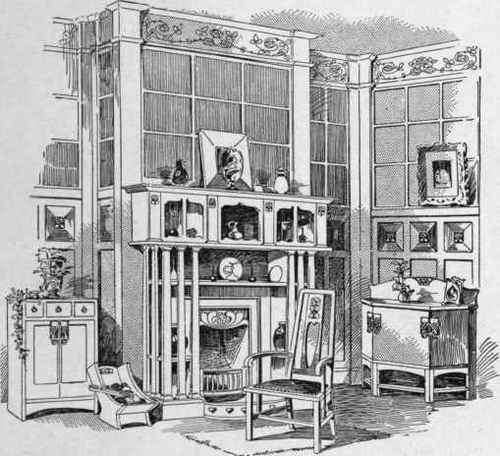
A Scheme of Quaint Furnishing (by W. Baldock) (Seepage 328 for reference)
To treat at length upon the tenets of the Arts and Crafts Exhibition Society; to set forth their propaganda; to follow the growth of the organisation; to tell of the unstinted admiration entertained by its members for the life-work of William Morris; and to write the life-story of "The Master" himself, is far too colossal a task to be entered upon here. All that I can do is to sum up, as concisely and yet as fully as lies within my power, the cardinal points of the creed subscribed to by this little band of workers who have come so greatly into prominence of late years. They may, I think, be stated as follows: - That the labourer is worthy of his hire. That the artist and craftsman, who create and produce beautiful things, have as much right to be known to the public as the middleman, who, in ninety-nine cases out of a hundred, could not produce a beautiful thing if he tried, and has no desire to. That both artist and craftsman should be in a position to work under such conditions that they may find actual pleasure in the labour of their heads and hands. That the public should be educated in such a way as to enable it to distinguish between the good and the bad in art and craftsmanship, and so be induced to encourage the one and reject the other. These, so far as I understand them, are the main teachings of the Society, but prevailing conditions always have been, and still are, too strong for them. What are those conditions? The labourer is compelled to fight for his hire, and not infrequently starves in the struggle to obtain it. If the artist and craftsman make any attempt to bring their names before the public, they do so at their own risk, knowing that it may spell financial ruin to them - the majority of the middlemen see to that. In the great mass of their work, the artist and craftsman are too much engaged in getting it through at a "cutting price" to find pleasure in it - disgust is nearer the mark. Most members of the public prefer to buy the cheap, showy - and nasty, to the cheap, simple - and good. This is a clear statement of the case, and one to which I think, alas, no objection can fairly be taken.
"Quaint." II. Plate 100
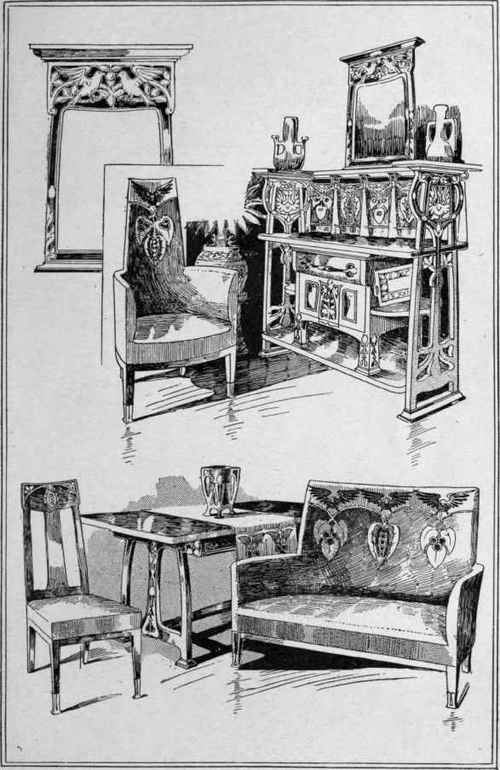
Reference, in Text. See pages 327, 328
Continue to:


My Books

